SMACNA Duct Construction Standards: The 2026 Reference Guide for HVAC Fabrication

A single field collision can cost more than the entire fabrication of a duct run. In the high-stakes environment of large-scale mechanical contracting, precision isn't just a goal; it's the baseline for survival. You've likely felt the frustration of translating complex paper specs into a digital model, only to find that varying pressure class requirements lead to costly errors during installation.
We understand that mastering the SMACNA duct construction standards is often the difference between a profitable project and a logistical nightmare. This 2026 reference guide bridges the gap between engineering theory and shop floor reality. You'll learn how to navigate gauge and reinforcement tables with confidence, ensuring every component meets national quality benchmarks before it ever leaves the coil line.
We're diving deep into the technical requirements that drive modern HVAC fabrication. We'll cover everything from verifying supplier compliance to leveraging BIM coordination for error-free spool drawings. By the end, you'll see how automated fabrication transforms these rigid standards into a tool for speed, reducing field labor and accelerating your project timeline.
Key Takeaways
- Identify critical updates between the 3rd and 4th editions of the manual to ensure your fabrication meets current structural and leak prevention benchmarks.
- Navigate gauge and reinforcement tables for static pressure classes up to 10" water gauge to maintain precision across rectangular and round ductwork.
- Apply SMACNA seal classes A, B, and C correctly to eliminate air leakage and guarantee long-term system integrity in large-scale projects.
- Integrate SMACNA duct construction standards with BIM coordination to automate compliance and bridge the gap between digital models and automated coil-line production.
- Leverage spool drawings and precision fabrication to reduce field labor and accelerate installation timelines for national accounts.
Understanding SMACNA Duct Construction Standards
Structural integrity in an HVAC system isn't a suggestion; it's a requirement for safety and performance. The Sheet Metal and Air Conditioning Contractors' National Association (SMACNA) provides the engineering foundation that keeps ductwork from collapsing under high static pressure or leaking expensive conditioned air. These standards serve as the universal benchmark for the industry, ensuring that every component, from a simple straight run to a complex fitting, can withstand the rigors of mechanical operation.
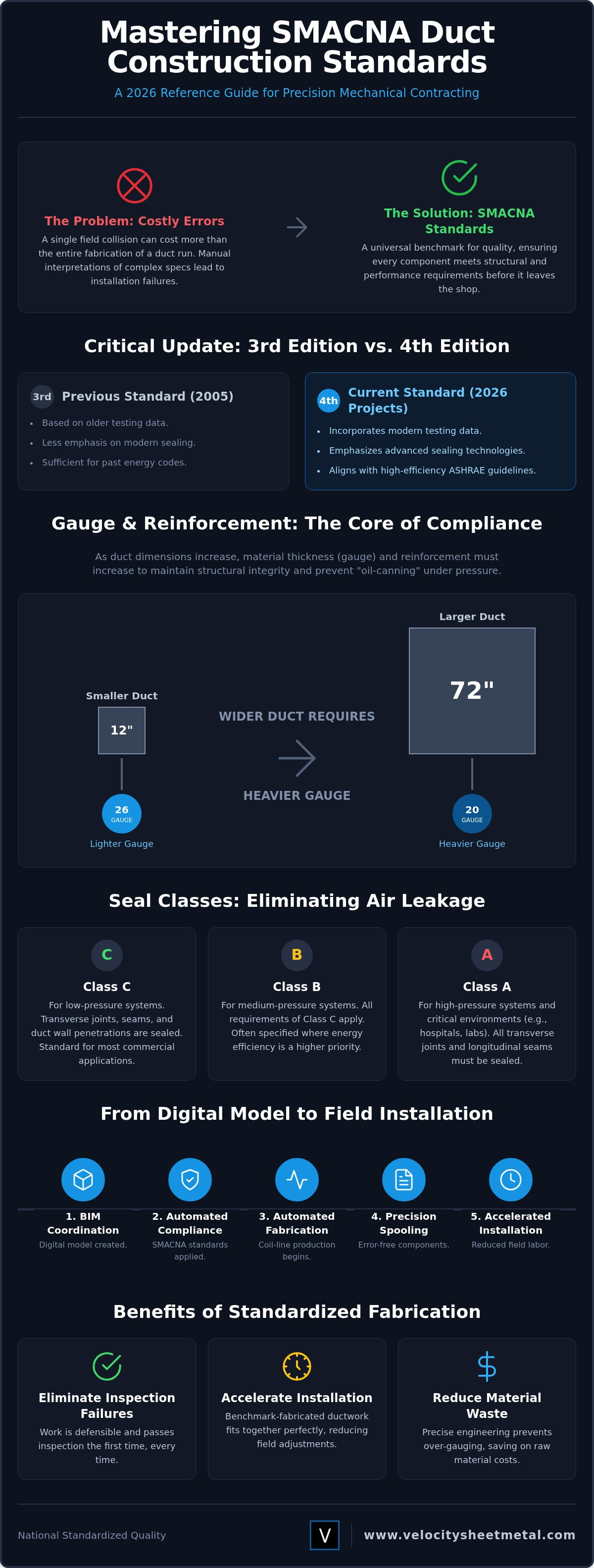
The industry has moved decisively into the 4th edition of the HVAC Duct Construction Standards, which updated the previous 2005 version. This current edition incorporates modern testing data and advanced sealing technologies that reflect today's high-efficiency requirements. For projects scheduled through 2026, adhering to these 4th edition SMACNA duct construction standards is vital. These rules align closely with ASHRAE airflow efficiency guidelines, creating a holistic approach to building health and energy conservation. When fabrication follows these specs, the entire building life cycle benefits from reduced mechanical strain and lower operational costs.
The Role of SMACNA in Modern HVAC Engineering
Engineering a duct system requires more than just calculating CFM. It demands a deep understanding of how metal behaves under stress. Adhering to SMACNA duct construction standards eliminates the guesswork by establishing minimum metal thickness and specific reinforcement intervals. These tables prevent "oil-canning," a phenomenon where duct walls flex and vibrate, leading to noise complaints and eventual metal fatigue. By providing a common language for engineers and fabricators, SMACNA ensures that the physical product delivered to the job site matches the digital intent of the BIM model. This level of precision is the only way to meet the rigorous energy codes currently being adopted across the country.
Why Standardized Fabrication Matters for Contractors
Consistency is the primary driver of profitability in large-scale mechanical contracting. When you manage national accounts, you can't afford "shop-specific" interpretations of quality. Standardized fabrication ensures that every piece of ductwork is pre-validated for its intended pressure class.
- Eliminate Inspection Failures: Code officials look for compliance with recognized construction tables. Following these standards ensures your work is defensible and passes inspection the first time.
- Reduce Material Waste: Precise engineering based on SMACNA specs prevents over-gauging. You use the exact amount of metal required for the pressure class, saving on raw material costs without sacrificing safety.
- Accelerate Field Installation: Ductwork fabricated to a national benchmark fits together as intended. This reduces the need for field "massaging" and speeds up hang times.
Standardized fabrication acts as a bridge between the digital design and the physical result. It turns compliance from a hurdle into a repeatable process that protects your margins and your reputation.
Key Specifications for Rectangular and Round Ductwork
Rectangular ductwork remains the workhorse of commercial HVAC systems. However, its performance depends entirely on adhering to SMACNA duct construction standards regarding metal thickness and reinforcement. Unlike round duct, which naturally resists pressure through its geometry, rectangular surfaces require specific gauge selections and bracing to prevent deflection. Fabrication isn't just about bending metal; it's about structural engineering at scale.
The transition from raw coil to finished duct involves a series of calculated decisions. These decisions impact everything from the shipping weight to the final static pressure capacity. Precision at this stage prevents the "oil-canning" effect that plagues poorly fabricated systems. When every piece is built to a national benchmark, the installation process moves from a series of field adjustments to a streamlined assembly line.
Sheet Metal Gauge and Reinforcement Requirements
The core of SMACNA compliance lies in the relationship between duct dimensions and material strength. As duct width increases, the sheet metal gauge must thicken to maintain structural rigidity under pressure. A 12-inch duct might only require 26-gauge steel, but a 72-inch span often necessitates 20-gauge or heavier material to prevent the walls from bowing.
If width alone exceeds the capacity of the metal gauge, external stiffeners or internal tie rods become mandatory. These components provide the necessary bracing for large-span ductwork. They ensure that even the largest plenums remain quiet and stable during system startup and shutdown. Over-engineering these parts wastes material and increases costs, while under-engineering invites structural failure. Precision automated fabrication ensures that every reinforcement is placed exactly where the tables dictate.
Transverse Joint and Longitudinal Seam Standards
Joint selection is where fabrication speed meets system performance. For high-pressure systems, the industry relies heavily on TDC (Transverse Duct Connector) and TDF (Transverse Duct Flange) joints. These are roll-formed directly onto the duct ends during the coil-line process. They create a robust, integral flange that simplifies field assembly and provides a superior surface for gaskets.
- Pittsburgh Lock: This remains the gold standard for longitudinal seams. It provides a mechanical bond that is virtually impossible to pull apart, ensuring the duct retains its shape throughout its service life.
- Slip-and-Drive: Typically reserved for low-pressure applications, this connection is fast but lacks the structural stiffness of flanged joints.
- Flanged Connections: Essential for high-pressure runs, these offer the best leak resistance and structural integrity.
While rectangular duct offers space-saving benefits in tight plenums, many projects now integrate spiral ducting for its superior airflow and lower leakage rates in specific zones. Choosing the right geometry is a balance of space, cost, and performance. If you're managing a high-volume project, working with a partner who provides precision-fabricated rectangular duct ensures every joint and seam meets these exacting SMACNA duct construction standards without the need for field corrections.
Pressure Classes and Air Leakage Control
Static pressure is the driving force behind any HVAC system, but it's also the primary cause of structural stress. SMACNA duct construction standards define static pressure classes ranging from 1/2" to 10" water gauge (WG). These classes dictate how the duct must be built to handle internal air force without failure. Matching the fabrication to the specific pressure class prevents system inefficiency and mechanical noise. It's the difference between a system that hums and one that rattles under load.
Supply ducts typically operate at higher pressures to push air through long runs and complex fittings. Return and exhaust systems often require lower ratings, though they're equally susceptible to structural issues if the gauge selection is incorrect. Standardized fabrication ensures that every run is engineered for its specific role in the building's airflow strategy.
Calculating Static Pressure and Seal Requirements
The engineering logic for selecting a seal class depends on the pressure the system will maintain. SMACNA seal classes, categorized as A, B, and C, establish the level of airtightness required for different zones. Seal Class A represents the most rigorous standard; it requires all transverse joints, longitudinal seams, and duct wall penetrations to be sealed to prevent pressure loss. For high-pressure applications above 4" WG, Seal Class A effectively minimizes leakage to ensure maximum airflow delivery to the terminal units.
Choosing the right seal class isn't just about code compliance. It's about system balance. If a return duct isn't sealed to the appropriate standard, it can pull unconditioned air from ceiling plenums, throwing off the entire thermal profile of the space. Precision fabrication accounts for these variables during the digital design phase, ensuring the physical product meets the engineer's intent.
Impact of Standardized Sealing on System Efficiency
Field sealing is often a bottleneck in the construction schedule. It's messy, inconsistent, and highly dependent on the installer's attention to detail. Automated sealing within a coil line offers a superior alternative. By applying sealant during the fabrication process, we ensure a uniform barrier that manual labor can't replicate. This level of precision directly impacts the building's bottom line. Airtight construction reduces the load on fans, lowering energy consumption for the building owner over the system's entire life cycle.
Leaking air is leaking money. When a system loses 10% of its air through poor seams, the fan must work harder to deliver the required CFM. This extra work increases electrical draw and accelerates wear on mechanical components. Integrating high-pressure HVAC duct fittings into your design further optimizes airflow by reducing turbulence at critical transitions. Verification of these SMACNA duct construction standards happens through rigorous testing. A standard Duct Air Leakage Test (DALT) uses a calibrated fan to measure air loss in a sealed section. When fabrication follows standardized quality, passing these tests becomes a predictable step rather than a source of project delays.

Integrating Standards with BIM and Automated Coil Lines
The transition from a paper reference manual to a finished duct run used to rely on a shop foreman's memory of gauge tables. Digital workflows have changed that. Integrating BIM for sheet metal fabrication ensures that compliance isn't an afterthought; it's baked into the geometry from the first click. Modern software embeds SMACNA duct construction standards directly into the design environment, automatically selecting the correct metal thickness and reinforcement based on the specified pressure class.
This digital-to-physical bridge eliminates the administrative delays of manual technical reviews. When the engineering logic is automated, the path from design to delivery accelerates. You get faster turnarounds without sacrificing the structural integrity required for large-scale commercial projects.
Digital Compliance: SMACNA in BIM Coordination
Coordination is about more than just avoiding pipes and beams. It's about ensuring the duct itself can exist in the space provided while meeting structural specs. By utilizing BIM clash detection for HVAC fabrication, we identify where external stiffeners or tie rods might interfere with other trades. This happens in the virtual model, not on the job site. Automating gauge selection within Revit or CADmep based on SMACNA rules prevents human error during the detailing phase. For national accounts, this level of accurate spooling ensures that every facility, regardless of location, receives identical, high-quality components that meet a single national benchmark.
Automated Fabrication and Precision Tolerances
The spool drawings generated from a coordinated model feed directly into the shop floor's brain. Automated coil line duct fabrication takes these digital instructions and produces rectangular duct with zero manual layout. The machine uncoils, levels, notches, and beads the metal with surgical accuracy. This ensures every piece meets exact SMACNA duct construction standards for joint alignment and structural beading. CNC precision eliminates the variability of manual assembly, particularly in the placement of reinforcement intervals.
Speed is a byproduct of this precision. Automation reduces lead times for high-volume orders by processing thousands of pounds of steel daily with minimal waste. CNC-guided systems apply insulation and liners with consistent adhesive coverage and edge-to-edge accuracy that manual application can't match. This methodical approach ensures that the finished product is a perfect physical manifestation of the digital model. To see how this precision can streamline your next project, contact us for BIM-driven duct fabrication services today.
Velocity Sheet Metal: National Standardized Quality
Velocity Sheet Metal operates at the intersection of engineering precision and industrial speed. We don't just follow SMACNA duct construction standards; we automate them. Our facility acts as a high-performance extension of your team, providing the technical capability to handle high-volume orders with surgical accuracy. With over 50 years of combined management experience, our leadership understands that in commercial HVAC, time is as valuable as the metal itself. We provide the "can-do" attitude required to meet tight deadlines without sacrificing the structural integrity of the build.
Our expertise in coil-line automated rectangular duct production allows us to serve national accounts with a level of consistency that smaller shops simply can't replicate. We've replaced traditional manual layout with a streamlined, digital-to-physical workflow. This ensures that every component, from the simplest straight run to the most complex fitting, meets the exact structural requirements of the project. We act as the essential bridge between a digital file and a tangible product, moving your project quickly from the initial digital concept to the final physical result.
Coil-Line Efficiency for Large-Scale Projects
Scaling production for major commercial developments requires a methodical approach to manufacturing. Our automated coil line processes thousands of pounds of galvanized steel daily, maintaining tight tolerances throughout the entire run. This automation eliminates the variability of hand-fabricated ductwork. It ensures that every joint and seam aligns perfectly. By delivering pre-assembled, standardized sections directly to your site, we help you slash job-site labor costs. Your crews spend their hours installing rather than correcting; this keeps your project on schedule and under budget. Consistent quality isn't just a goal; it's the output of our automated process.
National Shipping and BIM Support
Maintaining quality across a national footprint is a logistical challenge for many contractors. We solve this by offering nationwide shipping for our precision-fabricated components. Whether you're managing a single site or a multi-state rollout, our standardized quality remains constant. Our BIM coordination and spool drawing services are the first line of defense against field collisions. We identify structural issues in the digital model, long before the metal is cut. This proactive strategy ensures that your installation is predictable and repeatable across every facility.
Our commitment is simple: 100% SMACNA-compliant fabrication for every commercial HVAC need. We provide the technical documentation and the physical product to back up your performance claims on every job. Request a quote for SMACNA-compliant ductwork today and partner with a fabricator that values precision and delivery as much as you do.
Elevating Performance Through Standardized Fabrication
Adhering to SMACNA duct construction standards is no longer just about passing an inspection. It's about building a system that operates with maximum efficiency and zero structural risk. By integrating these engineering benchmarks into a digital BIM workflow, you eliminate the guesswork that often leads to field collisions and project delays. Automated coil-line production ensures that every piece of rectangular duct meets the exact gauge and reinforcement requirements for its specified pressure class.
We bridge the gap between digital models and physical results. Our facility combines automated production with national shipping capabilities to serve high-volume commercial needs. This precision eliminates human error and keeps your project moving at the speed of modern construction. We're ready to scale with your project requirements from day one.
Get Precision SMACNA-Compliant Ductwork Shipped Nationwide
Your next large-scale project deserves the precision and speed that only modern fabrication can provide. Let's get to work.
Frequently Asked Questions
What are the current SMACNA duct construction standards for 2026?
The 4th edition of the HVAC Duct Construction Standards, Metal and Flexible, remains the definitive benchmark for the industry through 2026. This edition provides the updated engineering data and construction tables required to meet modern high-efficiency building codes. It focuses on reducing air leakage and ensuring structural integrity across a wide range of static pressure classes.
How do I choose the correct sheet metal gauge for a 2-inch static pressure class?
You must cross-reference the maximum duct dimension with the 2" water gauge (WG) table in the SMACNA manual. For example, a rectangular duct with a 24-inch width at this pressure typically requires 24-gauge galvanized steel. As the width increases, the SMACNA duct construction standards require you to either increase the metal thickness or add specific reinforcement intervals to prevent wall deflection.
What is the difference between SMACNA Seal Class A, B, and C?
These classes define the level of sealing required to prevent air loss. Seal Class A is the most rigorous, requiring every joint, seam, and wall penetration to be sealed. Class B requires sealing on all transverse joints and longitudinal seams. Class C is the least restrictive, focusing only on transverse joints. High-pressure systems almost always demand Class A to maintain efficiency.
Are SMACNA standards mandatory for all commercial HVAC projects?
Most local and international building codes, including the IMC and UMC, incorporate SMACNA standards by reference. Engineers specify these standards in project manuals to ensure the system is defensible during inspections. Failing to adhere to these benchmarks can lead to structural failure, excessive noise, or costly energy waste, making compliance a practical necessity for every commercial contractor.
How does automated coil-line fabrication ensure SMACNA compliance?
Automation eliminates the variability of manual layout by programming SMACNA duct construction standards directly into the fabrication software. The coil line notches, beads, and forms the metal to exact tolerances. This ensures that every section of ductwork consistently meets the required gauge and reinforcement spacing, removing the risk of human error on the shop floor.
What are the SMACNA requirements for internal duct liners?
Liners must be secured using a combination of water-based or solvent-based adhesives and mechanical fasteners. SMACNA specifies the exact density of fasteners based on the air velocity within the duct. For high-velocity systems, the standards also require metal nosing on all leading edges to prevent the liner from peeling or eroding over time.
How do SMACNA standards address rectangular vs. spiral ductwork?
Rectangular standards focus on bracing flat surfaces against pressure, while spiral standards leverage the inherent strength of the circular geometry. Spiral ductwork can often handle higher pressures with lighter gauges because its shape resists deformation more effectively. This often makes spiral a more material-efficient choice for long, high-pressure supply runs where space allows for the circular profile.
Can BIM software automatically apply SMACNA standards to my design?
Modern BIM platforms like Revit and CADmep use specification-driven workflows to automate compliance. When you set the pressure class for a duct system, the software automatically pulls the correct gauge and joint types from pre-loaded SMACNA tables. This digital-to-physical integration ensures that the spool drawings we receive for fabrication are already engineered for maximum performance and code compliance.