How to Optimize Airflow with Custom HVAC Transition Fittings: A Contractor’s Guide

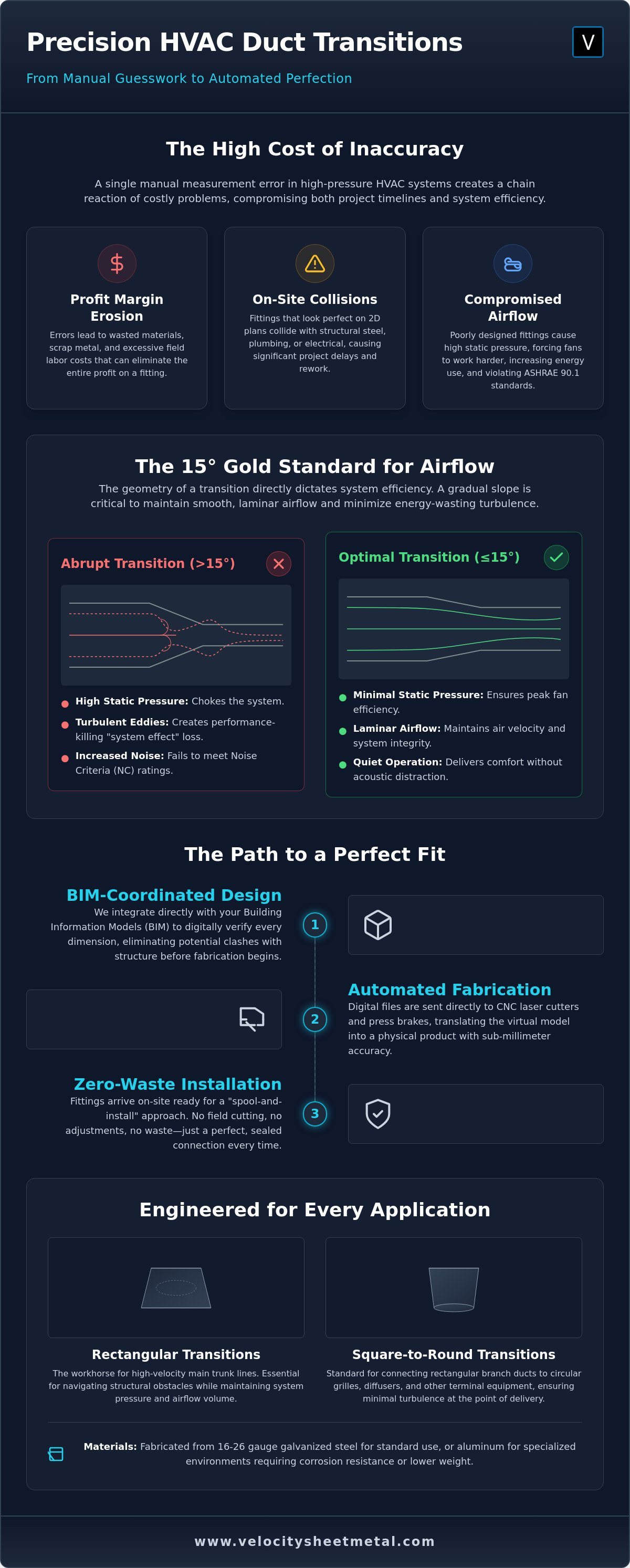
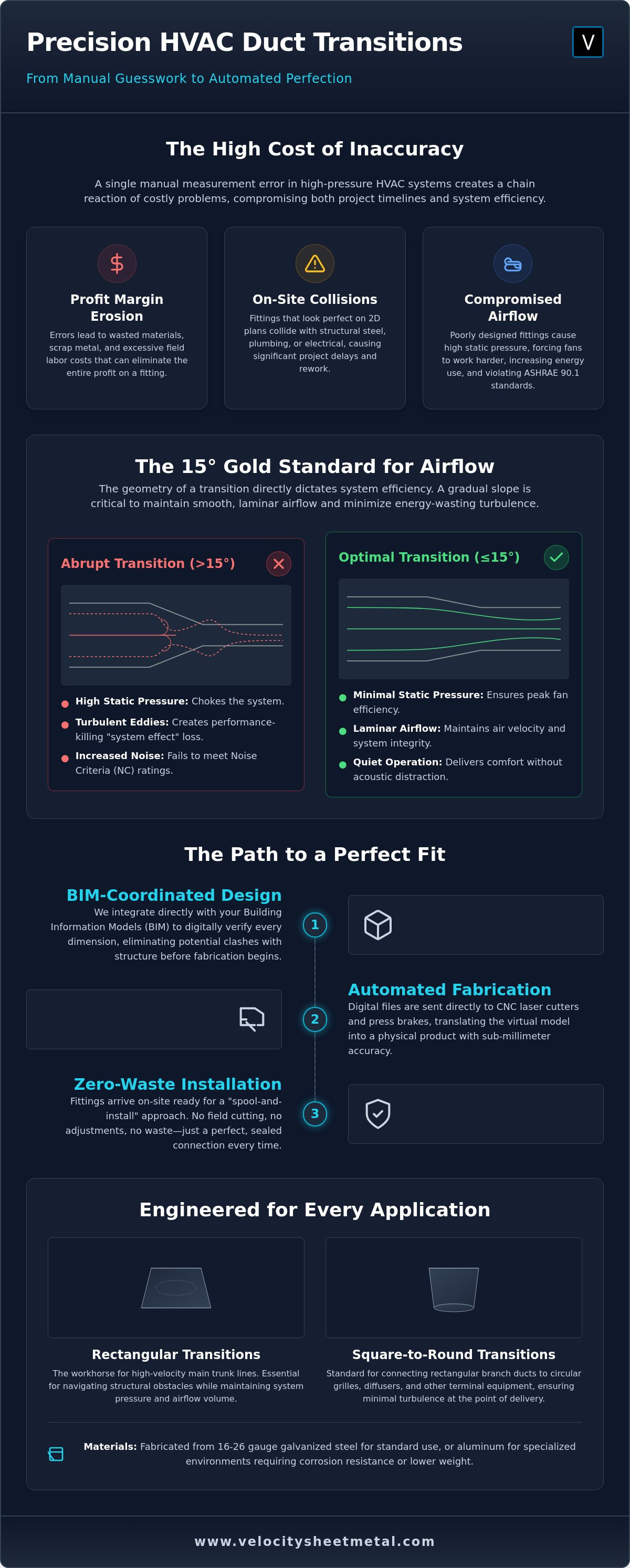
A single manual measurement error on high-pressure HVAC duct fittings doesn't just stall a project. It eats your entire profit margin in field labor and scrap metal. You've likely dealt with the frustration of a transition that looks perfect on a 2D submittal but collides with structural steel the moment it hits the job site. These errors lead to excessive static pressure drops and compromised airflow that modern energy standards like ASHRAE 90.1-2022 simply won't tolerate. Poorly designed fittings are the silent killers of system efficiency and project schedules.
We agree that field-fitting shouldn't be your default strategy for complex transitions. You need components that arrive ready for zero-waste installation, especially as the industry shifts toward A2L refrigerants and tighter efficiency mandates. This guide provides the technical roadmap to accurately specify, measure, and integrate custom HVAC transition fittings to eliminate collisions and maximize system performance. We'll cover the essential SMACNA standards for industrial duct construction and show you how a BIM-coordinated workflow turns a digital file into a high-precision physical product. It's time to move from manual guesswork to automated precision for your national projects.
Key Takeaways
- Understand the physics of smooth airflow and why adhering to a 15-degree transition slope is critical for minimizing static pressure drops.
- Simplify your ordering process by learning the exact measurement protocols for A, B, C, and D dimensions to guarantee a perfect first-time fit.
- Reduce field labor costs by utilizing BIM-coordinated high-pressure HVAC duct fittings that bypass common structural collisions before they occur.
- Leverage national fabrication partnerships to maintain consistent manufacturing quality and meet aggressive project timelines across multiple job sites.
- Transition from manual field adjustments to a streamlined "spool-and-install" model that maximizes system efficiency and contractor profitability.
Understanding the Critical Role of Custom HVAC Transition Fittings
Transitions are the critical components that bridge the gap between different duct shapes, sizes, or orientations within a mechanical system. In high-performance commercial environments, these aren't just simple connectors. They're precision-engineered pathways that maintain the velocity and pressure of conditioned air. When you're managing complex HVAC ducts, a transition is often the only way to navigate structural beams, plumbing stacks, or existing electrical trays while maintaining design intent.
In the world of commercial retrofits, space is a luxury you rarely have. You're often forced to connect new, high-efficiency air handlers to legacy distribution systems. This is where high-pressure HVAC duct fittings become indispensable. Without a custom-fabricated transition, installers often resort to "field-hacking," which is the practice of cutting and taping standard parts to make them fit. This leads to immediate air leaks and long-term performance degradation. A precision-made fitting ensures a sealed system from the start, protecting the integrity of the building envelope and the mechanical design.
The geometry of these transitions directly impacts energy consumption. Poorly designed fittings create excessive static pressure, forcing fans to ramp up and work harder to deliver the required CFM. This doesn't just spike utility bills; it significantly shortens the lifespan of the fan motors. By utilizing custom laser cutting and CNC press brake bending, we ensure every transition follows the exact aerodynamics required for peak efficiency.
Square-to-Round vs. Rectangular Transitions
Choosing the right transition type depends on the terminal equipment and the velocity of the line. Square-to-round transitions are standard for connecting rectangular branch ducts to circular grilles and diffusers. They provide the necessary taper to reduce turbulence at the point of delivery. Rectangular transitions are the workhorses of high-velocity main trunk lines. We manufacture these from 16 to 26 gauge galvanized steel for standard applications, or aluminum for specialized industrial environments where weight or corrosion resistance is a factor. Each piece is cut with laser precision to ensure the seams are airtight and the dimensions are exact.
Why Standard Fittings Often Fail in Commercial Projects
Modern VRF and VAV systems operate on thin margins of error. Standardized inventory simply can't account for the unique static pressure requirements of high-pressure HVAC duct fittings in a custom-designed system. Standard "off-the-shelf" fittings often lack the specific taper angles required for these high-performance systems. When a fitting is just "close enough," it creates massive turbulence. This turbulence manifests as increased noise levels, often exceeding the specified Noise Criteria (NC) ratings for the space. It can turn a quiet office into a humming distraction. While a custom fitting might seem like an upfront investment, the ROI is clear. You save hours of expensive field labor and eliminate the need for costly rework. Precision fabrication moves the work from the job site floor to a controlled shop environment, ensuring every piece fits the first time without the need for hammers or sealant patches.
Optimizing Airflow: The Science of Smooth Transitions
Airflow optimization is a game of physics and geometry. When designing high-pressure HVAC duct fittings, the primary goal is to minimize resistance. Every degree of slope in a transition directly correlates to static pressure loss. If the angle is too aggressive, the air separates from the duct wall, creating turbulent eddies. This turbulence acts as a physical roadblock, choking the system and forcing the fan to compensate by drawing more power. It's a chain reaction that starts with a single poorly angled fitting and ends with an inefficient building.
The 15-degree slope is the industry gold standard for a reason. It provides a gradual enough change in velocity to keep airflow laminar. Abrupt transitions, often seen in poorly planned field modifications, cause "system effect" losses that are difficult to calculate and even harder to fix once the ceiling is closed. Avoiding these abrupt changes is non-negotiable for high-velocity systems. Custom plenums play a vital role here as well. A well-sized plenum acts as a buffer, stabilizing air pressure and ensuring even distribution across the face of the transition fitting before it enters the branch lines.
Minimizing Static Pressure Drops
Poor transition design is an expensive mistake. When air hits a sharp reduction or expansion, velocity pressure converts poorly to static pressure. This forcing of the fan curve results in higher utility costs and premature equipment failure. To avoid this, we follow SMACNA standards for the length-to-width ratios of every custom part. By extending the length of a transition, we maintain a smooth velocity profile. If you need a partner to help design these high-performance components, our team at Velocity Sheet Metal can assist with technical review and precision fabrication.
Material Selection for Industrial Durability
Durability starts with matching the right gauge to the duct pressure class. For systems ranging from 1/2 to 10 inch wg, the structural integrity of high-pressure HVAC duct fittings is paramount. Standard thin-gauge metal might suffice for low-pressure residential runs, but commercial high-velocity systems require 16 to 22 gauge to prevent "oil-canning" or vibration noise. Stainless steel is the preferred choice for corrosive environments or cleanrooms where particulate control is mandatory. Regardless of the material, our precision laser cutting ensures tighter seals. This level of accuracy eliminates the micro-gaps that cause whistling and air leakage in high-pressure environments, ensuring the system performs exactly as the engineer intended.
How to Measure and Specify Custom Fittings for Fabrication
Field measurements are where most coordination errors begin. If your dimensions are off by even a quarter inch, your high-pressure HVAC duct fittings won't seat correctly. This leads to the air leakage and static pressure issues we've already established as profit killers. Precision in the shop starts with precision on your tape measure. You're translating a physical reality into a digital instruction for automated laser cutters.
Follow this sequential process to ensure your specifications are fabrication-ready:
- Step 1: Identify the A and B dimensions, representing the width and depth of the primary rectangular opening.
- Step 2: Determine the D diameter for round connections or the C and D dimensions for a secondary rectangular opening.
- Step 3: Measure the L length while accounting for existing mechanical equipment, electrical trays, and structural obstructions.
- Step 4: Calculate the required offset to determine if you need an eccentric transition to hug a wall or a concentric transition for straight-line flow.
- Step 5: Define the connection type, choosing between S-and-Drive for low-profile needs, TDC/TDF for high-pressure seals, or heavy-duty flanged connections for industrial exhaust.
The Critical Dimensions: A, B, D, and L
You must distinguish between raw opening sizes and finished dimensions. A common mistake is failing to account for the slip-fit required for a secure connection. For tapered transitions where multiple sides change simultaneously, provide the center-line offset. This ensures the fitting aligns perfectly with the downstream ductwork without forcing the metal. The L-dimension is the straight-line distance between connection faces. This length is the most critical factor in maintaining the 15-degree slope required for optimal airflow and system efficiency.
Accounting for Flanges and Connection Allowances
Standard measurements often ignore the external footprint of the hardware. TDC and TDF connections require additional clearance for corner bolts and cleats. If you're working in a tight mechanical chase, that extra inch can be the difference between a smooth install and a field collision. For national accounts, we recommend specifying pre-drilled flanges. This ensures consistency across different regional project sites regardless of the local crew's tools. Always specify whether your measurements are inside or outside dimensions. If you're using internal insulation lining, the "inside" dimension must be maintained. This prevents the air velocity spikes that occur when the lining narrows the effective duct area of your high-pressure HVAC duct fittings.
Transitioning from BIM Models to Automated Fabrication
BIM coordination is the bridge between a digital design and a successful installation. In the past, transitions were often the "problem children" of a job site. They were sketched on napkins or measured in the field after the main runs were hung. This reactive approach is incompatible with modern, high-velocity systems. Today, we translate .dwg or .rvt files directly into our production workflow. This digital-to-physical handoff ensures that high-pressure HVAC duct fittings are manufactured with surgical precision. Automated fabrication removes the human error inherent in manual shop layouts. It replaces guesswork with data. We move you from a digital concept to a physical reality in a fraction of the time required by traditional shops.
Eliminating Field Collisions with Spool Drawings
Mechanical spooling is the secret to zero-waste field installation. We use 3D models to perform clash detection before a single piece of metal is cut. This process verifies that a transition won't hit plumbing stacks, electrical trays, or structural steel. It's about seeing the problem in the model so you don't have to fix it in the ceiling. By breaking down the entire system into numbered, installable segments, we streamline the logistics of large-scale commercial projects. This digital verification ensures every custom fitting matches the coil line duct fabrication already on-site. When the truck arrives, the crew isn't wondering if the parts will fit. They're simply matching numbers and making connections. The workflow is methodical. It is repeatable. It is fast.
Precision Laser Cutting vs. Manual Layout
Manual layout is a relic of a slower era. Even the most skilled craftsman can't match the speed or accuracy of CNC technology for complex transition patterns. Our precision laser cutting services allow us to achieve tolerances that manual hand-snips simply cannot reach. This accuracy is vital for high-pressure HVAC duct fittings where even a slight gap can cause a whistle or a pressure drop. Automated nesting software also maximizes sheet yield. It reduces material waste by fitting custom shapes together with surgical efficiency. This precision keeps costs predictable and timelines tight. We cut the metal, you install the results.
If you're ready to eliminate field rework and accelerate your project schedule, partner with Velocity Sheet Metal for your next BIM-coordinated project. We have the technology to bridge the gap between your design files and the job site floor.
Streamlining Your Supply Chain with National Fabrication Partners
Supply chain efficiency is often the difference between a profitable job and a project in the red. For national accounts managing multi-site rollouts, relying on a patchwork of local shops creates inconsistency. You face varying lead times, differing fabrication standards, and fragmented communication. Partnering with a national fabricator solves these logistical headaches. It centralizes your BIM coordination and ensures that high-pressure HVAC duct fittings meet the same rigorous specifications regardless of the final project destination. This centralized approach turns your ductwork procurement from a variable into a constant.
Automated production lines are the engine behind this reliability. While local shops might struggle with complex custom geometry, our high-volume automated rectangular duct and custom laser cutting capabilities keep production moving. We don't just build parts; we build a predictable workflow. This includes the logistics of shipping large-format spiral ducting and custom fittings without the risk of transit damage. Our packaging protocols are designed for the rigors of national freight, ensuring components arrive job-site ready.
Reducing Lead Times for Custom Components
On-demand part production is essential for keeping field crews productive. When a crew is standing around waiting for a single transition fitting, your labor costs skyrocket. Our automated coil-line efficiency allows us to prioritize secondary fitting production without slowing down the main duct runs. National shipping is often faster than waiting on a backlogged local shop that lacks automated equipment. We cut the metal the moment the BIM file is approved. We ship it immediately. This speed eliminates the "administrative lag" that plagues traditional fabrication.
Standardizing Quality for National Accounts
Consistency is the hallmark of a professional mechanical contractor. Maintaining the same fabrication standards across every project site ensures that your system performance remains predictable. This is especially critical for high-pressure HVAC duct fittings, where a slight variation in seam quality or gauge can compromise the entire pressure class. A single point of contact for both BIM coordination and fabrication simplifies your project management. You have one team to hold accountable and one standard of excellence to expect. This streamlined communication prevents the "lost in translation" errors that occur when juggling multiple vendors.
Optimize your next project with custom HVAC transition fittings from Velocity Sheet Metal.
Accelerate Your Project with Precision-Engineered Transitions
Precision in ductwork is never an accident. It's the result of combining technical expertise with automated fabrication technology. By prioritizing the 15-degree slope and leveraging BIM coordination, you eliminate the guesswork that leads to field collisions and static pressure spikes. Your mechanical rooms deserve components that fit the first time, ensuring your high-pressure HVAC duct fittings perform exactly as the design intended. Moving the work from the job site floor to a controlled shop environment is the only way to maintain the margins your business requires.
Velocity Sheet Metal brings over 50 years of combined industry experience to every custom part we manufacture. We offer national shipping for all custom components and a BIM-integrated fabrication workflow that mirrors your digital concept. Stop fighting with field-hacked transitions and start installing results. Get a Precision Quote for Custom HVAC Fittings today. We're ready to get to work on your next national account rollout. Let's build a more efficient system together.
Frequently Asked Questions
What is the standard lead time for custom HVAC transition fittings?
Lead times vary based on project volume and complexity, but our automated production lines typically deliver faster results than local manual shops. By utilizing a digital-to-fabrication workflow, we eliminate the administrative delays that often stall custom orders. We prioritize speed to ensure your field crews stay productive and your project remains on schedule.
Can you fabricate transitions for both spiral and rectangular ductwork?
We fabricate high-precision transitions for both spiral and rectangular ductwork systems to ensure seamless integration. Our facility features automated coil lines for rectangular duct and specialized equipment for round and spiral components. This allows us to bridge different duct shapes while maintaining airtight connections across your entire mechanical system.
How do I calculate the static pressure loss of a custom transition?
Calculating static pressure loss requires identifying the fitting's loss coefficient based on its geometry and velocity. You multiply this coefficient by the velocity pressure of the air moving through the duct. We follow SMACNA standards to ensure our high-pressure HVAC duct fittings maintain the lowest possible loss coefficients through optimal taper angles.
What is the difference between a concentric and an eccentric transition?
A concentric transition aligns the centerlines of both openings, while an eccentric transition keeps one or more sides flat. Eccentric designs are essential when ductwork must hug a wall, floor, or ceiling to avoid structural obstructions. Concentric transitions are generally preferred for airflow symmetry when space is not a limiting factor in the mechanical chase.
Do you provide BIM coordination for custom HVAC fittings?
Yes, we provide comprehensive BIM coordination and mechanical spooling services for all custom fittings. Our team works directly with your .dwg or .rvt files to perform clash detection and verify dimensions before fabrication begins. This digital verification ensures that every transition fits perfectly on-site, eliminating the need for costly field modifications or rework.
What gauge of metal is typically used for commercial HVAC transitions?
Commercial HVAC transitions are typically manufactured using 16 to 26 gauge galvanized steel or aluminum. The specific gauge depends on the duct pressure class and the physical dimensions of the fitting. Our high-pressure HVAC duct fittings are engineered to withstand the structural demands of high-velocity systems without vibrating or oil-canning during operation.
Can you ship custom transition fittings nationwide?
We provide national shipping capabilities for all custom transition fittings and ductwork components across the country. Our logistics team uses specialized packaging protocols to protect large-format fittings from damage during long-distance transit. Whether your project is local or across several states, we ensure your precision-fabricated parts arrive ready for immediate installation.
How do I specify a transition from a rectangular plenum to a round duct?
To specify a rectangular-to-round transition, you must provide the width and depth of the rectangular side and the diameter of the round side. You also need to define the overall length and any required offsets. Providing these dimensions ensures the fitting maintains the correct taper for efficient airflow and a secure physical connection to the terminal equipment.