Spiral Ducting vs. Rectangular: A Commercial HVAC Comparison Guide (2026)

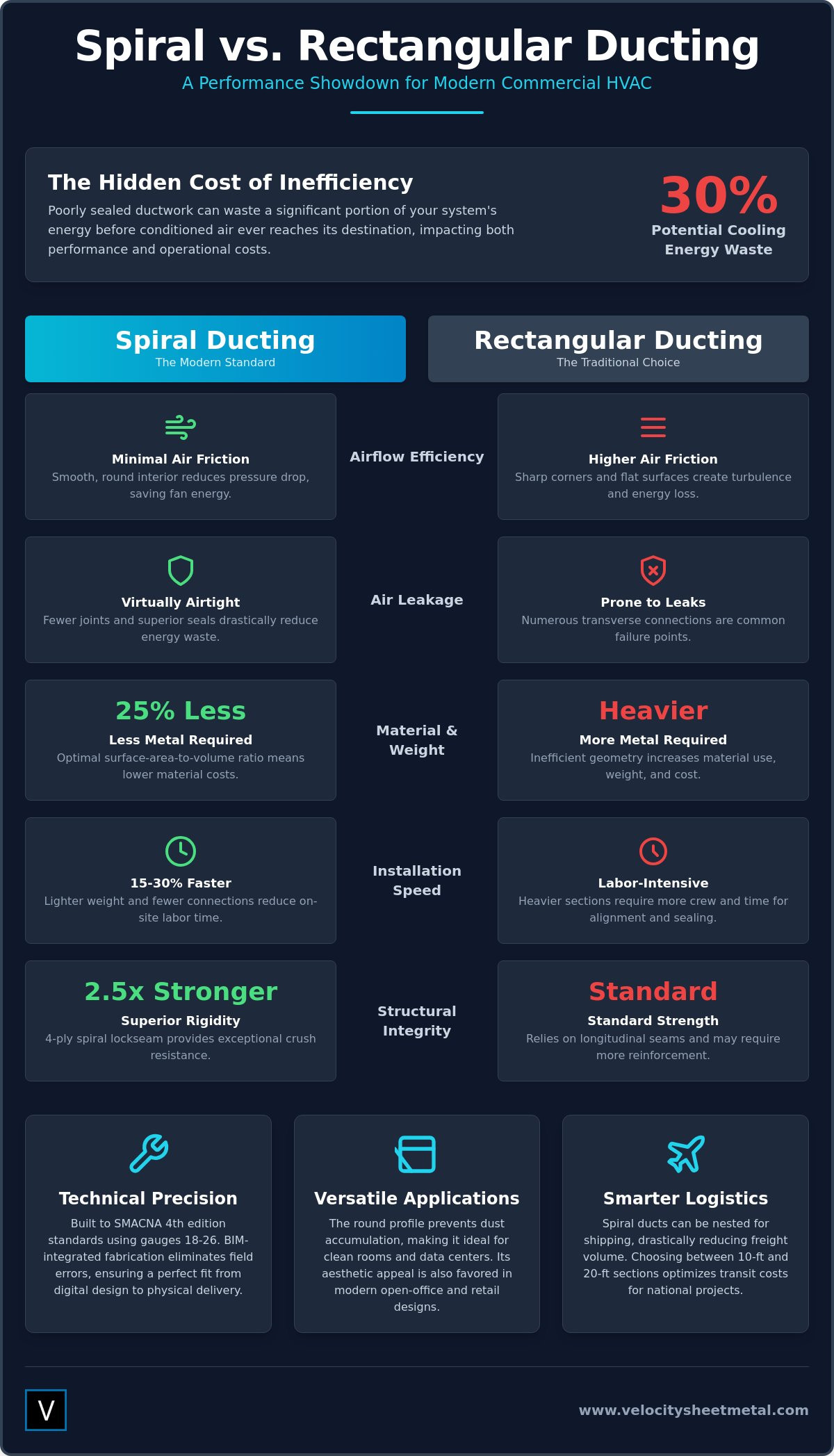
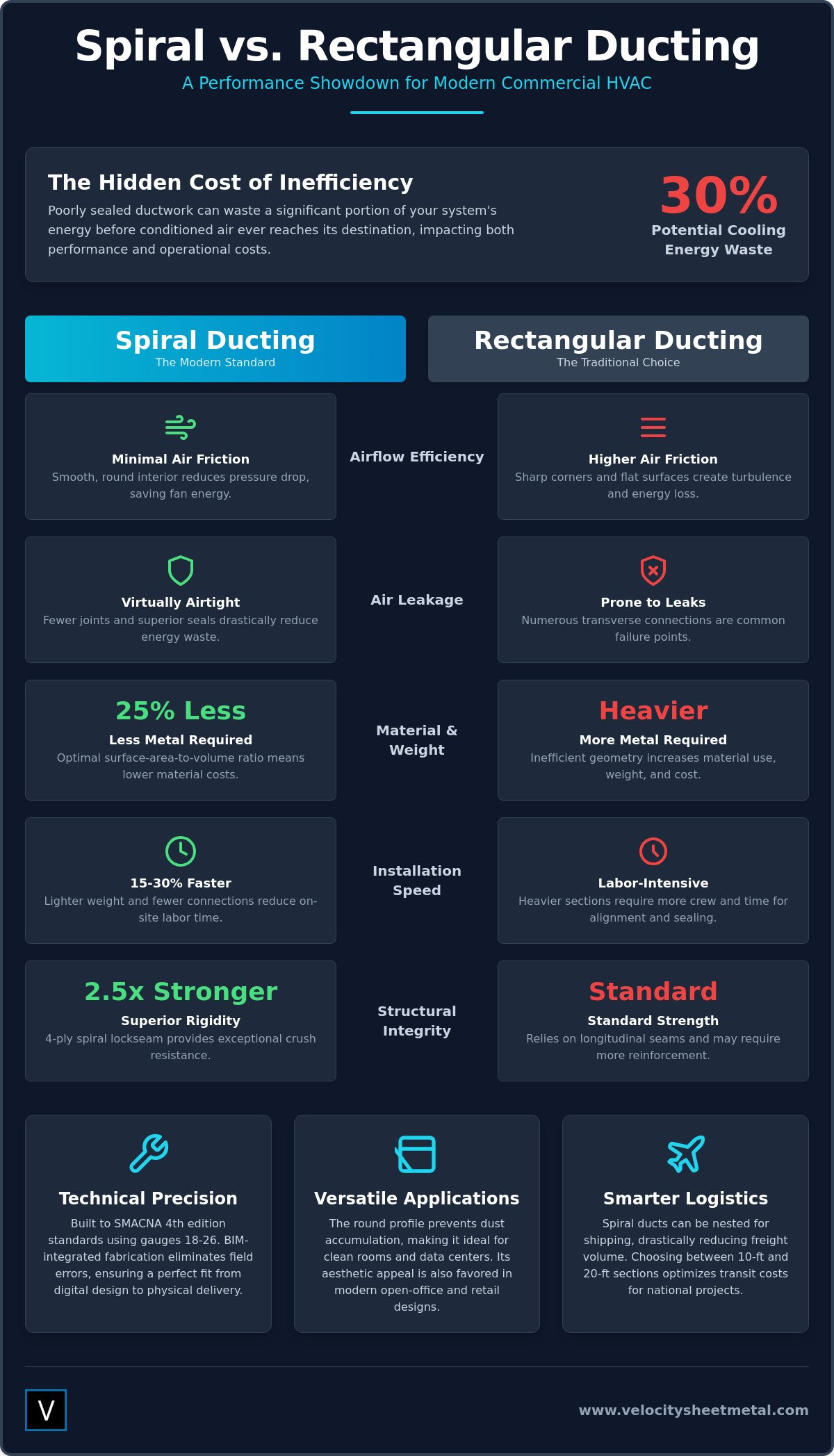
What if your choice of ductwork is actually wasting 30% of your system's cooling energy before the air even reaches the room? In 2026, the industry shift toward A2L refrigerants like R-454B and R-32 means your HVAC system's efficiency is under more scrutiny than ever. You're likely facing the triple threat of rising labor costs, tighter spatial constraints, and the constant risk of air leakage. It's frustrating to watch project margins shrink because of field fabrication delays or poorly sealed joints. Choosing spiral ducting over traditional rectangular options isn't just about aesthetics. It's a strategic move to reclaim your timeline and your budget.
We understand that every commercial project requires a balance between technical performance and bottom-line reality. This guide breaks down the essential trade-offs between spiral and rectangular systems so you can make an informed decision. You'll learn how to minimize air friction, ensure SMACNA 4th edition compliance, and leverage BIM coordination to speed up your workflow. From reducing energy loss to navigating national logistics, we're cutting through the noise to help you build a more reliable, precision-engineered system.
Analyze surface area-to-volume ratios to see why round systems use less metal and leak less air than rectangular alternatives.
Master SMACNA standards for spiral ducting gauges 18-26 and identify the essential fittings required for high-performance commercial builds.
Optimize project logistics by nesting pipes and choosing between 10-foot and 20-foot sections to slash freight expenses on national accounts.
Leverage BIM-integrated fabrication to eliminate field errors and bridge the gap between digital design and physical duct delivery.
Understanding Spiral Ducting in Modern Commercial HVAC
Commercial HVAC design is moving away from the "bigger is better" mentality of the past. Modern systems prioritize precision, and spiral ducting is at the center of this shift. Defined as a round, thin-gauge metal pipe with a continuous spiral lockseam, it represents a significant leap in fabrication technology. While rectangular systems were once the default for every commercial build, we're seeing a steady transition toward round systems. The reason is simple: efficiency. Round ducting provides a superior surface area-to-volume ratio, meaning it moves more air with less metal. When engineers evaluate HVAC ductwork materials, they're looking for that specific balance of weight, cost, and performance.
Material choice is dictated by the project environment. Most jobs utilize galvanized steel for its cost-effectiveness and corrosion resistance in standard air handling. In harsh industrial environments or facilities with high moisture levels, stainless steel becomes the necessary standard. This isn't just about utility. It's about longevity. A system that doesn't rust or degrade saves the owner thousands in replacement costs over the building's lifecycle. Beyond the technical specs, there's the aesthetic factor. Modern architecture has embraced the "industrial-chic" look, making exposed ductwork a centerpiece of open-office designs and retail spaces. It projects a clean, high-tech image that rectangular ducts often fail to match.
The Mechanics of the Spiral Lockseam
The structural integrity of this pipe comes from the 4-ply lockseam. This isn't just a simple joint. It's a structural reinforcement that runs the entire length of the pipe. This technology allows us to use lighter-gauge metal while maintaining incredible rigidity. Spiral seams provide up to 2.5 times the crushing resistance of traditional longitudinal seams. This strength is vital for high-pressure systems where a collapse could be catastrophic. The interior surface is also remarkably smooth. Unlike flexible ducting, which is prone to sagging and turbulence, the rigid interior of a spiral pipe reduces friction loss. This keeps air moving exactly where it needs to go without forcing the fan to work overtime. It's built for speed and endurance.
Applications: From Clean Rooms to Open Offices
Versatility is why we see these systems in such diverse settings. In data centers and clean rooms, the round profile is often a functional requirement. Rectangular ducts have flat tops where dust can settle, creating a constant contamination risk. Round pipes don't have that problem. Dust simply falls off, making them easier to maintain in sterile environments. In industrial ventilation, the ability to handle high-velocity air without vibrating makes it the only viable choice. We also see it dominating the modern office landscape. Architects use it to create height and space, leaving the ceiling open to showcase the precision-fabricated components. It acts as a bridge between high-end engineering and practical design.
Spiral vs. Rectangular Ducting: Efficiency, Cost, and Performance
Geometry dictates project economics. Round ductwork has the lowest surface area-to-volume ratio of any shape. This isn't just a math fact; it means you use significantly less sheet metal to move the same volume of air. Less metal equals lower material costs and a lighter overall system. Spiral ducting takes this a step further by offering superior structural integrity through its continuous lockseam, allowing for thinner gauges without sacrificing strength. It's a leaner way to build.
Leakage is the silent profit killer in commercial HVAC. Rectangular joints are notorious for air loss, often requiring extensive manual sealing at every transverse connection. In contrast, round systems naturally seal tighter. Verified research shows that poorly sealed ducts can waste 20% to 30% of cooling energy. By moving to a spiral ducting system, you're effectively plugging those leaks before the first fan turns on. It's the difference between a system that meets code and one that exceeds performance expectations.
Let's talk about the money. While rectangular duct is produced quickly on an automated coil line, the field labor for installation is often much higher. It's heavy. It requires more hangers and more time to align. Spiral pipe is lighter and uses fewer joints, typically reducing installation time by 15% to 30% on medium-sized projects. If you're looking for precision components that arrive ready for the hanger, check out our automated fabrication capabilities.
Airflow Dynamics and Energy Savings
Round shapes minimize air friction. This reduction in pressure drop allows engineers to specify smaller, more efficient fans, cutting long-term operational costs for the building owner. Noise is another factor. Rectangular panels can "oil-can" or vibrate under pressure, creating distracting acoustic issues in commercial spaces. Round duct is inherently rigid and quiet. Static pressure remains more consistent in round ductwork because the air moves in a natural, laminar flow without hitting the sharp corners of a rectangular profile.
The Headroom and Space Constraint Factor
Space isn't always on your side. In low-clearance ceilings, a 24-inch round pipe simply won't fit, whereas a 10x48-inch rectangular duct delivers the same volume in half the vertical space. This is where rectangular remains the superior choice for high-volume trunk lines in tight plenums. Flat-oval ducting offers a middle-ground solution, providing the efficiency of round with a lower profile. BIM coordination is the bridge here. It allows us to map exactly where to switch from spiral to rectangular to maximize headroom without sacrificing system performance. We use digital models to ensure every inch of spatial constraint is accounted for before fabrication starts.
Technical Standards: Gauges, Fittings, and SMACNA Compliance
Adherence to SMACNA standards isn't optional for commercial builds. It's the baseline for safety and performance. For spiral ducting, this means following the "HVAC Duct Construction Standards - Metal and Flexible, 4th edition." Fabrication typically utilizes galvanized steel in gauges ranging from 18 through 26. The specific gauge you select depends on the duct diameter and the system's pressure class. Precision in these technical standards ensures the system doesn't buckle or leak under load. It's about building for long-term reliability, not just passing the initial inspection.
A system is only as strong as its weakest joint. Essential fittings like elbows, tees, reducers, and lateral taps must meet the same rigid standards as the pipe itself. We use precision-cut components to maintain structural integrity throughout the run. This prevents the turbulence and air loss common in poorly fabricated systems. High-pressure applications also require specific sealants or EPDM gaskets to ensure a zero-leak environment. When every fitting is engineered to exact specifications, the entire system operates at peak efficiency.
Gauge Selection for Pressure Requirements
Pressure dictates material thickness. Small diameter pipes, usually under 14 inches, often use 26-gauge steel for standard supply air. Larger industrial lines require the thickness of 18 or 20-gauge material to handle the increased weight and static pressure. Negative pressure applications, such as exhaust or dust collection, are particularly sensitive. They require heavier gauges to prevent pipe collapse. In corrosive environments or high-moisture facilities, we swap galvanized for stainless steel. This ensures the system survives chemical exposure without degrading. It's a pragmatic approach to material selection based on the physical reality of the job site.
Precision Fittings and Joint Connections
The connection method determines your installation speed. Slip-fit joints are standard for smaller diameters, while larger commercial lines often utilize flanged connections for a more secure, airtight seal. Accuracy at this stage is critical. Our custom laser cutting technology ensures every fitting matches the BIM model perfectly. This level of precision eliminates the need for frustrating field modifications. When fittings fit the first time, you reduce lead times and keep labor costs under control. It's a streamlined process from the digital file to the final physical result.
Installation Logistics and National Shipping Considerations
Logistics is where project margins go to die if you aren't careful. Shipping spiral ducting across the country is essentially shipping air unless you have a precision-engineered loading strategy. We focus on trailer density to keep your freight costs under control. Nesting is our primary tool for this. By placing smaller diameter pipes inside larger ones, we maximize the volume of every truckload. It's a simple concept that requires complex coordination during the staging process, but the savings on national accounts are undeniable.
Section length is another critical variable. While 20-foot sections are available, they often require specialized freight and can be difficult to maneuver on a crowded job site. We typically standardize on 10-foot lengths. These sections offer a perfect balance between shipping ease and installation speed. Using 10-foot sections results in 50% fewer connections than the 5-foot lengths often sold by retail-focused suppliers. Fewer joints mean fewer leak points and less time spent on a lift. To ensure these components arrive in pristine condition, we utilize heavy-duty strapping and protective packaging. Dented pipe isn't just an eyesore; it's a structural failure that leads to field delays.
Reducing Field Labor with Pre-Assembled Spools
Modern commercial builds operate on razor-thin timelines. We use mechanical spooling services to move as much labor as possible from the field to the factory floor. By pre-assembling complex sections, we allow your crew to focus on hanging rather than fitting. This "just-in-time" delivery model ensures that ductwork arrives exactly when the rigging crew is ready for it, preventing on-site storage headaches. If your project requires high-volume rectangular components alongside your round runs, our coil line duct fabrication process provides the same level of automated speed and precision.
Standardization for National Accounts
Managing projects across multiple states requires a single, reliable fabrication partner. It eliminates the variability in quality that comes from using different local shops for every job. When your spiral ducting is fabricated to the same exact standard every time, you prevent field collisions and costly rework. We coordinate directly with your crane and rigging crews to synchronize delivery schedules. This level of transparency ensures that the metal is on the hook the moment it hits the site. If you're managing a multi-state rollout and need a partner who understands the high stakes of national logistics, contact us today for a logistical review.
The Velocity Advantage: BIM-Integrated Spiral and Rectangular Solutions
Velocity Sheet Metal isn't just a supplier. We're the essential bridge between a digital design and a tangible, high-performance product. With over 50 years of combined industry experience, we understand that precision in the shop is the only way to prevent chaos on the job site. Most fabricators treat rectangular and round systems as separate, disconnected workflows. We don't. We've integrated our automated coil-line production for rectangular duct with our custom fabrication for spiral ducting to create a unified solution. This synergy ensures that every transition and fitting fits the first time, every time. It's about moving your project forward without the typical administrative delays or fabrication errors that stall modern builds.
From Digital Model to Machine
Our workflow starts with the data. We take your BIM coordination files and translate them directly into machine-ready code. This seamless transfer eliminates the manual entry errors that often plague traditional shops. For mechanical contractors, our spool drawings act as a clear roadmap for the field installation crew. They provide exact dimensions and assembly sequences, turning a complex HVAC layout into a series of predictable, repeatable steps. Digital nesting further optimizes this process by mathematically arranging parts on a sheet of metal to minimize scrap. This reduces material waste and keeps your project's environmental footprint in check while protecting your budget. It's a methodical approach that prioritizes surgical precision.
Ready for Your Next High-Volume Project
National accounts and OEMs need a partner who can scale at the speed of their business. Whether you're managing a single high-rise or a multi-state facility rollout, our standardized production ensures consistent quality across every mile of spiral ducting we ship. We've built our reputation on being an authoritative expert operator. We're equally comfortable in a high-level design meeting or on the factory floor reviewing a custom lateral tap. When project deadlines tighten, you can't afford to wait on a fabricator that lacks modern automated technology. We operate with a "can-do" attitude grounded in manufacturing reality. We're ready to get to work immediately to ensure your next project is delivered on time and within spec.
Request a quote for your spiral and rectangular ducting needs
Optimize Your HVAC Infrastructure for 2026 and Beyond
The choice between spiral and rectangular systems isn't just about air volume. It's about engineering a system that survives the financial and technical pressures of 2026. You've seen how spiral ducting offers superior airflow dynamics while slashing field labor costs. You also know that precision fabrication is the only way to meet SMACNA standards without expensive rework. From initial digital concepts to national job site delivery, every step must be controlled and repeatable.
Success on large-scale commercial contracts requires more than just raw metal. It requires a partner who bridges the gap between BIM models and physical components. We've optimized our workflow to provide zero field collisions and standardized quality across all your national accounts. Our automated production line is ready to meet your tightest deadlines with surgical precision. Our national shipping capabilities ensure your materials arrive staged and ready for the lift.
Partner with Velocity for Precision HVAC Fabrication.
Let's get your next project moving with the speed and accuracy it deserves.
Frequently Asked Questions
Is spiral ducting cheaper than rectangular ducting for commercial projects?
Spiral ducting is generally more cost-effective because it requires less raw material and reduces field labor. While rectangular duct is produced quickly on automated coil lines, the installation labor for round systems is typically 15% to 30% lower. You also save on expensive sealants and the number of hangers required to support the system. It is a leaner approach to both material and labor budgets.
What are the standard lengths available for spiral ducting?
The industry standard lengths are 10 feet and 20 feet. We recommend 10-foot sections for most national accounts to balance shipping density with ease of on-site handling. Using 10-foot lengths results in 50% fewer connections than shorter 5-foot sections, which directly slashes your installation time. Shorter custom lengths are available through our precision fabrication process to match your specific BIM model requirements.
Can spiral ducting be used for high-pressure industrial exhaust systems?
Yes, the continuous 4-ply lockseam provides the structural rigidity necessary for high-pressure applications. It offers up to 2.5 times the crushing resistance of longitudinal seam pipe, making it ideal for both supply and exhaust. For extreme industrial environments or negative pressure systems, we utilize heavier 18-gauge or 20-gauge steel. This ensures the pipe maintains its integrity without the risk of buckling or collapse under load.
How does spiral ducting improve energy efficiency in HVAC systems?
Energy efficiency improves through superior airflow dynamics and significantly lower leakage rates. The round profile minimizes air friction, allowing for laminar flow that reduces the workload on fan motors. Research indicates that poorly sealed rectangular systems can waste up to 30% of cooling energy. Round systems naturally seal tighter at the joints, ensuring that the conditioned air reaches its destination without parasitic losses along the run.
Do I need special tools to cut spiral ducting on-site?
Standard metal-cutting tools like abrasive saws, plasma cutters, or high-speed reciprocating saws are sufficient for field modifications. However, our goal is to eliminate on-site cutting through BIM coordination and precision spool drawings. When components are fabricated to exact specifications in our shop, your crew spends their time hanging duct rather than modifying it. This precision-first approach keeps your project timeline on track and reduces material waste.
What is the lead time for custom spiral duct fittings?
Lead times are driven by project volume and complexity, but our automated laser cutting technology allows for rapid production. We prioritize speed and accuracy to meet tight construction schedules. Standard fittings are often ready for immediate shipment, while custom transitions are coordinated through the digital model for just-in-time delivery. We act as a reliable partner that cuts through the typical administrative delays of the industry.
Does spiral ducting require internal insulation or external wrapping?
The requirement depends on the specific thermal and acoustic needs of your project. Spiral pipe can be externally wrapped with standard insulation or internally lined for sound attenuation. Double-wall spiral is a high-performance alternative, featuring an inner perforated liner and a layer of insulation between the metal walls. This provides excellent thermal resistance and noise control while maintaining the smooth, clean look of exposed metal ductwork.
How do I handle transitions between spiral and rectangular ductwork?
Transitions are managed through custom-fabricated square-to-round fittings and lateral taps. We use laser-cutting technology to ensure these transitions provide an airtight seal and maintain consistent static pressure. BIM coordination is essential here; it allows us to map the exact point where a rectangular trunk line branches into round runs. This prevents field collisions and ensures that the transition pieces fit perfectly without the need for manual adjustments.