Precision Sheet Metal: 2026 OEM & Contractor Guide
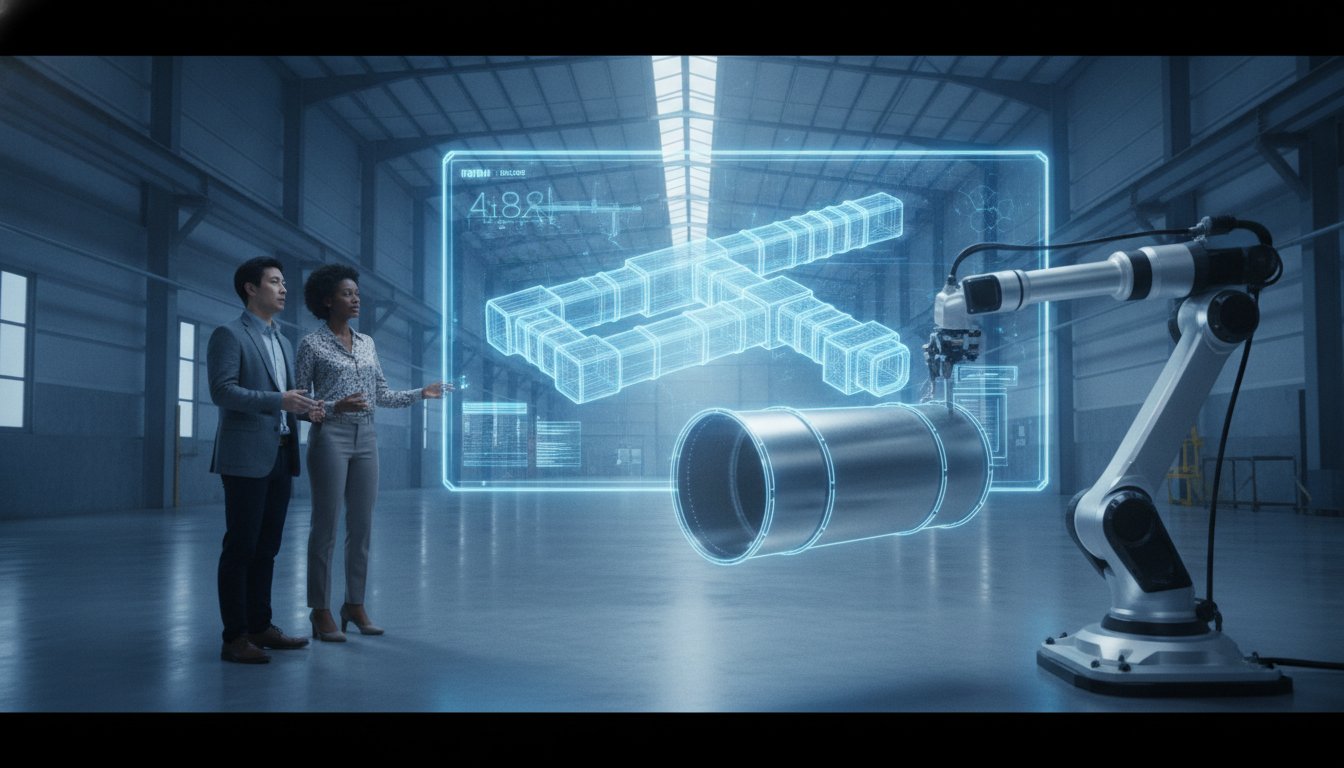
True precision in 2026 isn't just about the tolerance of a laser cut. It's about how that part integrates into a digital BIM model before it ever hits the shop floor. When you partner with precision sheet metal fabricators, you're looking for more than a vendor; you're looking for an essential bridge between a digital file and a tangible product. You've likely dealt with the fallout of poor coordination, including field collisions and mounting labor costs. These are the symptoms of manual shops that can't keep pace with modern digital workflows.
This guide provides a comprehensive framework for evaluating partners based on their automated capacity, BIM integration, and ability to scale nationally. We'll explore how automated coil-line production and CNC press brake bending reduce field labor and create predictable production schedules. You'll learn how to secure standardized quality and eliminate the guesswork from your national supply chain. The goal is simple: move from design to delivery with surgical precision.
Key Takeaways
- Identify why +/- 0.005 tolerances and automated coil-line production are now the baseline for eliminating manual measurement errors.
- Learn how BIM coordination and mechanical spool drawings identify and solve field collisions before fabrication starts.
- Use our framework to evaluate precision sheet metal fabricators based on their technological capacity and VDC integration.
- Achieve standardized quality and predictable production schedules for national accounts through automated manufacturing and logistics.
- Reduce field labor costs by shifting from manual on-site adjustments to pre-fabricated, bolt-ready precision components.
What Defines Modern Precision Sheet Metal Fabrication?
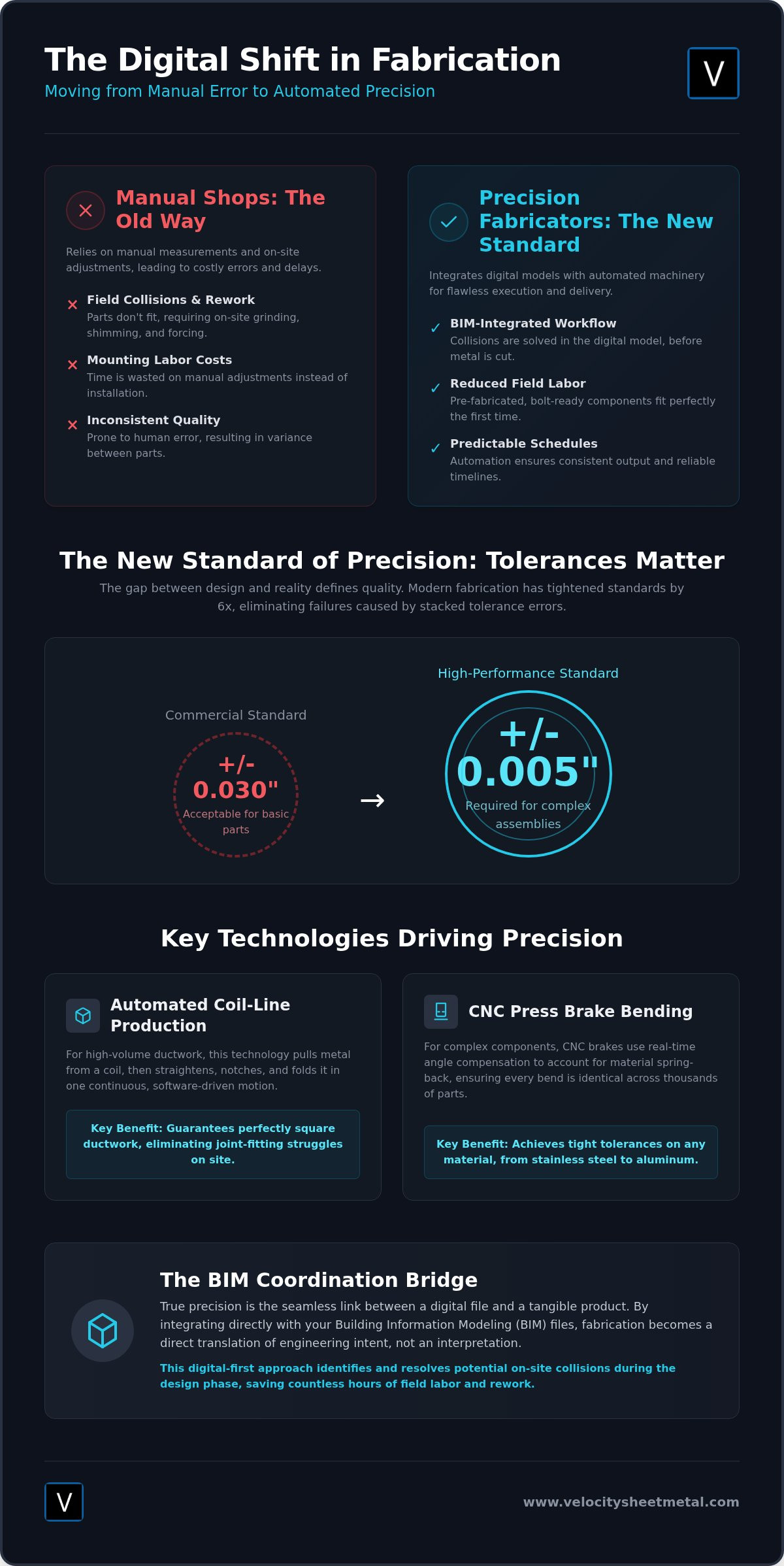
The era of the "close enough" measurement is over. Modern sheet metal fabrication has transitioned from a manual trade to a high-fidelity digital-to-physical workflow. Top-tier precision sheet metal fabricators no longer rely on hand-marked layouts or manual shears; they use direct CAD-to-machine interfaces that translate engineering intent into physical parts with zero data loss. This shift isn't just about accuracy. It's about eliminating the waste of field labor. When parts arrive on-site, they fit the first time. No grinding. No shimming. No re-work. Precision is the essential bridge between a digital file and a tangible product that performs exactly as designed.
Tolerances and Technical Standards in 2026
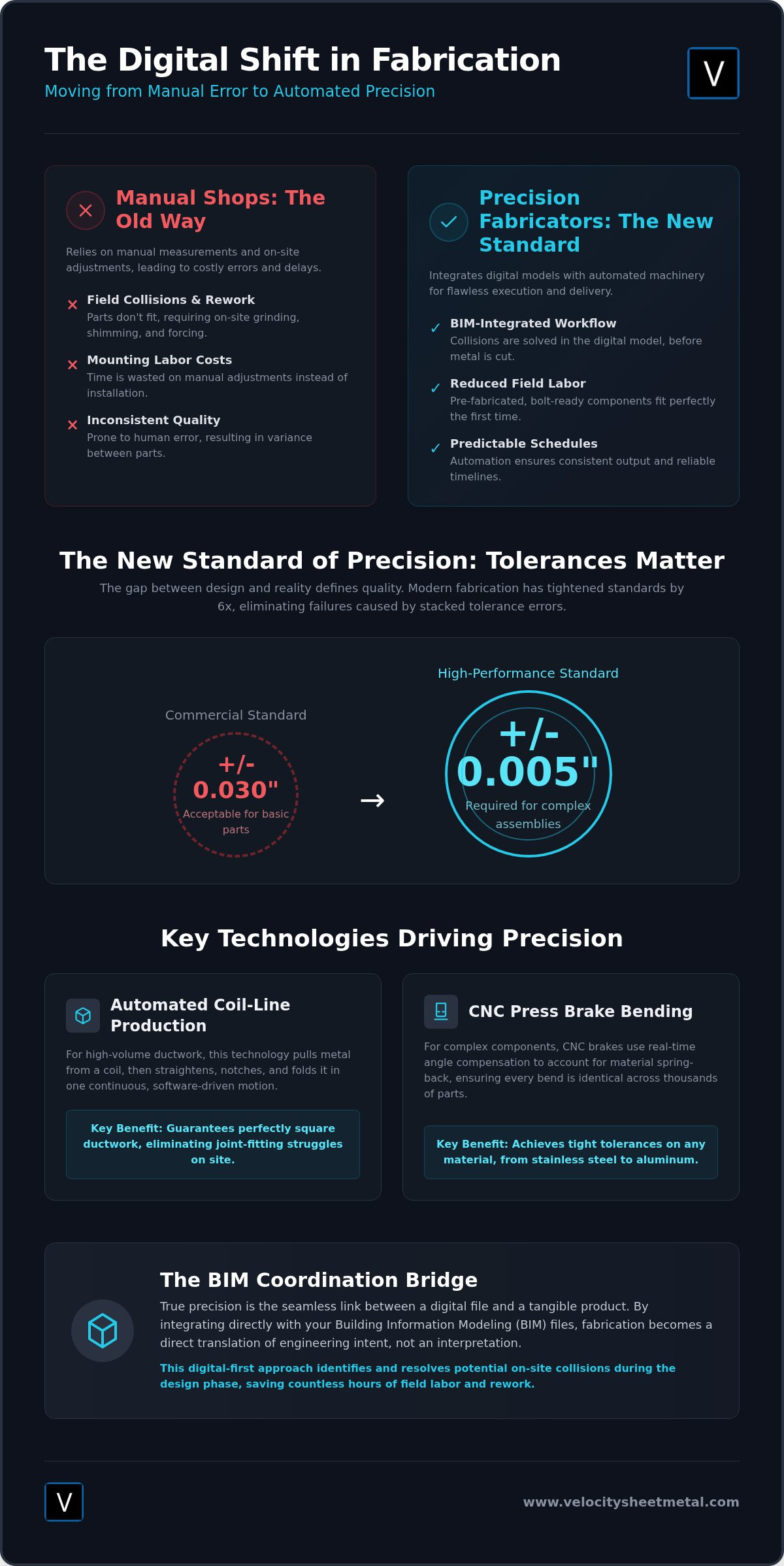
Precision is defined by the gap between the design and the final result. In 2026, the standard for high-performance OEM components has tightened to +/- 0.005 inches. This is a significant leap from commercial tolerances, which often hover around +/- 0.030 inches. Commercial standards might suffice for basic brackets, but they fail in complex assemblies where stacked tolerances lead to total system failure. Achieving these tighter specs across a production run of 1,000 parts requires CNC press brake bending with automated angle compensation. This technology accounts for material spring-back in real-time. Whether the project calls for 304 stainless steel or 5052 aluminum, the machine adjusts to the specific grain and thickness of the material to ensure every bend is identical. Material selection is critical; the alloy's ductility and tensile strength directly impact how the metal reacts under the pressure of the brake.
Why Speed is the New Dimension of Precision
Manual shops create a bottleneck that slows down the entire project lifecycle. Modern precision sheet metal fabricators solve this through high-speed automation that maintains accuracy even at peak volume. Automated coil lines for rectangular ductwork are a prime example of this evolution. These systems pull raw material directly from a coil, flatten it, notch it, and fold it in one continuous motion. This maintains perfect squareness at a speed manual teams can't touch. By removing the human element from repetitive tasks, shops deliver complex geometries with zero edge distortion on aggressive timelines. Precision fabrication is the elimination of manual variance through software-driven machinery. This automated approach ensures that the first part off the line is identical to the ten-thousandth, providing the consistency national accounts need to scale their operations without quality drift.
Key Technologies Driving Precision in High-Volume Production
High-volume production demands more than a sharp blade; it requires a synchronized ecosystem of automated machinery. For modern precision sheet metal fabricators, the goal is to maintain the tight tolerances of a digital model while maximizing throughput. This is achieved by removing the manual "stop-and-start" nature of traditional shops. From the initial cut to the final bend, every movement is governed by digital instructions that ensure the 500th part is as accurate as the first. This technical rigor is what allows contractors to move from design to delivery without the typical delays associated with manual fabrication.
The Power of Automated Coil-Line Production
In commercial HVAC, the rectangular duct is the backbone of the air distribution system. Transitioning to coil line duct fabrication is essential for projects where speed and scale are non-negotiable. These lines pull raw metal coils through a sequence of straightening, notching, and folding in one continuous motion. When procurement managers compare coil line vs hand fabricated ductwork, the difference in field labor is stark. Automated lines produce ductwork that is perfectly square, which eliminates the struggle of forcing joints together on a lift. This evolution in the Sheet Metal Technology/Sheetworking trade has effectively moved the heavy lifting of quality control from the field back to the shop floor, where it belongs.
Industrial Laser Cutting and CNC Bending
For OEM components with complex geometries, precision laser cutting services provide the necessary fidelity without the edge distortion of mechanical shearing. These lasers handle intricate patterns that are cost-prohibitive or impossible via traditional punching. Once cut, these parts move to CNC press brakes where software calibration prevents common press brake forming defects like cracking or over-bending. This level of control is also vital for spiral and round duct manufacturing. High-efficiency spiral duct offers several advantages for large-scale projects:
- Reduced air leakage: Continuous lock seams provide a tighter seal than longitudinal joints.
- Aerodynamic efficiency: Smooth interior surfaces lower pressure drop and energy costs.
- Structural integrity: The spiral rib acts as a reinforcement, allowing for lighter gauges without sacrificing strength.
For national accounts, this technology guarantees that a part fabricated for a site in New York is identical to one shipped to California. Consistency is the foundation of scalability. If you need to scale production without sacrificing accuracy, it's time to evaluate your fabrication partner's technology stack to ensure they have the automated capacity your project requires.
Evaluating Precision Sheet Metal Fabricators: A Procurement Checklist
Choosing between precision sheet metal fabricators is a high-stakes decision for procurement officers and mechanical contractors. It's about more than a quote; it's about project risk mitigation. In a 2026 market defined by tight margins and aggressive schedules, you need a partner who functions as an extension of your engineering team. This requires moving beyond a basic review of shop capacity. You must audit their digital infrastructure, the age of their automated fleet, and their ability to translate complex BIM data into physical reality without manual intervention. A partner who lacks VDC integration is not a partner; they are a liability that will eventually lead to field collisions and cost overruns.
Technical leadership is often the deciding factor in complex industrial projects. Look for a team with deep institutional knowledge, such as the 50+ years of combined management experience found at Velocity Sheet Metal. This expertise allows a fabricator to anticipate design flaws before the first piece of metal is cut. When reviewing a potential partner, look for alignment with the official U.S. government definition of a Metal Fabricator. True professionals understand the full scope of the trade, from metallurgical properties to advanced CNC programming. They don't just "make parts." They engineer solutions that streamline your entire installation process.
Capacity vs. Capability: What Do You Actually Need?
Capacity is the volume of metal a shop can process; capability is the complexity they can handle. For mechanical contractors, HVAC duct fabrication for mechanical contractors requires a specialized mix of both. You need a shop that can produce 20,000 pounds of rectangular ductwork on a coil line while simultaneously laser-cutting intricate custom curb adapters for a rooftop unit. Rapid prototyping capability is equally vital. If a shop cannot produce an on-demand "spool" for a critical field adjustment, your project stalls. Ensure your fabricator has the automated bandwidth to handle high-volume runs without sacrificing the flexibility needed for custom, one-off components.
Logistics and National Distribution Standards
A precision part is worthless if it arrives at the job site damaged or out of square. National shipping capabilities are the final pillar of a reliable fabrication partner. This is especially true for national accounts managing multi-state rollouts. Standardized quality across all project sites is only possible when your fabricator understands national procurement standards. This includes specific spooling and packaging requirements designed to prevent transit damage. By leveraging a single partner for national distribution, you eliminate the variance in quality that occurs when using multiple local shops. You receive the same precision, the same tolerances, and the same reliable delivery, whether your site is in Seattle or Miami.
BIM Coordination: Solving Field Collisions Before Fabrication
Precision is often misunderstood as a physical-only metric. In reality, it begins with data. Leading precision sheet metal fabricators use digital coordination to stop field errors before they ever reach the job site. By utilizing BIM clash detection for HVAC fabrication, contractors identify pipe, conduit, and structural overlaps months before a single hanger is installed. This foresight prevents the costly field re-work that typically erodes project profits. Digital coordination is the ultimate form of precision. It transforms the fabrication shop into a highly controlled environment where material take-offs are derived directly from the model, effectively eliminating material waste.
The transition from 3D models to mechanical spool drawings is the most critical step in the modern workflow. These drawings act as the tactical bridge between the engineer's intent and the machine's output. Instead of interpreting blueprints on the fly, the shop receives exact data points for every component. This ensures that the physical product is an identical twin of the digital model. When you remove the need for manual field measurements, you remove the primary source of installation delays.
Digital-to-Physical Workflow Integration
Spool drawings are the tactical instructions that drive automated machinery with 100% accuracy. They ensure that every notch, hole, and bend aligns with the master design. This is especially critical in commercial kitchen ductwork fabrication, where grease-tight seals and specific clearance requirements leave no room for error. BIM coordination reduces job site labor by up to 30% through pre-fabricated accuracy. This efficiency allows teams to focus on installation rather than modification, keeping the project on a predictable schedule.
Custom Curb Adapters and Specialty Fittings
Rooftop replacements often happen on tight, weekend-only schedules. Utilizing BIM data to manufacture rooftop unit curb adapters ensures a perfect fit-up between the existing curb and the new unit. Transition fittings and plenum boxes are fabricated to match the digital model exactly. This precision supports rapid RTU replacements, allowing cranes to move in and out with zero downtime. Every specialty fitting is checked against the digital coordination model to ensure it clears structural steel and existing utilities without on-site adjustments.
Need a partner who speaks the language of BIM? Connect with our coordination team today to start your next digital-to-physical project with surgical accuracy.
Velocity Sheet Metal: Your National Partner for Precision Fabrication
Reliability at scale is the primary challenge for national accounts. When managing projects across multiple states, you can't afford the quality drift that comes with fragmented local sourcing. Velocity Sheet Metal operates as a centralized hub for precision, ensuring that every component meets the same rigorous standards regardless of its final destination. We leverage over 50 years of combined management experience to solve complex engineering challenges before they hit the production line. Our facility is equipped for on-demand part production, backed by nationwide shipping capabilities that keep your projects moving at the speed of modern construction. We're not just a vendor; we're a high-capacity extension of your own shop floor.
Professional urgency is baked into our workflow. We understand that in the industrial sector, time is a physical constraint. Our team prioritizes clear communication and industrial pragmatism, cutting through the typical administrative delays that stall large-scale projects. By partnering with established precision sheet metal fabricators, you secure a supply chain that is as accurate as it is fast. This consistency allows you to bid on larger, more complex contracts with the confidence that your fabrication partner can handle the load.
Strategic Outsourcing for OEMs and Contractors
Building and maintaining an internal fabrication shop is a capital-heavy distraction. Most mechanical contractors find that outsourcing HVAC duct fabrication to specialized experts significantly increases project ROI. You gain immediate access to high-end CNC press brakes and industrial laser cutting technology without the overhead of equipment maintenance or specialized labor. Partnering with Velocity ensures consistent production standards across your entire portfolio. It's about focus. You handle the installation; we provide the precision-engineered components that make that installation seamless and profitable.
Get Started with Your Precision Project
Speed is our baseline. Our process is designed to move your project from a digital file to a physical part without friction. The Velocity approach starts with a methodical technical review of your designs. We don't just quote; we consult. Our team analyzes your files for manufacturability, suggesting optimizations that can reduce material waste or assembly time. To begin, submit your CAD files or BIM models through our portal for a rapid quote. You can also request a comprehensive capability overview to see how we support national accounts with standardized quality and professional urgency. We're ready to act as the essential bridge between your digital data and your physical product.
Secure Your Project’s Technical Foundation
Precision is no longer an optional upgrade; it’s a non-negotiable requirement for modern industrial projects. The shift from manual measurement to BIM-integrated workflows has redefined the standard for high-performance fabrication. By prioritizing automated coil-line technology and digital coordination, you eliminate the field collisions that erode your profit margins. Leading precision sheet metal fabricators provide the consistency needed to scale national accounts without the risk of quality drift. You move from the digital concept to the physical result with zero data loss.
Velocity Sheet Metal brings 50+ years of combined management experience to every complex engineering challenge. We offer a standardized quality that manual shops simply can’t replicate, ensuring every part fits the first time. We’re ready to act as your essential bridge from digital design to tangible delivery. It’s time to stop managing field errors and start executing with surgical accuracy across every site in your portfolio. You deserve a partner that values your timeline as much as the final tolerance.
Partner with Velocity for Precision Fabrication and Nationwide Shipping to streamline your next high-volume build.
Frequently Asked Questions
What are the standard tolerances for precision sheet metal fabrication?
Modern precision sheet metal fabricators work to a standard tolerance of +/- 0.005 inches for high-performance OEM components. This is a significant tightening from commercial standards, which typically allow for +/- 0.030 inches of variance. Maintaining these tight specs is essential for complex assemblies where stacked tolerances can lead to system failure. Real-time software calibration and CNC press brake bending ensure this accuracy remains consistent across high-volume production runs.
How does BIM coordination reduce project costs?
BIM coordination reduces costs by identifying and resolving physical clashes in a digital environment before any metal is cut. This proactive approach prevents the expensive field re-work that occurs when ductwork hits structural steel or plumbing on-site. By utilizing digital-to-physical workflows, contractors can reduce job site labor by up to 30%. The process shifts the burden of quality control from the field to the shop, where it is easier to manage.
Can you ship custom HVAC ductwork nationwide?
Yes, we provide nationwide shipping to support national accounts across the United States. This capability allows contractors to maintain a single, standardized level of quality across multi-state project sites. Every shipment is packaged and spooled according to national procurement standards to prevent damage during transit. This ensures that the precision achieved in our automated facility is preserved until the components reach your job site.
What is the difference between a coil-line and manual duct fabrication?
Coil-line fabrication is a fully automated process that pulls raw metal directly from a coil to notch, flatten, and fold ductwork in one continuous motion. This ensures perfect squareness and extreme speed for rectangular duct. Manual fabrication relies on hand-marking and traditional shears, which introduces human variance and slows down the production timeline. For high-volume projects, automation is the only way to guarantee predictable schedules and consistent quality.
Do you provide spool drawings for mechanical contractors?
We provide detailed mechanical spool drawings as a core part of our BIM coordination services. These drawings translate 3D models into tactical instructions for our automated machinery. For mechanical contractors, this means every piece of ductwork arrives with clear labeling and exact dimensions. This facilitates a bolt-ready installation process that eliminates the need for time-consuming on-site measurements and adjustments.
What materials can be processed with your laser cutting services?
Our custom laser cutting services process a wide range of industrial materials including stainless steel, aluminum, galvanized steel, and cold-rolled steel. These lasers achieve complex geometries with zero edge distortion, which is essential for intricate OEM parts. High-speed laser technology allows us to maintain tight tolerances while processing various gauges that would be difficult or impossible to handle with traditional mechanical punching methods.
How do curb adapters speed up rooftop unit installation?
Curb adapters act as the essential interface between an existing roof curb and a new HVAC unit. By using BIM data to manufacture these adapters, we ensure a perfect fit that eliminates the need for structural roof modifications. This precision supports rapid RTU replacements, often allowing a crane to swap units in a single weekend. It’s a pragmatic solution that minimizes facility downtime and reduces on-site labor costs.
Why should an OEM outsource their sheet metal components?
OEMs should outsource components to specialized precision sheet metal fabricators to access advanced CNC and laser technology without the massive capital investment. Outsourcing allows your team to focus on core assembly and product innovation while we handle the technical rigors of fabrication. You benefit from our 50+ years of combined management experience and automated capacity, ensuring a reliable, scalable supply of identical parts for your products.