Coil Line vs. Hand Fabricated Ductwork: 2026 Guide
In 2026, relying on manual fabrication for high-volume HVAC projects isn't just a tradition; it's a liability that drains your profit margin through field rework and labor overruns. You know the frustration of a project grinding to a halt because a manual shop can't keep pace with your field crew. The debate over coil line vs hand fabricated ductwork isn't just about volume anymore. It's about the digital precision required to survive in an industry where labor accounts for nearly 20% of your total installation costs. You need a workflow that moves as fast as your schedule demands.
We've built this guide to compare the technical and economic advantages of automated coil line production against traditional hand fabrication. You'll learn how to optimize your HVAC project timelines while eliminating the measurement errors that lead to costly field adjustments. We'll break down how to reduce on-site labor requirements and ensure precision fitment for even the most complex mechanical rooms. From BIM-integrated spooling to final delivery, it's time to bridge the gap between your digital files and a tangible, high-performance product.
Key Takeaways
- Understand the fundamental shift from manual shears and brakes to fully automated systems that transform raw metal into finished L-sections in seconds.
- Evaluate the technical and economic impact of coil line vs hand fabricated ductwork to determine which method best supports your project’s tolerance and SMACNA requirements.
- Identify the hidden costs of manual fabrication, including safety training, layout errors, and the high billable rates associated with traditional shop labor.
- Discover how BIM coordination and CNC laser cutting eliminate field rework by translating digital spool drawings directly into physical components with surgical precision.
- Establish clear criteria for selecting a fabrication partner that offers standardized quality and national shipping to keep your large-scale mechanical projects on schedule.
The Evolution of HVAC Fabrication: Coil Line vs. Hand Fabricated
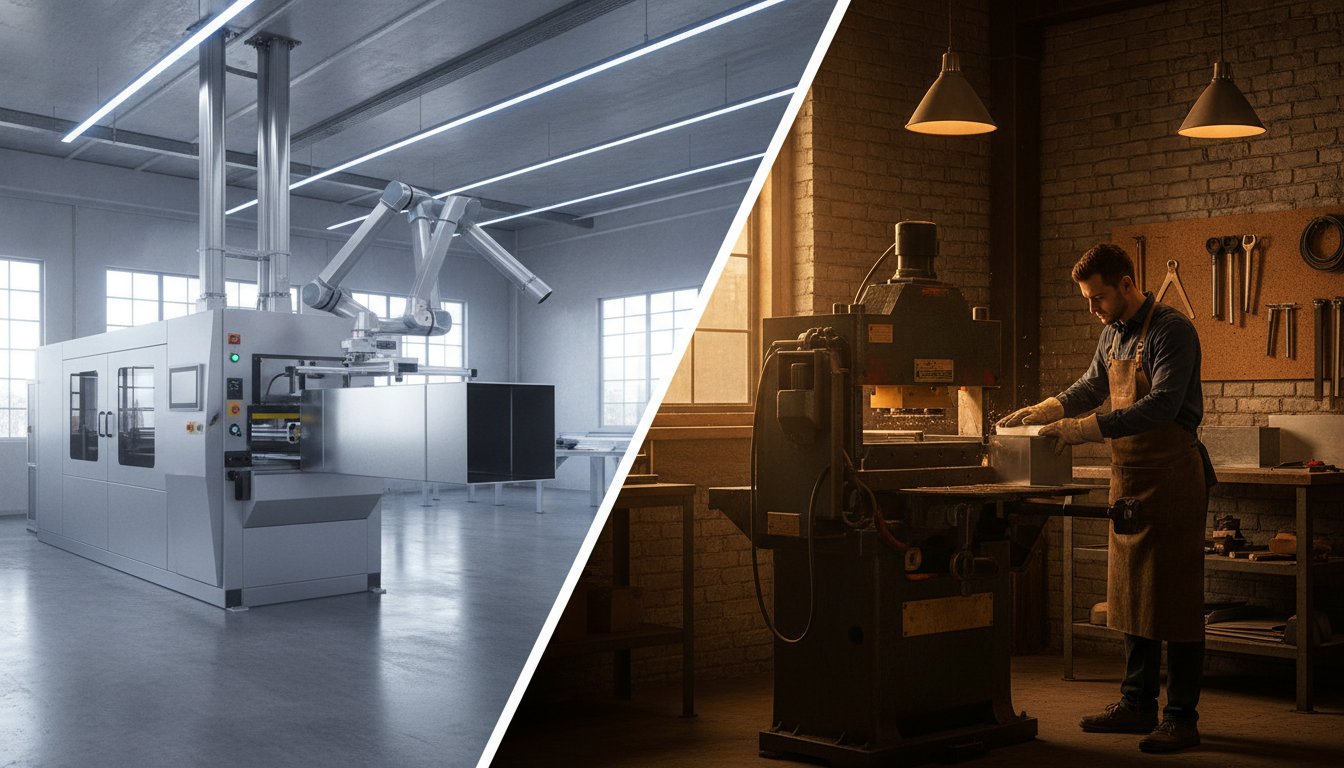
The sheet metal industry has hit a turning point. For decades, the local shop was the heartbeat of every mechanical project. Today, the choice between coil line vs hand fabricated ductwork determines whether a project stays on schedule or sinks into a cycle of field rework. Commercial projects in 2026 demand a level of precision that manual layout simply cannot sustain. This has fueled the rise of "fab-less" contracting. Smart mechanical firms are shifting away from maintaining their own shops. Instead, they partner with high-capacity specialists who bridge the gap between digital models and physical products.
The Evolution of HVAC Fabrication reflects a move from artisanal craftsmanship to industrial manufacturing. While manual methods served the industry well for smaller residential jobs, modern high-rise and industrial facilities require thousands of feet of straight duct with zero margin for error. Manual shops struggle to maintain the speed and consistency required for these massive mechanical volumes.
The Mechanics of Manual Fabrication
Hand fabrication is a labor-heavy process. It starts with a sheet of raw metal. A technician performs a manual layout, marking dimensions with a scribe and square. They use hand shears or a power slitter to cut the perimeter. Then, they move to the notchers for the corners. Finally, they use a manual or hydraulic brake to form the bends. This process is slow. It relies entirely on the operator's skill level on that specific day.
- Layout errors: A 1/8-inch mistake in a manual layout ripples through the entire run.
- Notch accuracy: Inconsistent notches lead to poor corner seals and increased air leakage.
- Material handling: Frequent manual lifting and flipping increases the risk of surface damage and kinks in the metal.
How Automated Coil Lines Transform Production
An automated coil line replaces a dozen manual steps with a single, continuous workflow. It pulls metal from a massive coil, straightens it, and levels it to remove any "coil set" memory. The machine then notches, beads, and shears the metal to the exact length specified in the digital file. This results in perfect L-sections or full-wrap duct ready for assembly. The machine doesn't get tired. It doesn't misread a tape measure.
This process ensures that every joint is identical. Whether it's a TDF flange or a slip-and-drive connection, the fitment is surgical. This level of coil line duct fabrication allows contractors to install ductwork as fast as they can hang it. There's no "making it fit" in the field. You get predictable results from the first foot to the last. This efficiency is why the industry is moving toward automated production for all high-volume commercial work.
Technical Performance: Accuracy, Tolerances, and SMACNA Standards
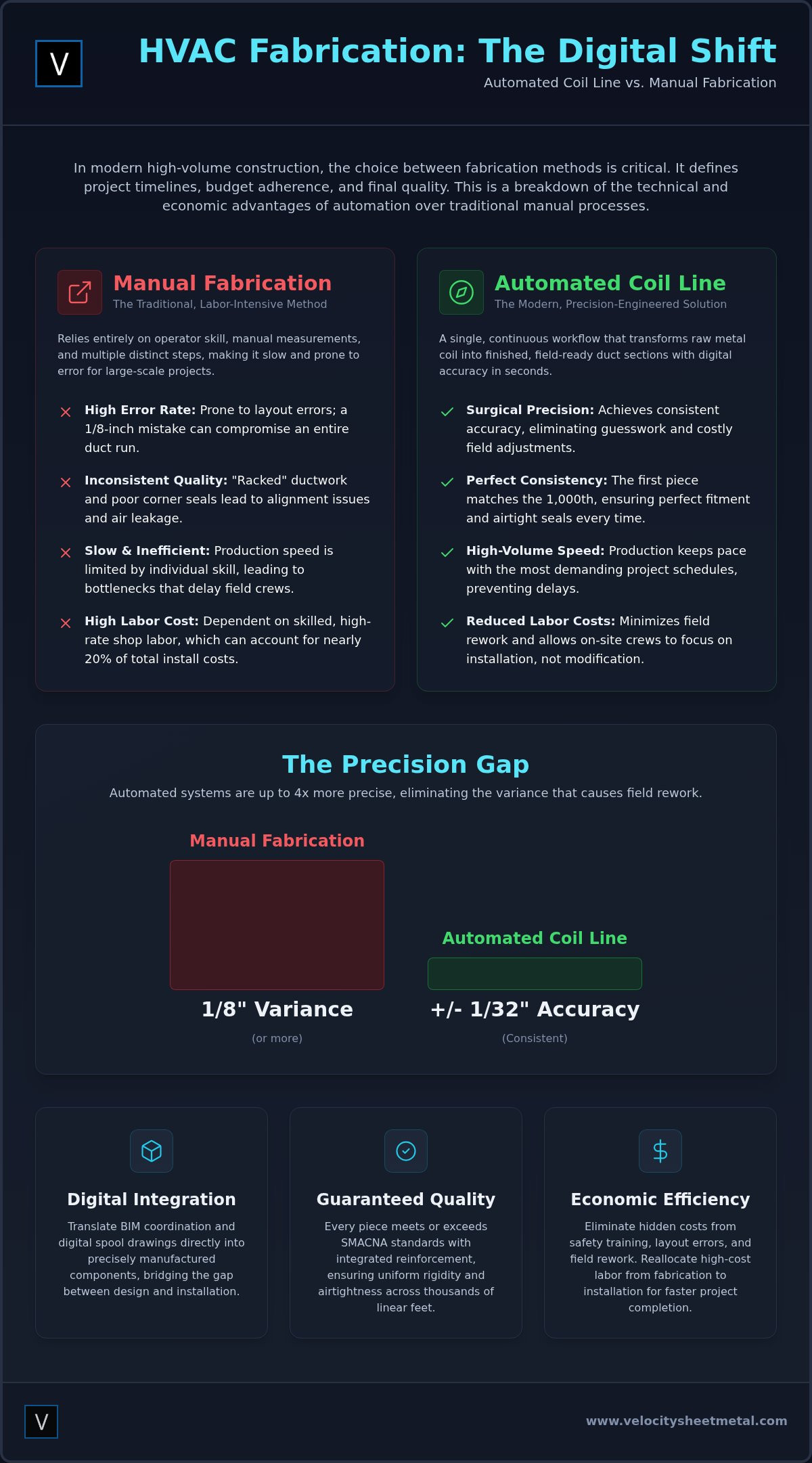
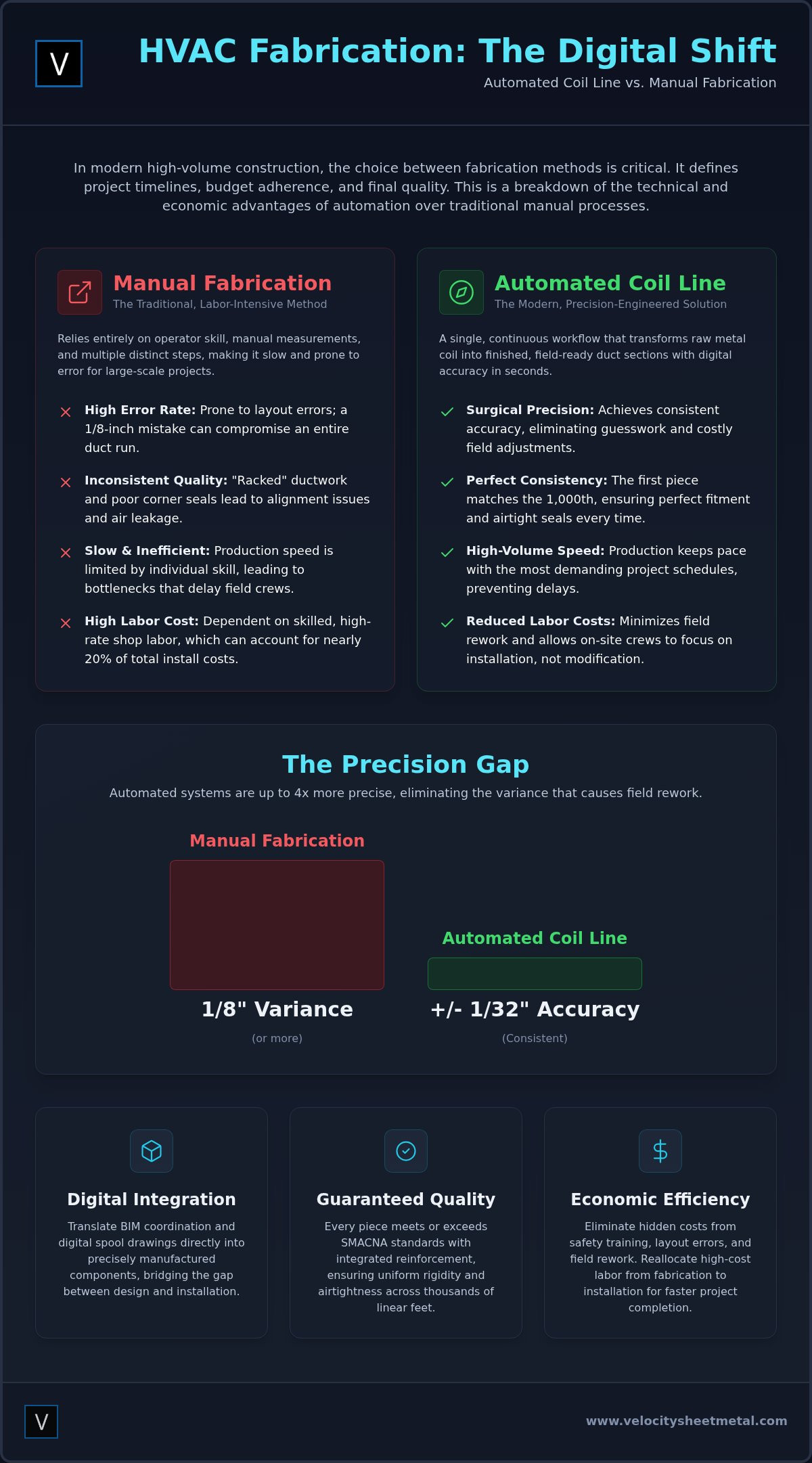
Precision is the baseline for modern mechanical rooms. When evaluating coil line vs hand fabricated ductwork, the difference in tolerance is stark. Automated systems consistently achieve +/- 1/32 inch accuracy. Manual layout often results in a 1/8 inch variance or more. This gap determines whether your duct fits perfectly on the first try or requires costly field modification. Every millimeter counts when you're coordinating tight ceiling spaces and complex riser shafts.
Rigidity is equally critical for long-term performance. Automated lines integrate reinforcement beads or cross-brakes directly into the production run. This ensures every piece meets SMACNA HVAC Duct Construction Standards without requiring extra manual labor. Whether your project specifies galvanized steel, stainless steel, or aluminum, the machine maintains these standards across every gauge. From standard 24-gauge residential runs to heavy 16-gauge industrial duct, the mechanical integrity remains uniform.
Consistency Across Thousands of Linear Feet
Reliability is built into the software, not just the steel. The first piece of duct matches the 1,000th piece in an automated run. Hand fabrication often produces "racked" ductwork where corners aren't perfectly square. This causes alignment issues that cascade through the entire installation. Precision notching also improves airtightness. It ensures tighter seals and higher leakage ratings for critical environments like hospitals or labs. If you're looking for a partner that prioritizes this level of technical detail, explore our automated fabrication capabilities to see how we deliver precision at scale.
Material Handling and Waste Reduction
Efficiency starts before the first cut. Nesting software calculates the most efficient use of metal, significantly outperforming manual sheet layouts. Using large coils instead of individual flat sheets reduces the number of seams and potential failure points in the system. This approach also streamlines the logistics of the shop floor. Automated shearing reduces material waste by up to 15%. This precision translates directly to lower overhead and faster turnaround times for your project. You move from raw material to a finished, high-performance product with surgical speed.
The Economic Reality: Labor Costs and Project Timelines
The financial impact of your fabrication choice becomes clear the moment your crew steps onto the job site. In 2026, labor accounts for approximately 19% of the total cost of a ductwork installation job. With a national median loaded rate of around $43.54 per hour for installers, every minute spent "making it fit" in the field is a direct hit to your profit. When comparing coil line vs hand fabricated ductwork, the math favors automation for any project requiring high-volume straight runs. Automated lines produce hundreds of feet per hour, while manual layout and forming can take days for the same output.
The hidden costs of maintaining a manual shop often go unrecorded until they cause a project delay. You aren't just paying for the metal; you're paying for floor space, safety training, and the constant risk of human error. Hand fabrication relies on a shrinking pool of skilled craftsmen who can perform complex manual layouts with precision. By outsourcing HVAC duct fabrication to an automated specialist, you eliminate these administrative burdens. You move from a variable, high-risk labor model to a predictable, fixed-cost production schedule.
Total Cost of Ownership (TCO) for Ductwork
Field rework is the primary driver of cost overruns in commercial HVAC. A manual layout error of just 1/8 inch can force a crew to stop installation, return to the shop, and refabricate a single transition. This triggers a ripple effect across other trades. Automated production eliminates this risk by ensuring dimensional accuracy from the first piece to the last. We provide kitted and tagged shipments, allowing your team to sort materials on-site with surgical speed. This organization moves your project from delivery to final inspection faster than manual methods allow.
Comparison: Coil Line vs. Manual Fabrication
| Feature | Automated Coil Line | Manual Hand Fabrication |
|---|---|---|
| Production Speed | High (Automated L-sections) | Low (Manual layout/forming) |
| Dimensional Accuracy | +/- 1/32 Inch | +/- 1/8 Inch Variance |
| Labor Intensity | Minimal (Software-driven) | High (Man-hour intensive) |
| Scalability | Unlimited (National capacity) | Limited (Shop headcount) |
The break-even point for coil line vs hand fabricated ductwork has shifted. While small, one-off custom fittings still have a place in the manual shop, any run exceeding a few hundred linear feet benefits from the speed of automation. National shipping capabilities mean you can access this precision regardless of your local shop's capacity. You get predictable lead times that move from weeks to days, ensuring your mechanical room is ready for equipment the moment it arrives on site.
Digital Integration: BIM Coordination and Laser Precision
Modern construction schedules don't allow for "figuring it out" on the job site. The real battle in coil line vs hand fabricated ductwork is won in the digital pre-construction phase. While manual shops often rely on hand-drawn sketches and field measurements, automated facilities utilize high-fidelity 3D models. We translate these digital files directly into machine-ready CNC code. This process eliminates the "lost in translation" errors that occur when a shop foreman misinterprets an engineer's intent. You move from a virtual model to a physical product with zero manual data entry.
Precision fitment is the direct result of BIM clash detection for HVAC fabrication. By identifying interference with structural beams or plumbing lines before the first cut, we ensure the ductwork fits the space perfectly. This digital integration reduces on-site "measure-and-cut" labor, which is often the most expensive part of any mechanical installation. Every piece is cut, notched, and labeled according to the spool drawing. This allows your field crew to focus on hanging duct rather than modifying it.
The Digital-to-Physical Workflow
We bridge the gap between design and delivery through mechanical spooling. Each spool drawing acts as a precise map for the production floor. The software optimizes the layout for the coil line while simultaneously sending complex geometries to the laser cutter. This workflow ensures that every transition, elbow, and offset aligns perfectly with the straight runs coming off the coil line. It's a seamless transition from the cloud to the factory floor. No manual layout. No guesswork. Just precision.
Custom Transitions and OEM Parts
A coil line excels at high-volume straight runs, but complex mechanical rooms require custom offsets and plenum boxes. This is where custom laser cutting and CNC press brake bending become essential. We use these technologies to handle the transitions that a standard coil line can't reach. This is particularly critical for specialized environments. For example, ensuring commercial kitchen ductwork fabrication meets exact kitchen hood specs requires the surgical accuracy of a laser. We combine automated straight runs with precision-cut fittings to provide a complete, clash-free system.
Stop wasting man-hours on field modifications and start installing precision-engineered systems. Request a quote for your BIM-integrated ductwork today and see how digital precision accelerates your timeline.
Partnering for Success: Scaling Your National HVAC Project
Scaling a commercial HVAC project across multiple regions requires more than just a local metal shop. It requires a manufacturing partner capable of delivering consistent results from coast to coast. The choice of coil line vs hand fabricated ductwork becomes a matter of logistical survival when you're managing national accounts. Regional manual shops often lack the capacity to handle simultaneous large-scale orders. They struggle with the administrative overhead of shipping and tracking. You need a partner that treats ductwork as a high-precision product, not just a commodity.
Logistics are the backbone of national success. Delivering precision ductwork without damage requires specialized packaging and reliable freight partnerships. We leverage over 50 years of industry experience combined with 2026 automation technology to ensure every shipment arrives on time and ready for assembly. This eliminates the uncertainty of local lead times. You get a predictable production window that doesn't fluctuate based on a shop's local labor shortages. Speed and reliability are built into the workflow from the initial digital file to the final delivery truck.
Standardized Quality for National Accounts
Multi-state developers cannot afford variations in fabrication standards. Across the country, a hospital facility must meet the same rigid air-leakage specifications as a data center. Automated coil lines ensure this uniformity. You benefit from a single point of contact for nationwide supply; this dramatically reduces procurement friction. Automated quoting and digital tracking provide the transparency you need to manage complex construction schedules. This consistency is nearly impossible to maintain when juggling multiple manual shops with varying layout techniques and tolerance levels. When you choose a partner that understands the nuances of coil line vs hand fabricated ductwork, you're choosing a standardized quality level that protects your reputation.
Next Steps for Your Project
Transitioning to a high-volume model starts with an audit of your current lead times. If your manual shop is quoting weeks for standard straight runs, you're losing money on every project. The next step is preparing your digital files for an automated workflow. We translate your BIM models and spool drawings directly into our production queue. This eliminates manual data entry and ensures the final physical product matches your digital design with surgical accuracy. It's time to move beyond the limitations of manual layout and embrace the speed of modern manufacturing.
Get a Quote on Automated Rectangular Ductwork and secure your project timeline with a partner built for 2026 precision.
Secure Your Competitive Edge in 2026
The choice between coil line vs hand fabricated ductwork is no longer just a shop-floor decision; it's a strategic move for your bottom line. Digital precision and automated speed are the new requirements for surviving 2026 construction schedules. You've seen how BIM integration eliminates clash detection issues and how national shipping provides the scalability your projects demand. Stop settling for the delays and inaccuracies of manual fabrication. It's time to bridge the gap between your digital models and physical ductwork with surgical accuracy. We provide the technical expertise and industrial capacity to turn your spool drawings into a tangible reality without the typical administrative friction.
Velocity Sheet Metal delivers Automated Coil-Line Production and BIM-Integrated Fabrication to ensure every piece fits perfectly the first time. We combine these capabilities with Nationwide Shipping and Standardized Quality to support your operations anywhere in the country. Don't let manual errors drain your profit margins or stall your field crews. Let's get to work on building a more efficient mechanical room together. Partner with Velocity for Your Next Commercial Project and experience the speed of modern manufacturing.
Frequently Asked Questions
What is the primary difference between coil line and hand fabricated ductwork?
The primary difference lies in the shift from manual labor to automated production. Coil lines use massive rolls of metal to produce straight sections in seconds. Hand fabrication requires manual layout, hand shears, and manual brakes for every individual piece. The debate over coil line vs hand fabricated ductwork centers on this move from artisanal craftsmanship to high-speed industrial manufacturing.
How much faster is an automated coil line compared to manual fabrication?
An automated line can produce hundreds of feet of duct per hour; a manual shop might take days for the same volume. It eliminates the time spent on manual measurements, notches, and shearing. This speed allows for faster project timelines and more predictable delivery schedules on large commercial sites. You don't have to wait for a technician to finish a layout before the next piece starts.
Can automated coil lines handle custom duct sizes and non-standard gauges?
Yes, modern coil lines are fully programmable to handle a wide range of custom dimensions. Standard machines typically process 16 to 24-gauge galvanized steel with ease. For non-standard sizes that the coil line cannot reach, integrated laser cutting technology handles the complex geometries. This ensures a perfect fit for the entire system regardless of the complexity of the mechanical room layout.
Does automated ductwork meet SMACNA standards for commercial buildings?
Automated ductwork is specifically engineered to exceed SMACNA standards for rigidity and airtightness. The machine-driven processes ensure consistent beading, cross-braking, and notch accuracy that manual methods cannot replicate. This repeatability guarantees that every piece of duct meets the technical requirements for commercial and industrial HVAC systems. It provides a level of quality that is difficult to sustain with manual forming.
How does BIM coordination improve the accuracy of fabricated ductwork?
BIM coordination identifies physical collisions in a 3D model before the first piece of metal is cut. It translates digital spool drawings directly into CNC code for the coil line vs hand fabricated ductwork workflows. This digital-to-physical process eliminates human transcription errors. It ensures that fabricated components fit perfectly into complex mechanical rooms, reducing on-site modifications and administrative delays.
Is it more expensive to ship automated ductwork nationally than to buy locally?
The savings in labor and reduced field rework often outweigh the costs of national shipping. High-volume automated facilities operate with lower overhead per foot than local manual shops. Standardized quality and kitted shipments also reduce site sorting time. This makes national procurement a more cost-effective strategy for large-scale developers who need consistency across multiple project sites. You trade local shipping for industrial efficiency.
What are the benefits of TDF flanges versus traditional slip-and-drive joints?
TDF (Transverse Duct Flange) joints are formed directly on the duct wall, creating a more rigid and airtight connection. They eliminate the need for separate corner pieces and manual assembly required by slip-and-drive joints. This results in faster installation times and significantly lower air leakage ratings for high-pressure systems. It's the standard choice for modern commercial projects that prioritize energy efficiency and speed.
How does precision laser cutting complement the automated coil line process?
Laser cutting handles the complex transitions, elbows, and offsets that a straight-run coil line cannot produce. It ensures that custom fittings match the surgical tolerances of the automated straight duct. This combination provides a complete system where every component aligns perfectly. It reduces the need for expensive "measure-and-cut" labor in the field. You get a fully coordinated package that is ready for immediate installation upon delivery.