Prefabricated Ductwork: 2026 Efficiency Guide
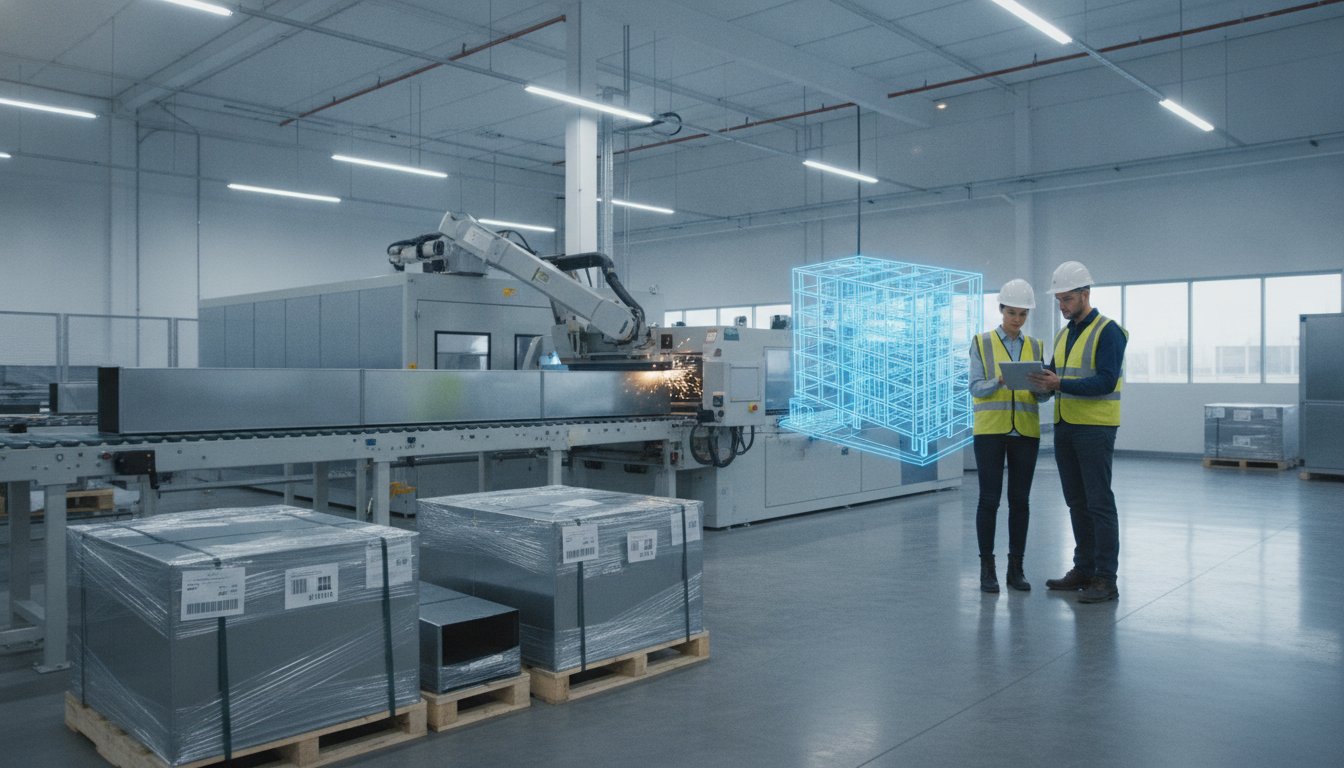
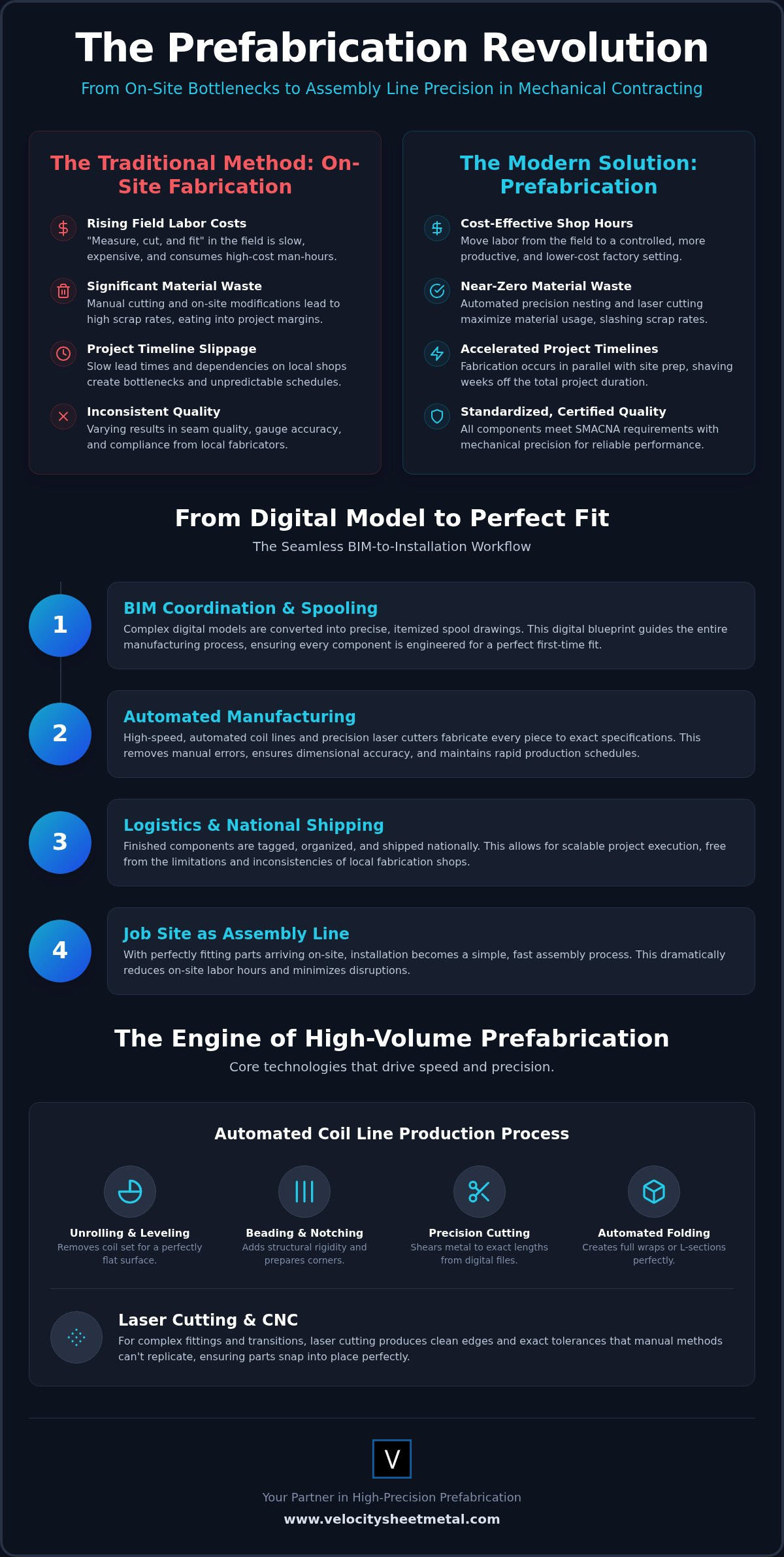
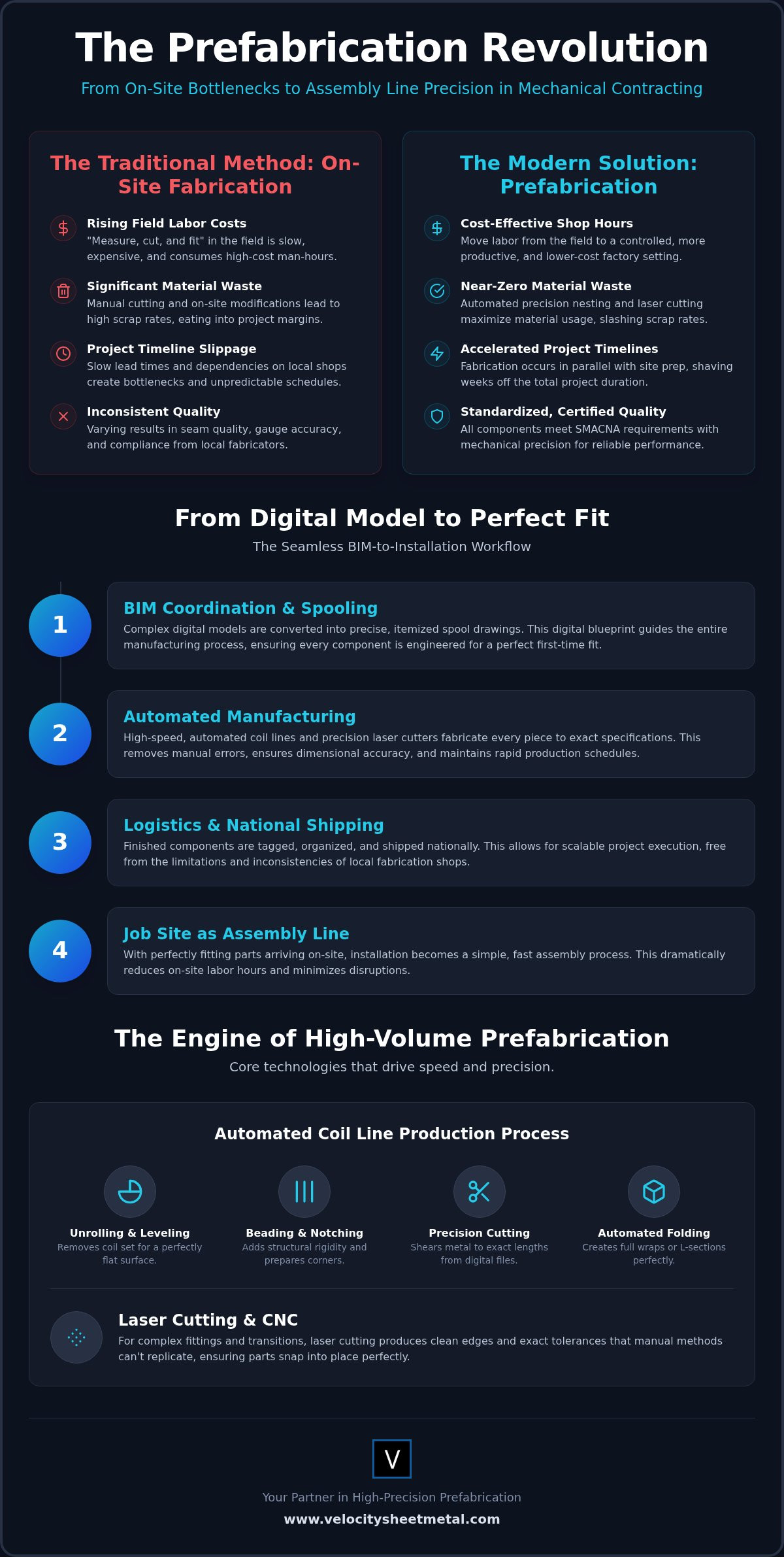
In 2026, the most profitable mechanical contractors aren't just installers; they're logistics experts who treat the job site like a precision assembly line. You've likely felt the pressure on your own projects. Rising field labor costs and material waste from on-site modifications are eating your margins. It's frustrating to watch project timelines slip because of slow lead times or inconsistent quality from local shops that can't keep up with modern demands.
We agree that the traditional "measure, cut, and fit" approach in the field is now a liability. This guide shows how BIM-integrated prefabricated ductwork for mechanical contractors eliminates redundant labor, slashes scrap rates, and accelerates commercial HVAC project timelines. You'll discover how to move the heavy lifting from the dirt to the automated shop floor for better precision and faster completion.
We'll break down the transition from digital models to physical products. We explore how automated manufacturing and spool drawings create a seamless bridge between your design and the final installation. It's time to reduce overhead and take control of your delivery schedule with a tech-forward approach to fabrication.
Key Takeaways
- Learn how mechanical spooling and BIM coordination turn complex digital models into shippable components that fit perfectly the first time.
- Understand how automated coil-line production provides high-volume, precision-engineered prefabricated ductwork for mechanical contractors to reduce on-site labor.
- Discover strategies for eliminating material waste and field modifications by shifting fabrication from the job site to a controlled factory environment.
- Explore how national shipping and standardized quality control allow you to scale commercial projects without the limitations of local fabrication shops.
- See how 50 plus years of manufacturing expertise and modern laser cutting technology create a reliable bridge between digital files and finished products.
Defining Prefabricated Ductwork for Modern Mechanical Contracting
Prefabricated ductwork is no longer a collection of off-the-shelf parts. It consists of factory-built HVAC components engineered to exact project specifications before they arrive at the site. The industry has moved past treating duct as a simple commodity. For commercial projects, it's an engineered system. This shift ensures that every piece of prefabricated ductwork for mechanical contractors integrates seamlessly with the overall building design. It covers a full range of products, from automated coil-line rectangular duct and spiral pipe to custom curb adapters and CNC-bent fittings. These are the essential bridge between a digital file and a tangible product.
The 2026 construction landscape demands a manufacture-first mentality. Project timelines are compressed. Skilled labor is scarce. Moving the fabrication process into a specialized shop floor allows you to treat the job site like a precision assembly line. This approach eliminates the "measure, cut, fit" cycle that slows down progress. It's a predictable workflow where the physical ductwork matches the digital intent perfectly. When manufacturing happens in parallel with site prep, you shave weeks off the total project duration.
The ROI of Prefabrication in High-Volume Projects
The math is simple: shop hours are consistently more productive and cost-effective than field hours. By utilizing prefabricated ductwork for mechanical contractors, you move high-risk, time-consuming tasks into a controlled setting. This reduces the total man-hours required for installation. Precision nesting and automated laser cutting also play a major role in profitability. These technologies maximize material usage and significantly reduce scrap rates compared to manual methods. Safety is another critical factor. When you minimize on-site fabrication, you reduce the risks associated with sharp metal, heavy machinery, and ergonomic strain in the field.
Standardization and SMACNA Compliance
Consistency is the backbone of performance. Local fabrication shops often produce varying results in seam quality or gauge accuracy. A professional partner provides standardized components that meet all SMACNA requirements for every shipment. This is especially vital for national accounts that need uniform quality across different regions. Factory-controlled environments ensure higher pressure-class compliance by utilizing automated equipment that maintains tighter tolerances than manual field assembly. Every joint, seam, and flange is executed with mechanical precision, ensuring the system performs exactly as the engineers intended.
Automated Coil Line Production: The Engine of High-Volume Prefab
High-volume prefabricated ductwork for mechanical contractors starts at the automated coil line. It's a relentless, high-speed process that removes the variables of manual labor. Raw galvanized steel enters as a massive coil. The system handles several critical steps in seconds:
- Unrolling and Leveling: Removing the coil set for a perfectly flat surface.
- Beading and Notching: Adding structural rigidity and preparing corners for folding.
- Precision Cutting: Shearing the metal to the exact length specified in the digital file.
- Automated Folding: Creating full wraps or L-sections with perfect 90-degree angles.
This automation ensures dimensional accuracy across thousands of linear feet. Every piece is a mirror image of the last. Manual measurement errors are non-existent in this workflow. Speed drives the entire operation. Continuous fabrication cycles allow for massive output without the fatigue or inconsistency of a manual shop. This capability is what slashes lead times for commercial projects. While a local fabricator might buckle under a sudden increase in project scale, an automated line maintains its pace. Precision laser cutting handles the complex geometry of fittings and transitions. It produces clean edges and exact tolerances that manual hand-cutting simply can't replicate. It's the difference between a part that "mostly fits" and one that snaps into place.
Rectangular Duct vs. Spiral Duct: Manufacturing Efficiency
Selecting the right profile depends on your project's physical constraints and airflow targets. Coil-line rectangular duct remains the gold standard for space-constrained plenums. It maximizes volume where vertical clearance is tight. On the other hand, automated spiral pipe production offers a distinct speed advantage for long, straight runs. It's rigid, lightweight, and minimizes friction loss. Reviewing the Spiral vs. Rectangular Duct: Industrial Efficiency Comparison helps you select the right geometry to keep your installation crews moving at full speed.
Custom Transition Fittings and Curb Adapters
Modern mechanical systems require more than just straight runs. Custom curb adapters are often the "missing link" in rapid RTU replacement projects. They allow new equipment to sit on existing roof openings without expensive structural modifications. We utilize CNC press brake bending for these heavy-gauge components to ensure they withstand high-pressure environments. Automated laser cutting provides the precision required for these on-demand parts, turning a complex transition into a simple bolt-on assembly. If you're ready to move faster, partnering with an automated fabrication shop can eliminate your project's biggest bottlenecks.
BIM Coordination and Spooling: The Digital-to-Physical Workflow
Precision isn't born on the shop floor; it's engineered in the digital model. BIM coordination is the critical foundation for prefabricated ductwork for mechanical contractors because it allows you to build the entire HVAC system in a virtual environment first. This pre-construction digital review identifies field collisions with structural steel, plumbing, and electrical runs long before a single sheet of metal is sheared. By solving these conflicts in the model, you eliminate the costly "RFI" delays that typically stall progress once the crew is already on-site. It moves the problem-solving phase from the field to the office, where it's cheaper and faster to fix.
Mechanical spooling takes this coordinated model and breaks it into logical, shippable sections. It turns a massive, complex design into a series of manageable assemblies. Each spool is designed for optimal transport and easy installation. This process ensures that every piece of prefabricated ductwork for mechanical contractors arrives exactly when and where it's needed, labeled for its specific location in the building. Spooling acts as the essential bridge between design intent and fabrication reality, ensuring that what was drawn is exactly what gets delivered.
From Model to Machine: The Seamless Integration
Spool drawings translate digital designs into machine-ready instructions. This isn't a manual data entry process; it's a direct data transfer. The software exports dimensions, notches, and connector types directly to the automated coil line and laser cutters. To keep the job site organized, every component receives a unique tag that matches the site plans. This "Lego-style" assembly approach means your field crews spend less time thinking and more time installing. For a deeper dive into this process, read our BIM for Sheet Metal Fabrication: The 2026 Guide.
Mechanical Contractor BIM Support
Partnering with a fabricator that speaks the language of VDC and BIM is a major competitive advantage. It moves the technical burden off your internal team and onto our specialists. Some industry professionals report that accurate pre-spooling can reduce field modifications by up to 90% compared to traditional field-fit methods. This precision allows you to scale your operations without adding more field labor, which is essential in a tight labor market. By utilizing our 50+ years of management expertise alongside modern digital workflows, we ensure your project moves from the computer screen to the mechanical room with surgical accuracy. It's about delivering a product that fits the first time, every time, without the need for a "plan B" on the job site.
Logistics and Scalability for National Mechanical Projects
Scaling a commercial HVAC project across state lines demands a logistical strategy that local shops cannot provide. Relying on ten different fabricators leads to ten different sets of standards. Using one centralized partner for prefabricated ductwork for mechanical contractors ensures that every fitting on every site is identical. This consistency is vital for maintaining SMACNA compliance and pressure-class integrity across a national portfolio. It eliminates the friction of managing multiple vendors with varying lead times and quality controls. You get one point of contact and one high standard of excellence.
We manage lead times across various time zones to keep your project on schedule. Just-in-time (JIT) delivery is the standard for modern job sites with limited staging space. We coordinate shipments so the ductwork arrives exactly when the installation crew is ready for it. This prevents the clutter and damage risk associated with storing massive amounts of metal on-site. Packaging is never an afterthought. We use specific palletizing and nesting strategies to prevent transit damage. Every load is secured to withstand the rigors of long-haul shipping. This ensures that when the truck arrives, the ductwork is ready for immediate installation, not field repairs.
Shipping and Nationwide Distribution
Large-scale ductwork shipments across the US require precise coordination. Centralized production allows for rigorous quality standards that are impossible to replicate across a fragmented supply chain. By leveraging high-volume production on our automated coil lines, we generate efficiencies that often offset the cost of long-distance shipping. You get a better product delivered to your site than what you could source from a local shop with limited technology. It is about maximizing the value of every truckload while maintaining the surgical precision your BIM models demand.
Standardizing National Accounts
Multi-site mechanical projects need a repeatable playbook. We create a standardized procurement process that covers everything from initial digital file transfer to final delivery. Dedicated project management acts as your single point of contact, cutting through the typical administrative delays of national procurement. This approach allows you to scale your operations without expanding your overhead. For a deeper look at optimizing your supply chain, check out our HVAC Duct Fabrication: 2026 Procurement Guide. If you are managing a high-stakes project and need a reliable partner, contact our team to streamline your logistics today.
Velocity Sheet Metal: Your Partner in High-Precision Prefabrication
Velocity Sheet Metal provides the industrial capability you need to win larger contracts and execute them with surgical precision. We combine 50 plus years of management experience with the latest in automated manufacturing technology. Our team understands the high stakes of commercial mechanical fabrication. We don't just deliver parts; we provide a repeatable system for success. From initial digital coordination to the final delivered load, we handle the technical heavy lifting so your field crews can focus on installation. When you source prefabricated ductwork for mechanical contractors from Velocity, you're investing in a partner who values your project timeline as much as you do.
Our direct-to-machine workflow is built for the modern, BIM-integrated contractor. We eliminate the manual data entry that leads to errors. Your digital spool drawings feed directly into our automated systems, ensuring that design intent is perfectly mirrored in the physical product. This seamless integration allows us to maintain standardized quality across every shipment, regardless of project scale. We provide nationwide shipping to ensure that your multi-site projects receive the same high-level components, whether they are across the state or across the country. We act as the essential bridge between your digital model and the tangible reality of the job site.
The Velocity Advantage: Precision and Speed
Our facility is engineered for high-volume output without sacrificing accuracy. We integrate automated coil-line rectangular duct production with custom laser cutting to handle the full scope of your mechanical needs. This combination allows us to produce standard runs and complex fittings simultaneously, keeping your entire project on one production schedule. We operate with industrial pragmatism and a commitment to straight-talk. You won't find marketing fluff here; you'll find a tech-savvy partner ready to get to work immediately. We cut through the typical administrative delays of the industry by focusing on what matters: speed, accuracy, and reliability. It's a "can-do" attitude grounded in the reality of modern manufacturing.
Get Started on Your Next Spool Drawing
The process for submitting your project is simple and direct. Submit your BIM files or spool drawings to our team for a technical review. We specialize in the components that other shops find difficult, including heavy-gauge curb adapters and intricate transition fittings. Our CNC press brake bending and laser cutting capabilities ensure these custom parts fit perfectly the first time. We remove the guesswork from your procurement process, providing clear lead times and consistent updates. If you're ready to reduce your field labor and accelerate your project completion, it's time to change how you source your metal. Request a Quote for Your National Project and see how our automated workflow can transform your next mechanical project.
Build Faster and Smarter with Precision Manufacturing
The transition to factory-controlled manufacturing is the most effective way to protect your margins in a volatile market. You've seen how integrating BIM coordination with automated coil-line production eliminates the expensive guesswork that usually happens on the job site. By moving the technical heavy lifting from the field to a precision-driven shop floor, you slash labor costs and keep your projects moving at full speed. It's about working smarter, not harder.
High-quality prefabricated ductwork for mechanical contractors serves as the vital bridge between a digital file and a tangible, high-performance HVAC system. It provides the scalability needed to manage national accounts without sacrificing the consistency of your results. Velocity Sheet Metal is ready to act as your industrial partner, providing the automated coil-line production, full BIM support, and nationwide shipping capabilities required for 2026 construction standards.
It's time to stop reacting to field delays and start engineering your success from the beginning. We have the technology and the experience to ensure your project stays on track and under budget.
Streamline Your Next Project with Velocity Sheet Metal
We're ready to get to work on your next high-volume project today.
Frequently Asked Questions
What are the primary benefits of prefabricated ductwork for mechanical contractors?
Primary benefits include significant field labor reduction and minimized material waste. By shifting the heavy lifting to an automated shop, you eliminate the need for on-site cutting and fitting. This approach accelerates project timelines and lowers overhead costs. Using prefabricated ductwork for mechanical contractors allows your crews to focus strictly on installation. This results in cleaner job sites and more predictable delivery schedules for high-volume commercial projects.
How does BIM coordination improve the prefabrication process?
BIM coordination acts as the digital blueprint that prevents physical collisions in the field. It allows our team to identify conflicts with other trades before manufacturing starts. This digital-to-physical workflow ensures that every piece of metal matches the building's structural reality. By resolving RFI issues in the virtual model, you avoid the costly delays and field modifications that typically occur during the installation phase of a complex HVAC system.
Can you ship prefabricated ductwork to national accounts across the US?
Yes, we provide nationwide shipping for all commercial HVAC components. We manage the logistics of large-scale shipments across various time zones to ensure just-in-time delivery. Centralized production ensures that every project site receives the same high-quality prefabricated ductwork for mechanical contractors, regardless of its location. Our packaging and palletizing strategies are specifically designed to prevent damage during long-haul transit, keeping your components ready for immediate assembly.
What is the difference between custom and prefabricated duct systems in 2026?
In 2026, the line between custom and prefabricated has effectively disappeared. Modern prefabrication is custom-engineered manufacturing driven by your specific BIM models. Unlike off-the-shelf commodity parts, these systems are built to the exact geometry of your project. This manufacture-first mentality treats the job site like a precision assembly line. You get the speed of a factory with the exact fit of a custom-built solution, eliminating the need for field adjustments.
How does an automated coil line improve rectangular duct quality?
An automated coil line removes human error from the fabrication process. It handles unrolling, leveling, beading, and cutting in one continuous cycle. This ensures that every rectangular duct section has perfect 90-degree angles and precise dimensional accuracy across thousands of feet. Factory-controlled environments maintain tighter tolerances than manual shops can achieve. This results in higher pressure-class compliance and consistent seam quality that meets rigorous industrial standards for every shipment we deliver.
What types of fittings and adapters can be prefabricated?
We prefabricate a wide range of components beyond straight duct runs. This includes custom curb adapters, transition fittings, elbows, and offsets. Our CNC press brake bending and precision laser cutting allow us to create complex geometries that fit perfectly into your system. These components are labeled and tagged to match your site plans. This level of detail turns a difficult installation into a straightforward assembly process, even for the most intricate mechanical room layouts.
How do you ensure prefabricated ductwork meets SMACNA standards?
We ensure SMACNA compliance through automated manufacturing and strict quality control protocols. Every joint, seam, and flange is executed with mechanical precision to meet specific pressure-class requirements. By using consistent material gauges and automated sealing processes, we eliminate the variables found in manual field assembly. Our 50 plus years of management experience ensures that every piece of ductwork leaves our facility meeting or exceeding the structural standards required for commercial HVAC applications.
What is mechanical spooling and why is it necessary for prefab?
Mechanical spooling is the process of breaking down a complex BIM model into manageable, shippable assemblies. It's necessary because it translates design intent into a logical production and installation sequence. Each spool is a specific section of the system designed for easy transport and rapid assembly on-site. This bridge between digital design and physical fabrication ensures that your field crews receive exactly what they need to maintain a fast-paced installation schedule.