HVAC Duct Fabrication: 2026 Procurement Guide

In 2026, the profitability of a large-scale mechanical project is decided before the first truck arrives at the job site. You've likely dealt with the frustration of local shops missing deadlines or delivering ductwork that clashes with structural steel the moment it's lifted into place. Modern HVAC duct fabrication for mechanical contractors has moved past these manual bottlenecks. It's now a high-speed digital workflow where the digital file and the physical product are identical.
We know that unpredictable field labor is your highest risk. This guide explores how automated fabrication and BIM coordination eliminate the "measure twice, cut three times" reality of traditional shops. You'll discover how to secure predictable delivery schedules, reduce on-site modifications to zero, and maintain standardized quality across your national accounts. From coil-line efficiency to laser-cut precision, here is your roadmap for streamlined procurement in the modern era.
Key Takeaways
- Automated coil-line production slashes lead times and eliminates the quality inconsistencies found in manual job-shop labor.
- BIM coordination and precision laser cutting align digital designs with physical products to remove the risk of field collisions.
- Custom curb adapters ensure seamless RTU retrofits by providing accurate sizing that prevents leaks and airflow restrictions.
- Modern HVAC duct fabrication for mechanical contractors uses nested shipping and strategic palletizing to make national distribution cost-effective.
- Professional fabrication acts as the essential bridge between complex digital files and tangible, installation-ready components on the job site.
HVAC Duct Fabrication: Why Mechanical Contractors are Outsourcing in 2026
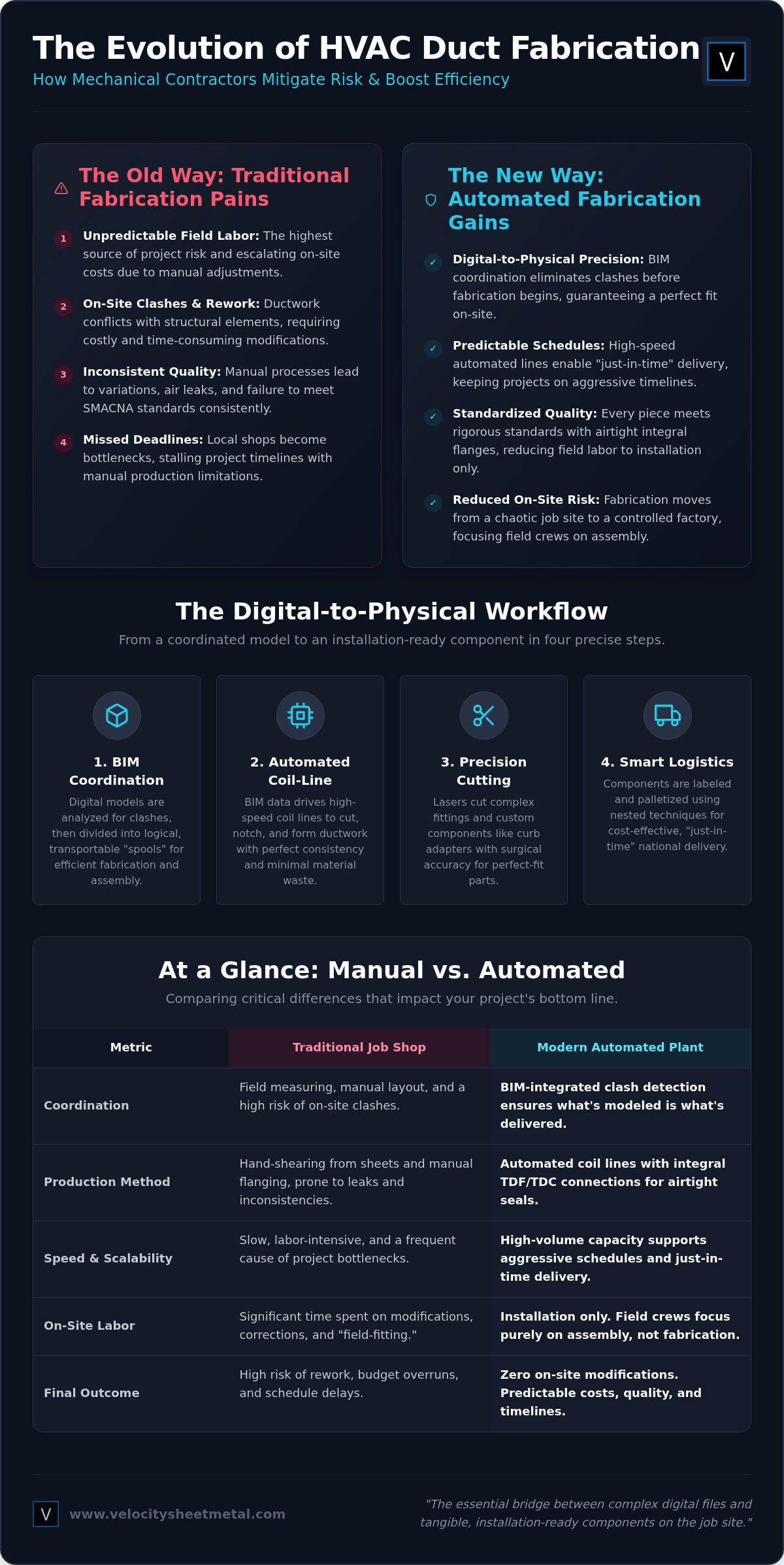
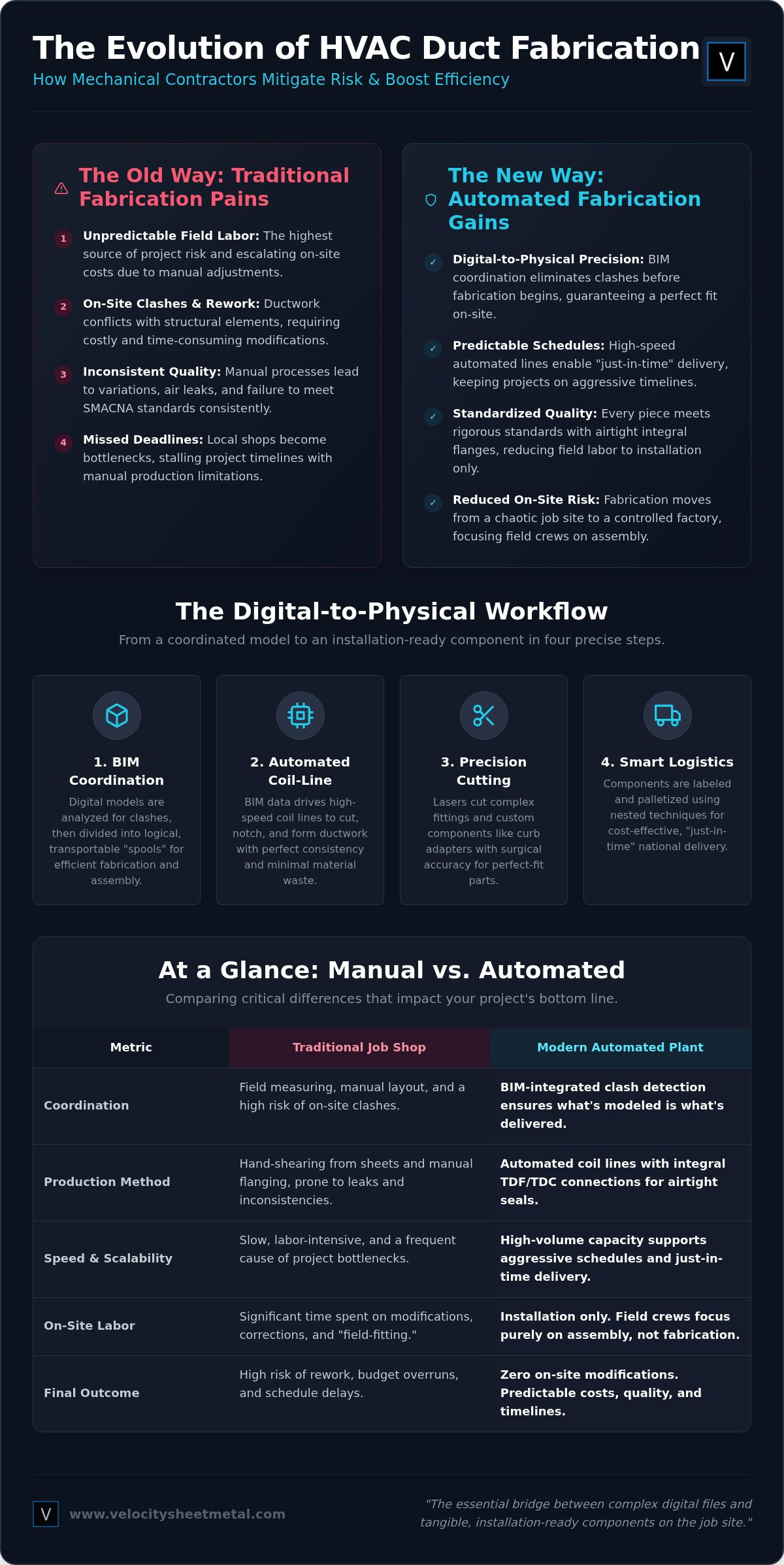
Automated HVAC duct fabrication for mechanical contractors represents a fundamental shift from manual craftsmanship to industrial-scale manufacturing. In 2026, the industry has reached a tipping point. Mechanical contractors no longer view fabrication as a side task for their own crews. Instead, they treat it as a specialized procurement stream. This shift is driven by the need for extreme precision that manual job shops simply cannot replicate at scale. While traditional ductwork fabrication often involves manual layout and hand-shearing, automated systems use digital inputs to drive high-speed production lines with zero margin for error.
Rising on-site labor costs have made every hour spent in the field a liability. By moving the heavy lifting to a controlled factory environment, contractors can focus their field crews on installation rather than modification. Every piece produced must meet rigorous SMACNA standards to ensure structural integrity and pressure class compliance. Outsourcing to a specialized partner ensures these standards are met consistently. It provides a layer of risk management that local, manual shops often struggle to maintain across a high-volume project.
The Cost Efficiency of Automated Coil-Line Production
Automated coil lines are the engine of modern HVAC procurement. These systems unroll massive steel coils, flatten the metal, and perform all necessary notches and beads in a single continuous motion. This process significantly reduces material waste compared to cutting from individual sheets. One of the most critical advantages is the consistency of TDF and TDC integral connections. Unlike manual flanging, which is prone to air leakage and misalignment, automated integral flanges provide an airtight seal every time. For a deeper dive into these technical differences, see our comparison of coil line vs hand fabricated ductwork.
Meeting Tight Construction Schedules with Precision Fabrication
Project timelines in 2026 are more aggressive than ever. Precision HVAC duct fabrication for mechanical contractors allows for a "just-in-time" delivery model. Instead of cluttering a job site with weeks of inventory, components arrive exactly when the installation crew is ready for them. Because every fitting is cut to the exact specifications of the digital model, field-fit time is virtually eliminated. There's no need for "field-measuring" or on-site corrections that stall progress. High-volume capacity ensures that even when a project hits a peak demand phase, the production line keeps pace. It keeps the critical path on track and prevents the bottlenecks that typically occur with smaller, manual operations.
Technical Capabilities: From BIM Coordination to Precision Laser Cutting
The transition from digital design to physical output must be seamless. Modern HVAC duct fabrication for mechanical contractors relies on this data continuity to eliminate the "field-fit" errors that plague traditional projects. It's about more than just cutting metal; it's about executing a coordinated engineering plan with surgical precision. High-precision fabrication also helps maintain good indoor air quality by ensuring the system operates exactly as the designers intended, with tight seals and optimized airflow.
The Digital-to-Physical Workflow: BIM and Spooling
Mechanical spooling is the process of dividing a complex duct system into logical, transportable sections. These "spools" are fabricated in a controlled shop environment and labeled for rapid assembly on-site. When integrated with Building Information Modeling (BIM), this workflow becomes a powerful risk-mitigation tool. Clash detection identifies where ductwork might hit a structural beam or a plumbing line long before the material reaches the job site. This saves thousands in rework costs and prevents project delays. Our software takes these BIM files and converts them directly into fabrication instructions. This direct link ensures that what was coordinated in the model is exactly what arrives on the truck. If you want to understand the full scope of this process, read our BIM for sheet metal fabrication guide.
Custom Laser Cutting for High-Performance Fittings
Traditional plasma tables often leave dross or rough edges that require manual finishing. Precision laser cutting eliminates these secondary processes. It handles complex transition fittings with extreme accuracy, maintaining tolerances that plasma simply cannot reach. This level of detail is critical for national accounts that require standardized parts across multiple locations. Whether it's galvanized steel for a warehouse or specialized stainless steel for a high-performance laboratory, the results are repeatable. Laser technology also allows for tighter nesting of parts. This reduces material scrap and passes the cost savings directly to the contractor.
For industrial projects requiring high-pressure durability, we utilize heavy-gauge CNC press brake bending. This allows for the fabrication of custom plenums and reinforced housings that meet industrial SMACNA standards. You can view our full range of technical services to see how these capabilities fit your next project. This technical foundation ensures that HVAC duct fabrication for mechanical contractors is no longer a bottleneck, but a streamlined part of the construction schedule.
Mechanical Contractor's Guide: Custom Curb Adapters
Rooftop unit (RTU) retrofits often present the highest risk for field delays. A mismatched curb can stall a crane rental and leave a building exposed to the elements. This is where specialized HVAC duct fabrication for mechanical contractors becomes a critical logistics partner. Custom curb adapters serve as the essential transition between an existing roof curb and a new, high-efficiency unit. They eliminate the need for expensive roof modifications while ensuring that airflow remains unobstructed. It's a high-stakes component that demands precision before the equipment ever leaves the ground.
The "on-demand" nature of these projects requires a fabricator who can move as fast as the installation crew. Emergency replacements don't allow for long lead times or "good enough" fits. When a unit fails, the replacement must be seamless. This requires a digital-to-physical workflow that translates field measurements into a structural foundation with zero margin for error. By focusing on factory-controlled production, contractors can avoid the leaks and airflow restrictions that typically plague field-modified curbs.
Sizing and Selection for Rooftop Unit Retrofits
Most RTU replacements happen because of emergency failure or energy efficiency upgrades. In 2026, new units often have different footprints than the legacy equipment they replace. Precise sizing is mandatory to prevent air bypass and water leaks. Contractors must provide exact supply and return dimensions, along with the overall curb footprint. To streamline this, we recommend using our rooftop unit curb adapter checklist to capture every critical measurement before production begins. Accurate data at the start prevents costly field adjustments later. It ensures the internal ductwork aligns perfectly, maintaining the static pressure required for optimal system performance.
Material Durability and SMACNA Compliance
Quality matters when supporting several tons of equipment above a finished space. We fabricate curb adapters from heavy-gauge galvanized steel to ensure long-term structural integrity. These components must meet national SMACNA standards and local requirements for wind and snow loads. Unlike field-assembled kits that rely on fasteners and sealant, factory-welded seams provide a rigid, leak-proof foundation. This level of HVAC duct fabrication for mechanical contractors ensures that the retrofit is as durable as the new RTU it supports. Before placing an order, ensure your specs include the following:
- Existing curb dimensions (OD/ID) and duct locations.
- New unit model number and footprint.
- Required height for clearance or insulation.
- Specific gauge requirements based on unit weight.
- Wind or snow load specifications for your specific climate zone.
Our workflow moves from your measurements to a finished, welded adapter with industrial speed. This ensures your crew stays productive and the building remains secure. By treating the curb adapter as a precision-engineered component rather than a field afterthought, you secure the profitability of the entire retrofit project.
Logistics and National Distribution for Large-Scale Projects
A common misconception in the industry is that shipping fabricated ductwork across state lines is cost-prohibitive. For regional shops with limited capacity, this might be true. However, high-volume HVAC duct fabrication for mechanical contractors utilizes advanced logistics to make national distribution a competitive advantage. The secret lies in nested shipping and high-density palletizing. By nesting smaller fittings inside larger rectangular sections, we maximize every cubic foot of trailer space. This strategy transforms freight from a burden into a manageable line item that is often offset by the labor savings of factory-direct procurement.
Precision labeling and spool mapping are the backbone of this logistics engine. When ductwork is fabricated off-site, it must arrive in a logical sequence. We provide detailed spool drawings that correspond to physical tags on every piece of metal. This ensures that when the truck is unloaded, your field crew isn't searching for parts. They are installing them. This methodical approach reduces on-site sorting time and keeps the project moving at an industrial pace. It creates a seamless link between our Selma, Texas facility and your job site, regardless of the distance.
Standardizing Quality Across National Accounts
National mechanical contracting firms often struggle with inconsistent fabrication quality when relying on a patchwork of local shops. One shop might use different flanging methods while another struggles with SMACNA pressure class requirements. Partnering with a single-source fabricator eliminates these variables. You get the same TDF connections, the same gauge consistency, and the same precision laser-cut fittings on every project. Procurement becomes a repeatable process rather than a series of one-off negotiations. This simplifies your internal billing and allows your project managers to work with a partner who already understands your specific standards and national code requirements.
Shipping and Lead Time Management
Project schedules don't wait for manual labor. Automated shops maintain a speed that traditional job shops simply cannot match. High-speed coil lines and CNC technology allow for faster turnarounds, even when shipping nationwide. Rectangular ductwork is palletized for stability, while spiral duct is bundled to ensure it arrives without damage. We manage the logistics of multi-state footprints by coordinating "just-in-time" deliveries that align with your installation phases. This prevents job site clutter and reduces the risk of material damage during storage. If you are ready to stabilize your supply chain, you can request a shipping quote for your national account today. This level of control ensures that your HVAC duct fabrication for mechanical contractors remains a predictable part of your project's success.
Partnering with Velocity Sheet Metal for Precision Fabrication
Velocity Sheet Metal acts as the essential bridge between your digital design and the physical product. We solve the traditional friction points of HVAC duct fabrication for mechanical contractors by applying industrial pragmatism to every project. With over 50 years of combined management experience, our team has seen every job site collision imaginable. We built our Selma facility to stop those collisions before they start. We don't just sell metal; we sell the certainty that your ductwork will fit the first time it's lifted into the hangers.
Our approach is grounded in modern manufacturing reality. We've replaced the slow, manual administrative delays of the past with a tech-forward workflow that prioritizes your project's critical path. Whether you're managing a single large-scale facility or a multi-state national account, our production line scales to meet your demand. We position ourselves as a reliable, expert operator ready to get to work immediately on your most complex requirements.
Comprehensive Service from Spiral to Custom Fittings
Our capabilities span the entire spectrum of commercial mechanical requirements. We handle everything from high-volume automated coil-line rectangular duct to precision spiral and round fittings. For specialized environments, we provide commercial kitchen ductwork fabrication that meets strict grease-tight standards and precision requirements. Our laser cutting technology and CNC press brake bending allow us to produce complex transition fittings that most shops would have to hand-fabricate. There's no fluff in our delivery. We focus on the technical specs and the delivery schedule with surgical precision.
Get Started: The Velocity On-Boarding Process
We move quickly because your project timeline demands it. The process starts when you submit your BIM files or 2D drawings for a technical review. Our team doesn't just "cut what's on the paper." We perform a thorough review to ensure every spool and component is field-ready upon arrival. This technical oversight is what separates a generic fabricator from a strategic partner. Once approved, your project enters our automated production queue. From digital input to final palletized delivery, the workflow is methodical and transparent. HVAC duct fabrication for mechanical contractors should be a streamlined extension of your own operations. Stop settling for the quality inconsistencies of traditional shops. Request a Quote for Your Next Project and see how a precision-first approach stabilizes your bottom line.
Future-Proofing Your Mechanical Procurement
The construction landscape of 2026 requires a total departure from traditional, manual job-shop bottlenecks. Success now depends on the seamless transition from a digital model to a physical product. By embracing an automated, BIM-integrated workflow, you eliminate the risk of field collisions and the waste of on-site modifications. This precision-first approach ensures that HVAC duct fabrication for mechanical contractors is a predictable component of your project's critical path rather than a source of delay.
Velocity Sheet Metal brings 50+ years of combined industry experience to every order. Our automated coil-line production and national shipping capabilities provide the speed and reliability your national accounts demand. We act as your authoritative expert operator; moving your project from initial concept to installation-ready results with surgical efficiency. It's time to stop fighting field errors and start scaling your operations with a partner who values your time as much as your precision.
Streamline your next project with precision HVAC fabrication from Velocity Sheet Metal.
We're ready to get to work on your next high-volume build. Let's build something precise together.
Frequently Asked Questions
What are the benefits of outsourcing HVAC duct fabrication versus in-house production?
Outsourcing allows contractors to focus on installation while leveraging industrial-scale automation that isn't feasible in a typical job shop. It eliminates the overhead of maintaining a full fabrication facility and the risk of labor shortages. By using a specialized partner, you gain access to high-speed coil lines that produce more consistent joints and flanges than manual labor.
How does BIM coordination reduce total project costs for mechanical contractors?
BIM coordination reduces costs by identifying and resolving spatial clashes in the digital model before any metal is cut. This proactive approach eliminates the "field-fit" labor and material waste that occur when ductwork hits structural steel or plumbing. It transforms on-site work from a series of problem-solving exercises into a streamlined assembly process, significantly lowering total project man-hours.
What is the typical lead time for custom curb adapters on a commercial retrofit?
Typical lead times for custom curb adapters vary based on project complexity, but our streamlined workflow prioritizes rapid turnaround for retrofit projects. We understand that emergency RTU replacements require immediate action to keep buildings operational. By providing accurate measurements through our standard checklist, you enable us to move from digital design to a factory-welded foundation with industrial speed.
Do you provide nationwide shipping for large-volume rectangular duct orders?
Yes, we provide nationwide shipping for high-volume HVAC duct fabrication for mechanical contractors by utilizing high-density nesting and strategic palletizing. This logistics approach maximizes trailer space and reduces freight costs per pound of steel. Our Selma, Texas facility is positioned to serve national accounts efficiently, ensuring that standardized, high-quality ductwork arrives at your job site exactly when your crew is ready for installation.
What standards do you follow for commercial ductwork fabrication?
Every piece of ductwork we produce follows rigorous SMACNA standards to ensure structural integrity and pressure class compliance. We focus on industrial-grade specifications that meet or exceed local building codes across the country. This commitment to quality ensures that your system performs as engineered, minimizing air leakage and maintaining the airflow performance required for modern commercial energy standards.
Can you fabricate custom fittings from my existing BIM or CAD files?
We can fabricate custom fittings directly from your existing BIM or CAD files to ensure total data continuity. Our software integrates with industry-standard formats to translate your coordinated designs into precise fabrication instructions. This "digital-to-physical" workflow eliminates manual data entry errors and ensures that the finished product matches your model with surgical accuracy.
How do you handle shipping for spiral ductwork to prevent damage?
We prevent damage to spiral ductwork by using specialized bundling and bracing techniques during the loading process. Spiral duct is inherently rigid, but its length makes it vulnerable to impact during transit. Our logistics team secures these loads to prevent shifting, ensuring that every section arrives with its roundness intact and ready for immediate connection.
What materials are available for custom laser-cut HVAC components?
Our custom laser-cutting services handle a variety of materials, including galvanized steel, stainless steel, and aluminum. This versatility is essential for HVAC duct fabrication for mechanical contractors working in specialized environments like commercial kitchens or laboratories. Laser technology provides cleaner edges and tighter tolerances than traditional plasma tables, regardless of the material thickness or fitting complexity.