Precision Bending for OEM: 2026 Technical Procurement Guide
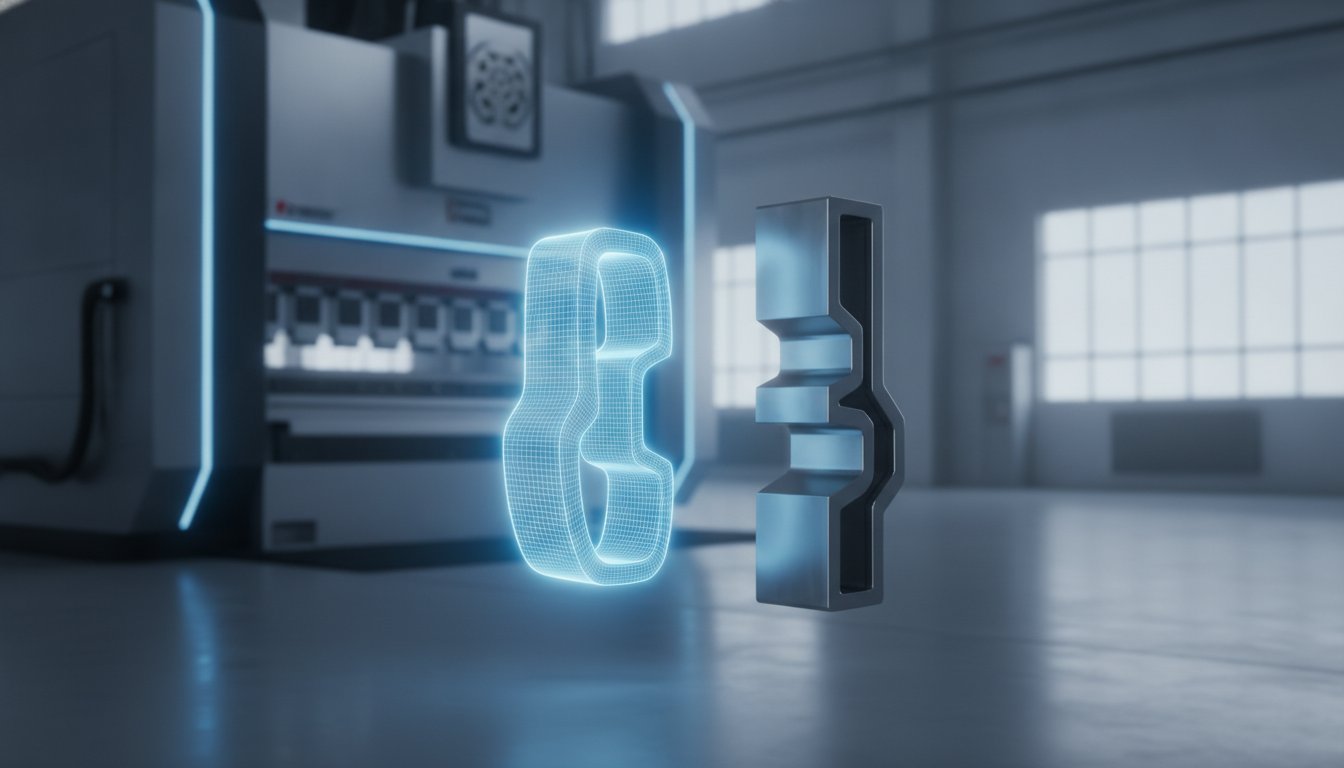
In 2026, the success of an OEM production line isn't decided on the shop floor. It's won or lost in the digital environment long before the press brake engages the metal. You've likely dealt with the headache of inconsistent bend angles across material batches or surface marking that ruins aesthetic components. These delays in sourcing precision bending for OEM components aren't just an inconvenience; they're a threat to your scalability. We understand that your reputation depends on components that fit perfectly every time.
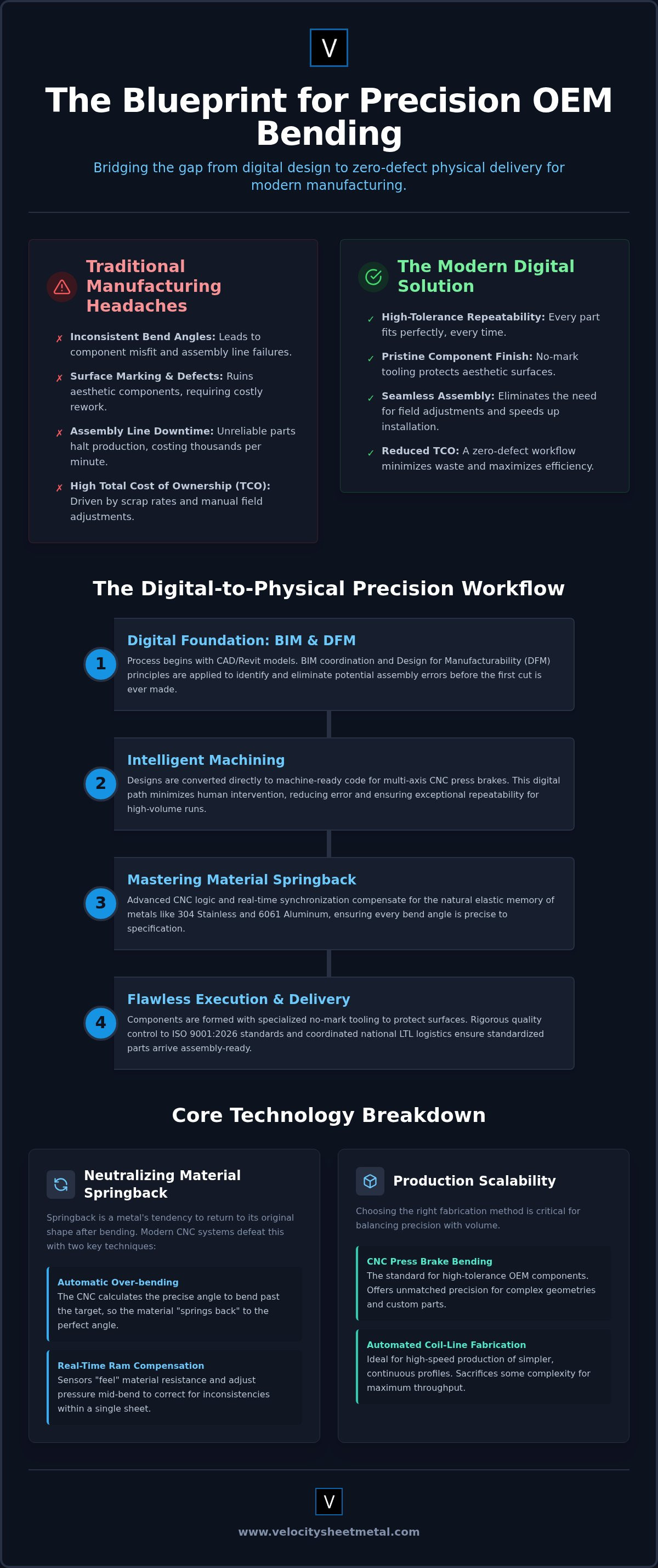
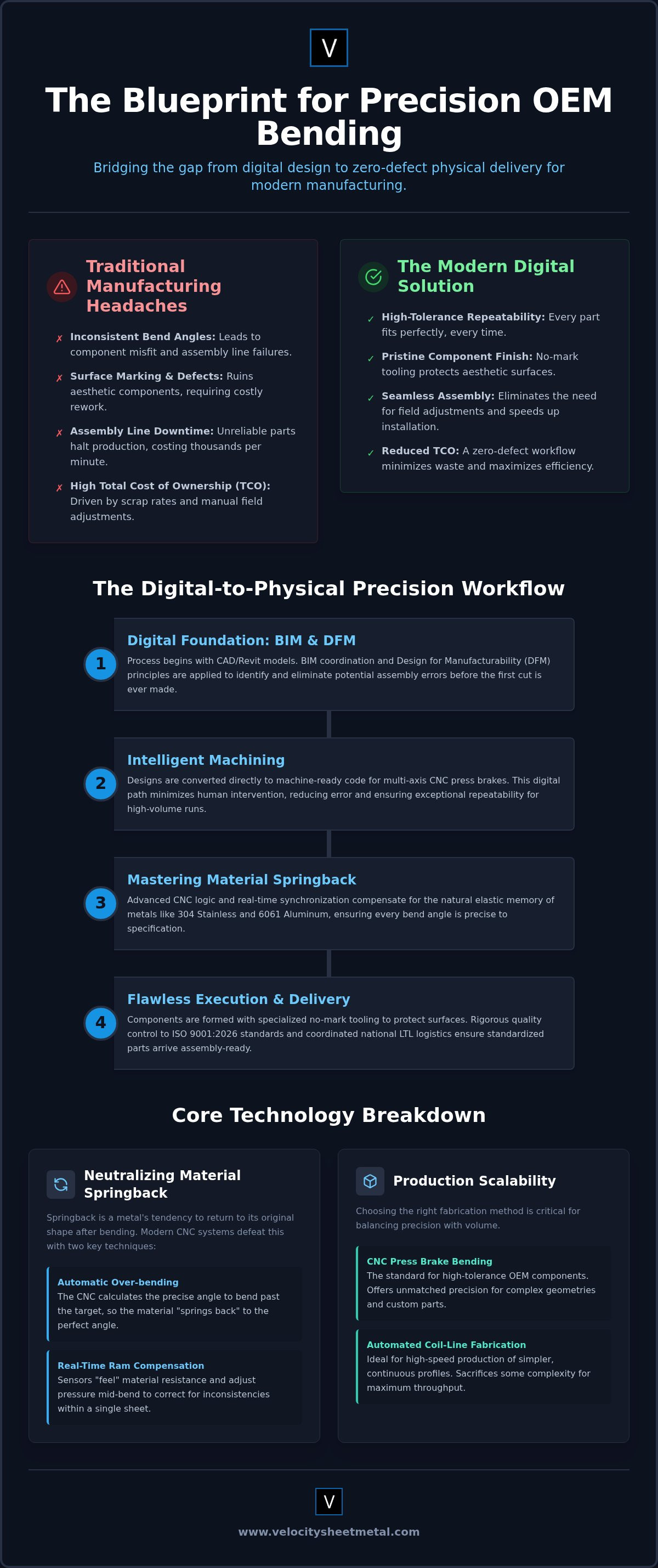
This technical procurement guide provides the roadmap to bridging the gap between digital design and physical delivery. You'll learn how a "Digital Twin" approach and BIM coordination eliminate mechanical error before production starts. We'll cover the transition to ISO 9001:2026 standards and the logistical strategies required for a zero-defect workflow. From initial Revit 2026.5 modeling to national LTL freight coordination, this guide outlines how to build a seamless supply chain that grows with your demand.
Key Takeaways
- Identify why multi-axis CNC technology is the new standard for meeting the strict tolerance requirements of modern OEM production.
- Learn to manage material springback through real-time CNC synchronization and specific alloy compensation protocols to ensure part accuracy.
- Evaluate the scalability of your production by comparing the advantages of CNC press brake bending versus automated coil-line fabrication.
- Discover how BIM coordination and DFM principles optimize precision bending for OEM components to eliminate assembly errors before the first cut.
- Master the logistical strategies needed to maintain standardized quality across national shipping routes for a more resilient assembly line.
The Role of Precision Bending in Modern OEM Component Manufacturing
Precision bending for OEM components is no longer a simple mechanical task. It's the technical integration of multi-axis CNC technology and sophisticated material science. Modern OEMs are rapidly moving away from traditional manual forming. They're choosing high-precision CNC press brakes to secure a level of repeatability that older methods simply can't provide. This shift isn't just about accuracy. It's about survival in a market where assembly line downtime costs thousands per minute.
When you source components, you aren't just buying bent metal. You're buying assembly line efficiency. High-tolerance parts ensure that every bracket, housing, and transition fits perfectly. This precision directly impacts your Total Cost of Ownership (TCO) by eliminating the need for field adjustments and reducing scrap rates. Whether you need custom structural brackets or complex HVAC transition housings, the physics of Bending (metalworking) must be controlled through automated logic, not manual guesswork.
Standardizing Quality for National OEM Accounts
Reliability requires standardized quality. For national OEM accounts, a part produced on Monday must be identical to a part produced three months later. We achieve this through rigorous material sourcing and calibrated CNC profiles. Consistent material properties are the foundation of predictable bending. Without them, springback variations create assembly nightmares. By standardizing these fabrication protocols, we reduce field collisions and ensure that large-scale installations proceed without mechanical interference.
From CAD to Component: The Precision Workflow
The bridge between a digital file and a tangible product is the precision workflow. We move your design from CAD files directly to machine-ready code. This digital-to-physical path reduces manual intervention. It minimizes the human error that often plagues high-volume production runs. For climate control OEMs, our automated rectangular duct production utilizes this same logic. We turn complex BIM data into spool drawings and finished components with surgical speed. It's a seamless transition from the initial digital concept to the final physical result.
Technical Specifications: Solving the Challenges of Material Springback
Material science is the invisible variable in every production run. When you source precision bending for OEM components, you're fighting the metal's natural tendency to return to its original shape. Every alloy, from 304 stainless steel to 6061 aluminum, possesses a unique elastic memory. Understanding the hows and whys of springback is critical for maintaining the tight tolerances required for 2026 mechanical fit-up. Without precise compensation, a batch of parts can vary by several degrees, leading to assembly failures and costly rework.
Modern fabrication relies on real-time CNC synchronization to solve these variances. This technology detects thickness fluctuations within a single sheet of metal and adjusts the ram depth instantly. For aesthetic or pre-coated components, we utilize no-mark tooling. This specialized equipment prevents surface marring during the forming process. It ensures your parts arrive assembly-ready without the need for secondary finishing. This level of control is essential for OEMs who prioritize both structural integrity and visual quality in their final products.
Neutralizing Springback via Advanced CNC Logic
Advanced press brakes calculate over-bending angles automatically by analyzing the material's yield strength and grain direction. Bending against the grain provides higher strength but requires different pressure profiles than bending with the grain. Real-time Compensation is the automated adjustment of ram depth during the stroke. This logic allows the machine to feel the resistance of the metal and adjust the pressure mid-bend. It ensures that the first part in a high-volume run is identical to the thousandth, regardless of slight material batch inconsistencies.
Managing Tolerances for Complex Mechanical Assemblies
Geometric integrity depends on more than just the bend angle. We maintain strict hole-to-bend and edge-to-bend relationships to prevent dimensional "creep" in complex assemblies. Multi-axis back-gauging allows for the precise positioning of asymmetrical parts. This ensures every flange, tab, and notch aligns perfectly with your original CAD specifications. If these variables aren't controlled, you face common precision metal punching and bending defects that stall your production line. Our workflow integrates these technical benchmarks to keep your assembly floor running at peak efficiency. You can view our technical bending capabilities to see how we handle high-tolerance OEM requirements.
Evaluating CNC Metal Forming Services for High-Volume Production
Scaling production from a single prototype to a mass-market run is where most supply chains break. Success depends on selecting the right forming method for your specific geometry. Advanced manufacturing systems allow us to pivot quickly between complex, low-volume brackets and high-speed, high-volume production. This flexibility is the core of precision bending for OEM components in 2026. By utilizing an on-demand production model, you can significantly reduce inventory carrying costs. You order what you need for the week's assembly, and we deliver it with surgical timing.
Quality control isn't a final step; it's an integrated process. We use first-article validation to lock in the setup before the full run begins. During production, in-process Statistical Process Control (SPC) monitors every bend. This ensures that the physical part never drifts from the digital master. It's a methodical approach that guarantees zero-defect parts for your assembly floor. When you source precision bending for OEM components, you're investing in a workflow that prioritizes repeatable accuracy over mere output volume.
CNC Press Brake Capabilities and Limits
Choosing the right machine involves balancing bed length and tonnage requirements. For heavy-gauge industrial components, you need the raw power of a high-tonnage brake without sacrificing the accuracy of CNC back-gauging. Our CNC press brake services for OEMs provide this balance across a wide range of material thicknesses. We help you decide between air bending for versatility or bottoming for extreme precision in specific mechanical tolerances. It's about matching the tool to the task to ensure repeatable results.
Automated Coil-Line Integration for HVAC OEMs
When speed is the primary requirement, automated coil line duct fabrication is the superior choice. This system moves material from raw coils to finished rectangular duct in one continuous flow. It reduces waste through optimized nesting and automated shearing, which directly lowers your material costs. For national HVAC accounts, this means standardized quality that fits perfectly into standardized installations. It's the most efficient way to handle high-volume climate control orders without the bottleneck of manual forming.
The Digital Advantage: BIM Coordination and DFM for OEM Success
Modern manufacturing demands a "Digital Twin" approach. BIM coordination acts as the critical brain behind precision bending for OEM components. It bridges the gap between high-level architectural design and the physical reality of the factory floor. By identifying mechanical conflicts in a virtual environment, we eliminate the risk of parts that don't fit during final assembly. This digital-first workflow ensures that every flange and bend is accounted for before the first piece of metal is cut. It's the only way to manage the complexity of modern commercial HVAC assemblies without incurring the high costs of field rework.
Designing for Manufacturing (DFM) is the second pillar of this digital strategy. We don't just execute your files; we optimize them. By reviewing part geometry early, we can suggest modifications that improve bending efficiency. This might involve simplifying a bend sequence or standardizing a radius to reduce machine setup time. These small adjustments lead to significant savings in labor and material waste. When your digital models are optimized for our CNC press brakes, you get a faster, more reliable path from concept to completion. You can partner with us for precision OEM fabrication to leverage these digital efficiencies.
Mechanical Spooling and BIM Integration
Converting a complex 3D model into machine-ready spool drawings is a precision task. We use BIM data to generate accurate shop instructions that leave no room for interpretation. This process includes BIM clash detection for HVAC fabrication, which identifies overlaps and interference points early. For national accounts, this integration ensures identical production standards regardless of project scale. It allows us to move from a Revit 2026.5 file to a finished physical component with absolute geometric certainty. The result is a streamlined production line that delivers exactly what the model promises.
Optimizing OEM Parts for Rapid Production
Efficiency in high-volume production requires a focus on repeatability. We work with your engineering team to standardize radius requirements across part families. This minimizes tool changes and keeps our CNC press brakes running at peak capacity. Simplified bend sequences further reduce machine setup time and labor costs. DFM feedback often reveals opportunities to reduce part weight without sacrificing structural integrity. By optimizing these variables, we help you build a more scalable production model that responds quickly to market demand. It's a methodical process that turns digital intelligence into physical performance.
Velocity Sheet Metal: National Logistics for OEM Component Delivery
Velocity Sheet Metal bridges the gap between digital design and nationwide distribution. We support national accounts by maintaining identical production standards across every order. With over 50 years of combined industry experience, we understand that precision bending for OEM components requires more than just high-end machinery. It requires a logistical infrastructure that ensures your parts arrive on time and in perfect condition. Our on-demand production model meets the aggressive timelines of modern assembly lines. This allows you to scale production without the burden of excessive inventory or administrative delays. We move your project from raw material to refined component with surgical speed.
Our operation acts as an authoritative expert operator on your behalf. We don't just fabricate parts; we manage the transition from a digital file to a tangible product. This pragmatism is grounded in the reality of modern manufacturing, where speed and accuracy are non-negotiable. By integrating our CNC bending capabilities with a robust shipping strategy, we provide the reliability that national OEMs demand. Each shipment is a reflection of our "can-do" attitude and our obsession with technical detail.
Nationwide Shipping and Supply Chain Security
Logistics are often the weakest link in a manufacturing supply chain. We eliminate this vulnerability through specialized packaging and crating protocols designed specifically for high-tolerance components. These measures prevent shipping damage that could compromise the geometric integrity of your parts. For our national accounts, we provide reliable lead times that ensure zero downtime on your assembly floor. By leveraging national distribution networks, we offer predictable pricing and production priority. It's a methodical approach to supply chain security that protects your bottom line from regional market fluctuations. From initial design review to final crating, every step is controlled and repeatable.
Custom Solutions for Industrial and HVAC OEMs
Our capabilities extend beyond standard brackets. We specialize in fabricating custom curb adapters and specialized HVAC fittings for complex industrial projects. By combining scalable laser cutting with CNC bending, we provide a one-stop shop for on-demand part production. You get direct access to our engineering expertise to solve the most difficult fabrication challenges. Whether you need a single prototype or a mass-market run, we deliver the technical reliability your assembly line demands. We act as the essential bridge between your digital models and the physical components that drive your business forward.
Future-Proofing Your OEM Production with Precision Bending
Success in the 2026 OEM landscape requires more than just raw fabrication power. It demands a seamless integration of BIM coordination and high-tolerance CNC execution. We've explored how a digital-to-physical workflow eliminates mechanical error and how advanced CNC logic neutralizes the physics of material springback. By prioritizing these technical benchmarks, you ensure that every part fits perfectly into your assembly line, regardless of the production volume or geographic destination. It's the difference between a stalled project and a scalable, efficient workflow.
Velocity Sheet Metal provides the essential bridge between your CAD files and tangible components. With 50+ years of combined industry experience and robust nationwide shipping capabilities, we're equipped to support your most complex industrial projects. Our standardized quality protocols ensure that national accounts receive consistent, zero-defect parts with every order. It's time to move past the administrative delays and technical inconsistencies of traditional forming. We act as your authoritative expert operator on the factory floor.
Request a quote for your national OEM account today and experience the speed of on-demand precision bending for OEM components. We're ready to help you build a more resilient, scalable supply chain that keeps your production lines moving forward.
Frequently Asked Questions
What are the typical precision bending tolerances for OEM components in 2026?
Standard CNC press brake tolerances in 2026 often target ±0.05 mm for high-performance industrial runs. Achieving tighter tolerances, such as ±0.01 mm, is possible but significantly increases production costs due to the required precision and inspection. We utilize real-time CNC synchronization to maintain these specs across high-volume batches. This level of accuracy is essential for ensuring that precision bending for OEM components meets the strict mechanical fit-up requirements of your assembly line.
How does Velocity Sheet Metal handle national shipping for large sheet metal parts?
We utilize specialized crating and packaging protocols to secure high-tolerance components during transit. Our national logistics strategy involves less-than-truckload (LTL) freight and dedicated carriers to ensure reliable delivery across the United States. By leveraging national accounts, we provide predictable lead times and production priority. This systematic approach prevents shipping damage and ensures that your components arrive ready for immediate integration into your production flow without administrative delays.
Can BIM coordination reduce the cost of custom OEM part production?
BIM coordination serves as the digital brain of the fabrication process, identifying mechanical clashes before production begins. By converting 3D models into machine-ready spool drawings, we eliminate the need for costly field adjustments and reduce material waste. This "Digital Twin" approach allows for Design for Manufacturing (DFM) optimizations that lower labor costs. Ultimately, BIM reduces the Total Cost of Ownership by ensuring every part fits the digital model perfectly the first time.
What materials are best suited for high-precision CNC press brake bending?
High-precision CNC press brake bending is most effective with materials like Grade 304 stainless steel, various aluminum alloys, and hot-rolled coil steel. Each material has unique springback characteristics that our multi-axis CNC systems calculate automatically. We also process copper for specialized industrial applications. Using standardized material batches is critical for maintaining consistent results across large-scale production runs, as it allows for more predictable bending profiles and tighter tolerances across every part.
How do you prevent surface marking on aesthetic OEM metal components?
We utilize no-mark tooling and specialized urethane dies to prevent surface marring on aesthetic or pre-coated components. This is particularly important for OEMs producing visible exterior housings or high-finish architectural parts. Protective films can also be applied during the laser cutting and bending stages to maintain surface integrity. These protocols ensure that your parts meet visual specifications without requiring secondary finishing or polishing after they leave our facility, saving you time and labor.
What information is required to receive a precision bending quote for national accounts?
To provide an accurate quote, we require detailed CAD or BIM files, specific material grades, and desired tolerances. Providing information on annual volume and batch sizes helps us optimize production scheduling and pricing for national accounts. If your project involves complex HVAC assemblies, including spool drawings can further accelerate the technical review process. This data allows our engineering team to evaluate the project's feasibility and provide a methodical production roadmap with surgical precision.
Does Velocity Sheet Metal support rapid prototyping for new OEM designs?
We support rapid prototyping through our on-demand part production model and digital-to-physical workflow. This allows OEMs to test new designs and verify mechanical fit-up before committing to high-volume production runs. Our custom laser cutting and CNC bending capabilities enable us to produce single prototypes with the same precision as mass-market components. This speed is essential for reducing your time-to-market and refining product geometry based on real-world DFM feedback before full-scale manufacturing begins.
How does automated coil-line production differ from custom CNC bending for OEMs?
Automated coil-line production is designed for high-speed, high-volume manufacturing of rectangular ductwork directly from raw metal coils. In contrast, custom CNC bending uses press brakes to form complex, asymmetrical components or heavy-gauge parts. While the coil-line excels at standardizing rectangular profiles for HVAC OEMs, CNC bending provides the flexibility needed for custom brackets, housings, and specialized fittings. Both systems are integrated into our BIM-driven workflow to support diverse and demanding OEM requirements.