Custom Metal Panel Fabrication: The 2026 Industrial Explainer
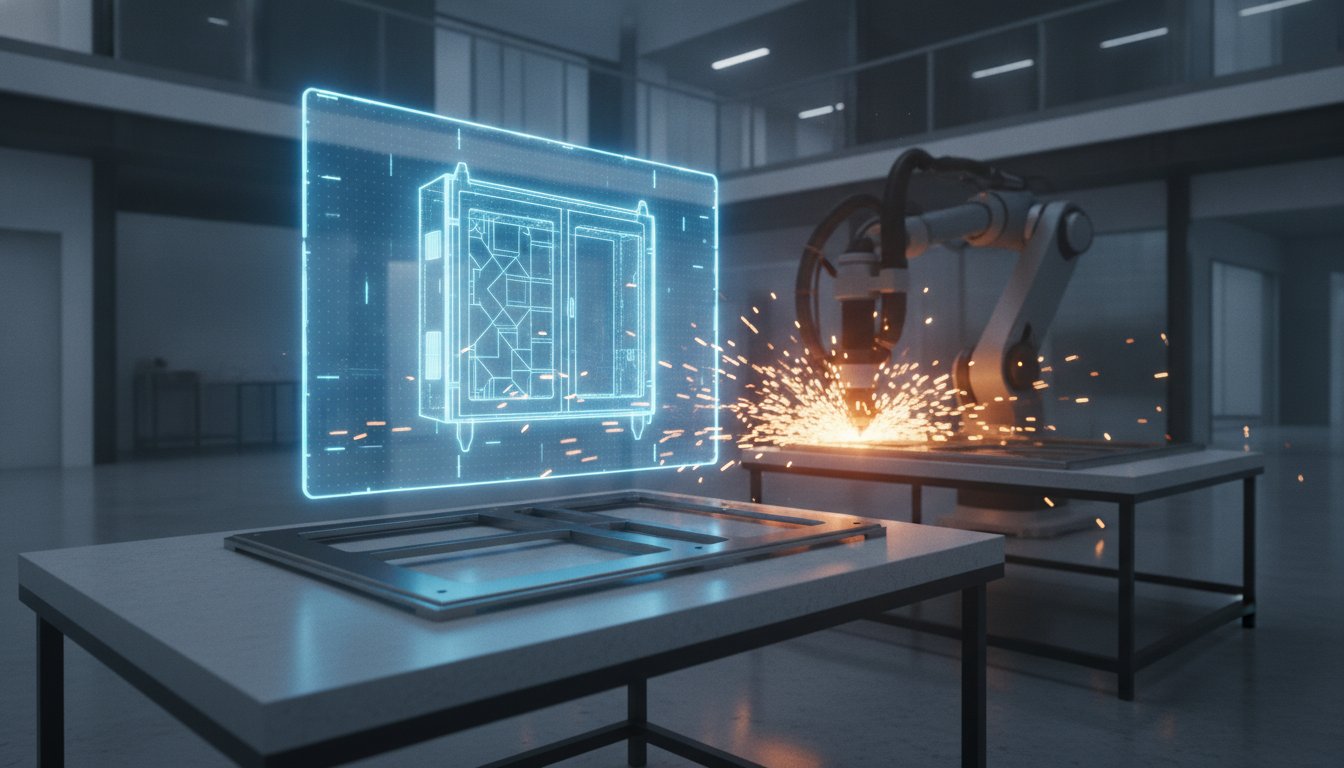
Precision in the field isn't born on the job site. It's engineered in the digital twin before the first sheet of steel ever touches a laser. If you're still relying on manual measurements and local job shops, you're likely battling the same old industrial ghosts: field collisions, inconsistent tolerances, and lead times that stall your momentum. Relying on outdated methods for custom metal panel fabrication is a recipe for wasted material and blown budgets in an era where speed and accuracy are the only currencies that matter.
We know the frustration of a high-end BIM model that doesn't survive the transition to the shop floor. This guide changes that dynamic. You'll learn to master the technical essentials of modern fabrication, from digital-to-physical workflows to high-precision laser cutting and national scalability. We're moving beyond the manual craft mentality to a standardized, automated approach that ensures every panel fits perfectly the first time. We'll break down how BIM-to-fabrication integration eliminates waste, the role of automated CNC bending in 2026, and how to secure consistent quality for industrial enclosures across your entire national portfolio.
Key Takeaways
- Identify how BIM coordination creates a digital twin to eliminate field collisions before production begins.
- Execute high-precision custom metal panel fabrication through automated laser cutting and CNC press brake workflows.
- Reduce field waste by applying DFM principles that optimize bend radii and material strength-to-weight ratios.
- Bridge the gap between digital CAD files and physical components for specialized HVAC and OEM applications.
- Scale national operations with centralized fabrication that guarantees consistent quality and rapid delivery across every project site.
What is Custom Metal Panel Fabrication in 2026?
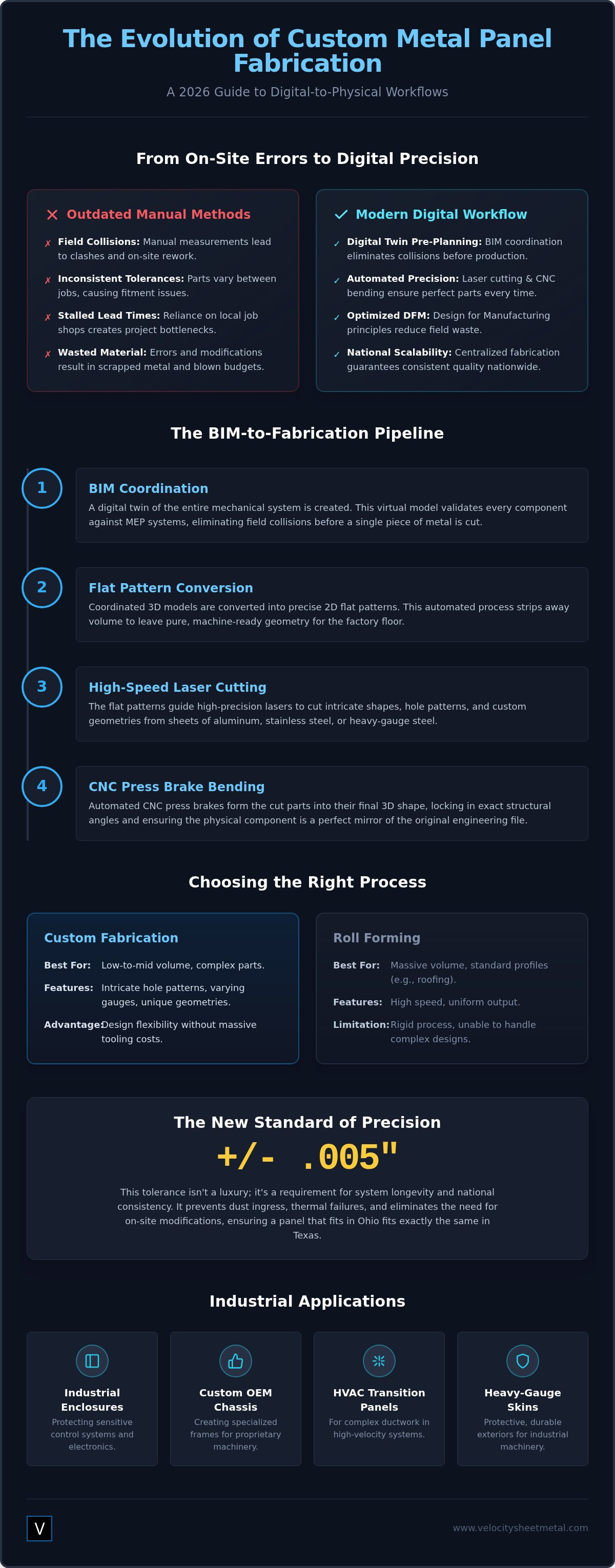
In 2026, custom metal panel fabrication represents the intersection of high-level engineering and automated production. It's no longer a manual craft performed in a disconnected job shop. It's a digital-to-physical workflow. We define this process as the creation of non-standard metal components through high-precision laser cutting and CNC press brake bending. It's the technical response to industrial problems that standard, off-the-shelf parts can't solve. The industry has moved from static shop drawings to living digital twins. This shift ensures every cut and bend is validated in a virtual environment before the first sheet of metal is ever loaded into a machine.
Modern HVAC and OEM projects demand this level of customization as a standard. Whether it's a unique transition for a complex mechanical room or a protective skin for proprietary machinery, custom is the new baseline. Precision is no longer optional. Key components in this category include:
- Industrial enclosures for sensitive control systems
- Custom chassis for specialized OEM equipment
- Transition panels for high-velocity HVAC systems
- Heavy-gauge specialized skins for industrial environments
The Distinction: Custom Fabrication vs. Roll Forming
Roll forming is built for speed and massive volume. It's the right choice for miles of standard roofing or uniform siding profiles. But roll forming is rigid. It can't handle complex hole patterns, varying gauges, or unique geometries. This is where custom fabrication takes over. We utilize CNC technology to accommodate intricate designs that roll formers simply can't touch. When your project requires tight tolerances and low-to-mid volume runs, custom is the superior choice. It provides the flexibility to iterate designs quickly without the massive tooling costs associated with traditional mass production. Metal fabrication processes have evolved, and the ability to pivot between different geometries is now a core requirement for industrial speed.
The Role of Precision in Modern Infrastructure
Precision isn't a luxury; it's a requirement for system longevity. Custom panels often serve as the primary defense for sensitive electronics in industrial enclosures. A panel that doesn't seat perfectly can lead to dust ingress or thermal management failures. We push for tolerances as tight as +/- .005 inches in mechanical assemblies to prevent these issues. Engineers now prioritize standardized fabrication for national rollouts to ensure consistency across every site. If a panel fits in a facility in Ohio, it must fit exactly the same way in a facility in Texas. This level of repeatability reduces field waste and eliminates the need for on-site modifications. It's about moving the labor from the field to the controlled environment of the factory floor.
The Digital Workflow: From BIM Models to Laser Precision
The digital workflow for custom metal panel fabrication is a four-phase production line that starts in a virtual environment. We don't just cut metal; we execute a data-driven process that begins with Phase 1: BIM coordination. This creates the digital twin of the mechanical system. Phase 2 converts these 3D models into precise flat patterns. We strip away the volume to leave machine-ready geometry. Phase 3 moves to high-speed laser cutting for intricate patterns. Finally, Phase 4 utilizes CNC press brake bending to lock in exact structural angles. This methodical progression ensures that the physical part is a perfect mirror of the engineering file.
BIM Coordination: Eliminating Field Collisions
Utilizing BIM for sheet metal fabrication ensures every panel arrives on-site ready for immediate installation. We've moved past the era of manual spool drawings. Today, we generate machine-ready files directly from the coordinated model. This eliminates the "measure twice, cut once" mantra because measurements are validated against the entire building's MEP systems first. Digital pre-planning significantly reduces field waste in complex industrial environments. If you need to bridge the gap between a CAD file and a finished part, our BIM-to-fab capabilities are designed for that exact purpose.
Precision Laser Cutting for Complex Panels
Standard punching machines are a relic of the past for high-complexity work. We rely on precision laser cutting services to handle aluminum, stainless steel, and galvanized steel with surgical accuracy. Fiber laser technology in 2026 delivers cutting speeds of up to 2,000 inches per minute on thin-gauge materials, slashing production timelines without sacrificing edge quality. This speed allows us to process intricate geometries that would otherwise require multiple tool changes on a turret press. The Fabricators & Manufacturers Association, International (FMA) highlights that this software-driven automation is what allows modern shops to maintain tight tolerances across massive national orders. Once the laser finishes the cut, the part moves to the CNC press brake. Automated back-gauging ensures every bend is identical, providing the repeatability your OEM chassis or HVAC plenums require.
Material Selection and Design for Manufacturing (DFM)
Material choice isn't just about the spec sheet. It's about how that metal behaves under a fiber laser and on a CNC press brake. Successful custom metal panel fabrication requires a calculated balance between raw performance and manufacturability. We analyze material properties through the lens of the specific application. For industrial panels, this means weighing strength-to-weight ratios against corrosion resistance. A panel that's over-engineered is just as problematic as one that's under-specced. It adds unnecessary weight, increases shipping costs, and complicates the bending process. We focus on selecting the optimal gauge thickness that provides structural integrity without ballooning the project budget.
Design for Manufacturing (DFM) is the bridge between a good idea and a profitable product. We use advanced nesting software to maximize sheet utilization. This technology calculates the most efficient geometric orientation for parts on a raw sheet of metal. By reducing scrap rates, we lower the total cost per part. DFM also involves optimizing hole placement and bend radii. If a design requires a unique tool change for every single bend, the lead time will suffer. We aim for standardized geometries that allow for continuous production runs. This methodical approach ensures that your panels are built for speed and precision from the very first cut.
Common Materials in Panel Fabrication
Galvanized steel remains the industrial workhorse. It's the primary choice for HVAC transition panels due to its inherent rust resistance and cost-effectiveness. When weight is the primary constraint, we pivot to aluminum. It's the ideal material for custom sheet metal enclosures for electronics where thermal conductivity and lightness are critical. For food-grade environments or high-corrosion chemical processing plants, stainless steel is the only viable option. Each material requires specific laser settings and bend allowances to maintain the tight tolerances we demand.
Engineering for Efficiency
Precision is vital, but over-tolerance is a common pitfall. If a panel only requires a +/- .030 tolerance for a non-critical fit, specifying +/- .005 adds unnecessary inspection time and machine slowdowns. We guide engineers to simplify geometries whenever possible. Complex, multi-stage bends increase the risk of common press brake forming defects like cracking or springback. By utilizing standard tooling and uniform bend radii across a part, we accelerate production speed. This logic moves the project from the design phase to the shipping dock faster, ensuring your national rollout stays on schedule.
Industrial Applications: Where Custom Panels Drive Efficiency
Industrial efficiency isn't just about speed; it's about the precision of the components. Custom metal panel fabrication provides the necessary bridge for systems that standard catalog parts cannot accommodate. We see this most clearly in high-growth sectors where thermal management and environmental protection are non-negotiable. Data centers, for example, rely on specialized airflow management panels to maintain server rack temperatures. A gap of even a fraction of an inch can compromise cooling efficiency. Similarly, the renewable energy sector requires rugged, weather-tight enclosures for solar inverters and battery storage systems. These aren't just boxes; they are engineered shields that must withstand decades of environmental exposure while maintaining structural integrity.
The manufacturing floor also demands specialized solutions. Protective equipment panels and chassis for industrial machinery must be fabricated to exact specifications to ensure operator safety and equipment longevity. These components often require intricate hole patterns for venting or cabling that standard parts simply don't offer. By utilizing automated laser cutting, we can produce these complex geometries with zero tool-wear degradation, ensuring the last part in a run is as accurate as the first. This level of repeatability is essential for national accounts that need to maintain standardized equipment across multiple facilities.
Custom HVAC Solutions and Curb Adapters
Mechanical contractors often face the challenge of retrofitting modern, high-efficiency equipment onto aging infrastructure. This is where custom curb adapters and plenums become essential. Standardizing HVAC duct fabrication for mechanical contractors across large national footprints ensures that every rooftop unit (RTU) transition fits perfectly, regardless of the site's original configuration. Precision-fit transition panels eliminate the need for field modifications. These on-site "hacks" are the primary source of labor cost overruns and air leakage. By moving this complexity into a controlled fabrication environment, we ensure that every assembly meets the exact specifications of the mechanical design.
OEM and On-Demand Part Production
For OEM manufacturers, the transition from a single prototype to high-volume production must be seamless. Consistency across thousands of identical units is only possible through automated laser cutting and CNC bending. We specialize in custom sheet metal chassis fabrication for electronics, providing the rigid protection and thermal venting required for industrial machinery. This on-demand part production model allows national accounts to maintain lean inventories while ensuring a reliable supply of mission-critical components. The ability to scale production while maintaining tight tolerances is what separates a strategic partner from a simple job shop. If you are ready to standardize your components and eliminate field errors, partner with Velocity Sheet Metal for your next national project.
Scaling Production: National Fabrication and Quality Standards
Scaling custom metal panel fabrication for national accounts requires more than just a large shop floor. It requires a centralized production strategy that eliminates the variability inherent in regional job shops. When a project spans multiple states, relying on a patchwork of local vendors introduces a high risk of inconsistent tolerances and material mismatches. We solve this by centralizing the digital-to-physical workflow. This ensures that a panel fabricated for a facility in Seattle is identical to one delivered to Miami. Centralization allows us to maintain a single source of truth within the BIM model, pushing validated data directly to our automated lines for total repeatability.
Centralized vs. Regional Fabrication
Using multiple local shops for a single national rollout creates an administrative nightmare. It forces project managers to juggle different lead times, varying quality standards, and fragmented shipping protocols. By utilizing centralized CNC press brake services for OEMs, you reduce administrative overhead and achieve genuine economies of scale. High-volume automated lines don't just work faster; they work more predictably. We leverage this automation to ensure that every bend and every cut remains within the specified tolerance, regardless of the order size. This predictability is the foundation of successful national account management.
Standardizing Quality Across the US
Quality control in 2026 is a data-driven discipline rather than a manual inspection. We implement rigorous QC checks for every custom run, utilizing automated technology to verify dimensions against the original CAD file. Standardizing quality across the US means removing the "human element" from repetitive tasks. We use standardized materials and automated precision to guarantee that the panel made today matches the one made next month. This consistency is critical for OEM components that must integrate into larger, complex mechanical assemblies without field adjustments.
Logistics is the final, critical phase of the fabrication process. Protecting custom panels during transit requires specialized packaging and a reliable national shipping network. We don't just drop parts in a box; we engineer the crating to ensure that high-precision edges and finishes arrive at the site without damage. Velocity Sheet Metal acts as the essential bridge between your digital design and national delivery. We provide the technical expertise of a high-end engineering firm with the practical throughput of a modern automated factory. Partnering with a national fabricator for on-demand production allows you to scale your operations without the burden of maintaining your own manufacturing infrastructure.
Standardizing Your National Fabrication Strategy
Modern industrial production in 2026 demands a shift from manual craftsmanship to automated precision. We've explored how a BIM-integrated workflow bridges the gap between a digital file and a physical part. This ensures that custom metal panel fabrication is no longer a source of field collisions or material waste. By centralizing production, national accounts can finally achieve the standardized quality and repeatable results required for complex HVAC and OEM systems.
Precision isn't just a technical specification; it's a strategic advantage. Utilizing automated laser cutting and coil-line technology allows you to move parts from the design phase to the shipping dock with surgical speed. We've built our process to handle the heavy lifting of industrial coordination. This allows your team to focus on the final installation. Whether you're retrofitting a mechanical room or scaling a new machinery line, the right fabrication partner acts as the essential link in your supply chain.
Ready to eliminate field errors and streamline your procurement? Request a Quote for Your Custom Metal Panel Project today. We're ready to help you scale.
Frequently Asked Questions
What is the standard lead time for custom metal panel fabrication?
Standard lead times typically range from two to four weeks depending on material availability and design complexity. We prioritize speed by utilizing automated laser cutting and CNC bending to move projects quickly from the engineering review to the shipping dock. Lead times for national accounts remain consistent because we control the entire production line in-house. We'll provide a firm delivery date once we've reviewed your digital files.
Can custom metal panels be shipped nationwide without damage?
We eliminate shipping damage through engineered crating and rigid internal bracing. Custom panels are secured with high-density foam and steel strapping to prevent movement during transit. Our logistics team coordinates with national carriers who specialize in industrial freight. This ensures your components arrive at the job site in the same condition they left our factory floor, ready for immediate installation.
What file formats are required for custom laser cutting and bending?
We require .DXF, .DWG, or .STEP files to ensure a seamless transition from your digital model to our machines. These formats allow our software to extract precise geometric data for laser cutting and bend allowances. If you're working within a BIM environment, we can integrate your Revit or Navisworks models directly into our coordination workflow. This digital-to-physical path eliminates manual data entry errors.
Is custom fabrication more expensive than using stock metal panels?
While the initial unit price may be higher, custom metal panel fabrication is often more cost-effective when you calculate total project labor. Off-the-shelf panels frequently require expensive field modifications that lead to material waste and installation delays. Our precision-engineered parts arrive ready to fit, slashing on-site labor hours. You're trading a slightly higher component cost for a massive reduction in field-related overhead.
What are the maximum size limitations for custom-bent panels?
Maximum size limitations are generally dictated by our laser bed dimensions and press brake capacity. We typically handle sheets up to 60 inches by 120 inches, though larger formats are possible for specific applications. Our CNC press brakes can accommodate bends up to 12 feet in length. If your project requires larger dimensions, we can engineer multi-panel assemblies that lock together with precision-fit joints for structural integrity.
Do you provide BIM coordination for custom HVAC panel projects?
We provide full BIM coordination and spool drawings for all custom HVAC panel projects. Our team works directly with your mechanical designers to resolve collisions in the virtual model before production starts. This process ensures that complex plenums and transition fittings integrate perfectly with existing ductwork. We act as the technical bridge between your 3D design and the final physical installation.
What materials are best for outdoor industrial enclosures?
Aluminum and stainless steel are the superior choices for outdoor industrial enclosures due to their natural corrosion resistance. Aluminum offers a high strength-to-weight ratio and handles thermal dissipation well for electronics. Stainless steel provides maximum durability in harsh chemical or coastal environments. We can also provide powder coating or specialized finishes for galvanized steel if your project requires a specific aesthetic or additional protection.
Can you handle both prototyping and high-volume production?
We handle everything from the initial prototype to high-volume national production runs. Our automated fiber lasers allow us to pivot between single-part testing and mass manufacturing without expensive tooling changes. This flexibility is essential for OEM accounts that need to iterate designs quickly before scaling. We maintain the same tight tolerances whether we're cutting one panel or ten thousand identical units.