On-Demand Metal Part Production: Scalable Custom Enclosures for 2026
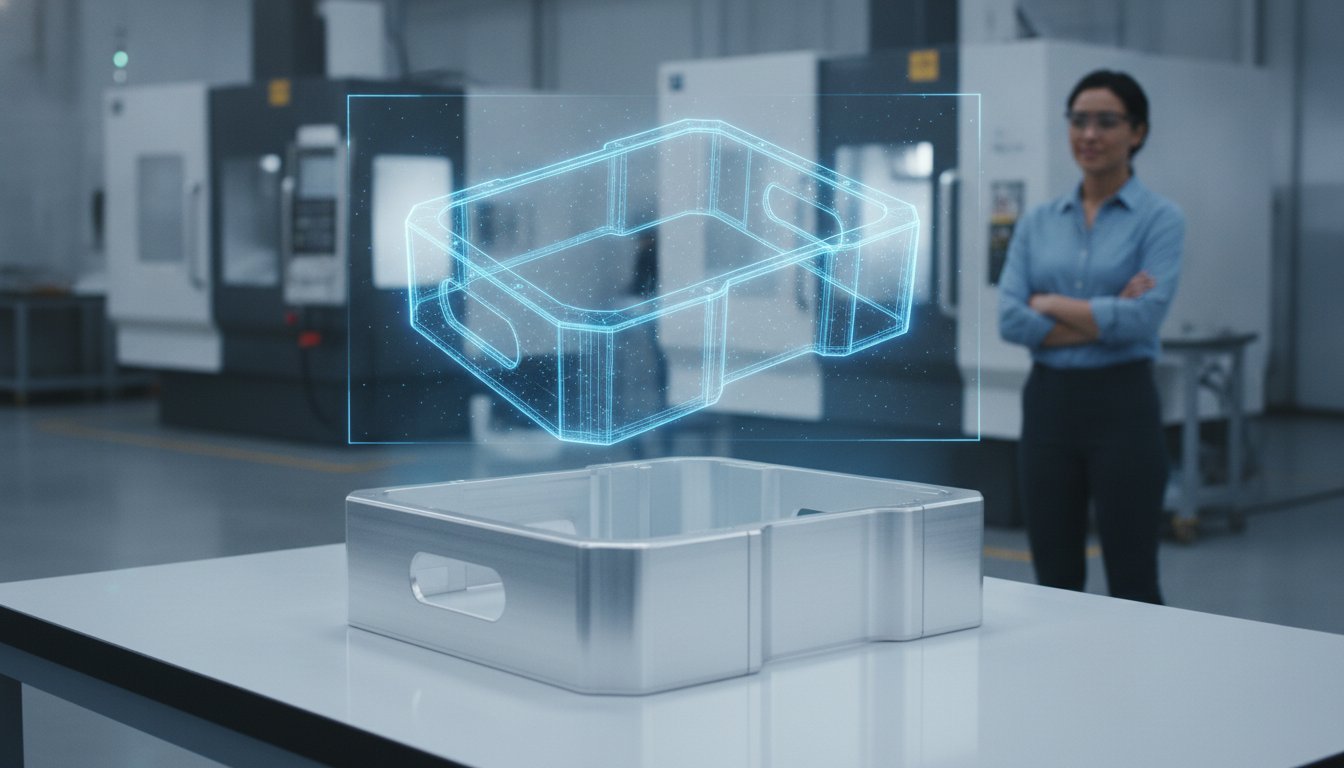
The gap between a high-fidelity digital design and a physical part shouldn't be a bottleneck for your 2026 production cycle. In an era of rapid iteration, waiting weeks for laser cutting or dealing with parts that don't match your CAD files is an avoidable failure. If you're scaling custom sheet metal enclosures for electronics, you need a workflow that moves as fast as your software. We understand the pressure to maintain precision while moving from a single prototype to a national rollout.
You've likely struggled with the administrative weight of managing multiple vendors or the quality drift that happens when production is scattered. It's a common pain point in modern manufacturing. This article shows you how on-demand manufacturing bridges the gap between complex digital designs and precision-fabricated metal enclosures at a national scale. We'll break down how to achieve a seamless digital-to-physical workflow that delivers standardized quality and rapid turnaround for every unit, regardless of where it's shipping.
Key Takeaways
- Transition from rigid batch manufacturing to a digital-first, on-demand model that prioritizes speed and industrial precision.
- Discover how precision laser cutting and CNC bending achieve the surgical tolerances required for custom sheet metal enclosures for electronics.
- Bridge the gap between digital CAD designs and physical parts by optimizing your workflow for automated fabrication and mechanical spooling.
- Scale your production seamlessly from initial thermal airflow prototypes to low-to-mid volume national distribution.
- Ensure standardized quality across all units by leveraging a single, tech-savvy fabrication partner with nationwide shipping capabilities.
What is On-Demand Metal Part Production for Electronics?
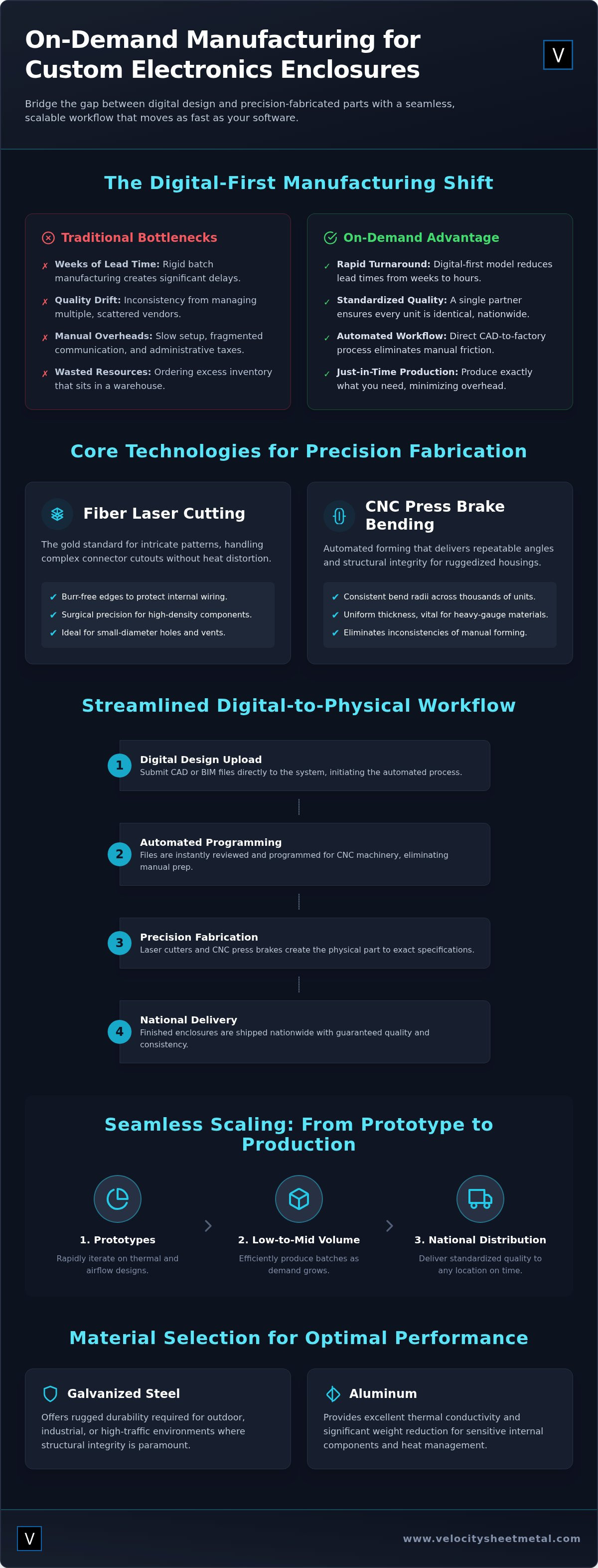
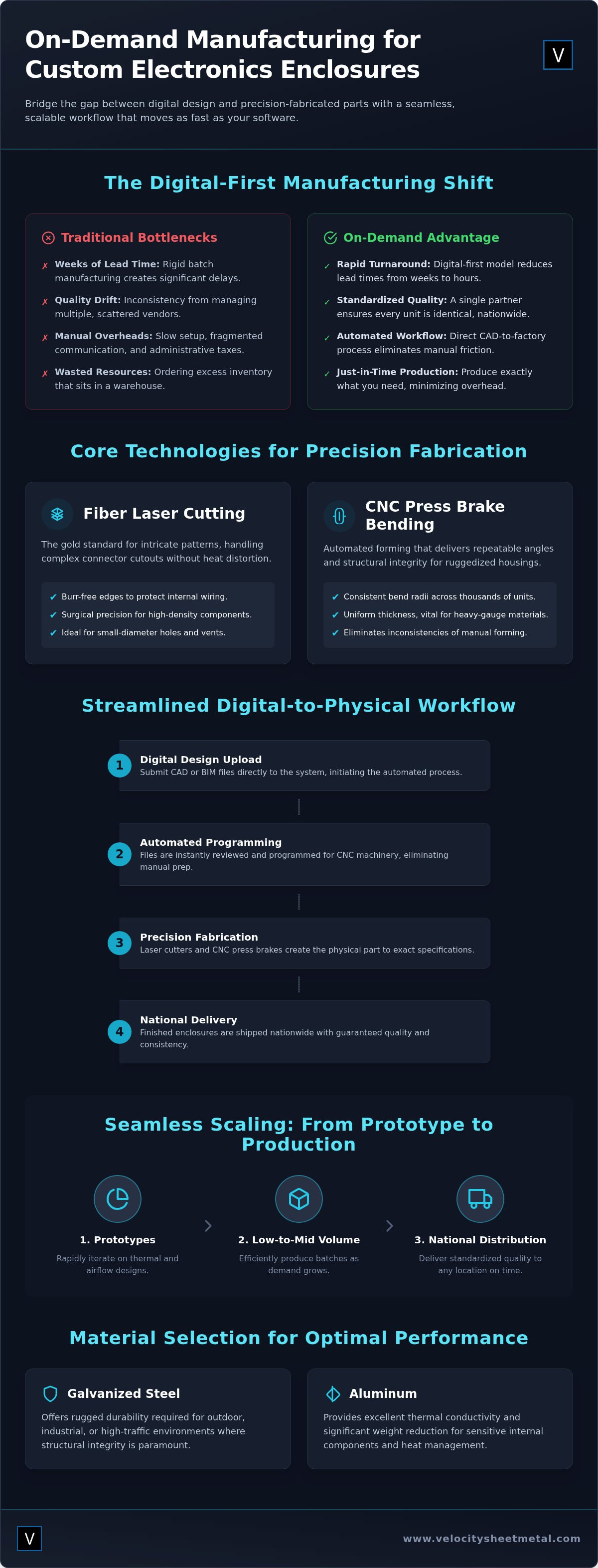
On-demand metal part production is a digital-first manufacturing model. It bypasses the friction of traditional procurement. In this system, custom sheet metal enclosures for electronics move directly from CAD or BIM files to the factory floor. It's a shift away from the outdated batch-and-queue mentality. Instead of ordering thousands of units to sit in a warehouse, you produce exactly what you need when you need it. This transition to just-in-time industrial delivery minimizes overhead and maximizes agility.
Electronics fabrication demands a higher level of technical scrutiny than general construction. You aren't just building a shell; you're managing electromagnetic interference (EMI) and complex thermal profiles. Precision mounting points must align perfectly with internal PCBs. Airflow must be calculated to prevent component failure. On-demand production serves as the essential bridge between a designer's digital intent and a physical industrial component.
The Evolution of Industrial Fabrication
The industry has moved beyond paper blueprints and manual measurements. Modern sheet metal fabrication relies on automated quoting engines and instant digital file reviews. By 2026, automation standards have effectively eliminated the need for manual shop drawings in the initial stages. This digital maturity reduces administrative lead times from weeks to hours. For modern electronics supply chains, just-in-time production isn't a luxury. It's the only way to keep pace with rapid hardware lifecycles and shifting market demands.
Traditional Shops vs. On-Demand Speed
Traditional fabrication shops often struggle with an administrative tax. This includes manual setup times, fragmented communication, and slow, localized shipping. These bottlenecks kill momentum. On-demand models strip away these inefficiencies by centralizing the workflow. Consider the differences in the process:
- Manual setup is replaced by automated CNC programming directly from your files.
- Fragmented emails are replaced by integrated digital project management.
- Local limitations are bypassed through robust national logistics and standardized quality.
When you're scaling custom sheet metal enclosures for electronics across a national footprint, consistency is everything. Centralized fabrication ensures that the unit produced in January matches the unit delivered in December. This model eliminates the quality drift common in multi-vendor projects. It provides a reliable, tech-savvy path from a digital concept to a tangible product that arrives on site, on time, and within spec.
Core Technologies Behind Precision Enclosure Fabrication
Precision is a requirement. It's not a suggestion. When building custom sheet metal enclosures for electronics, the margin for error is microscopic. We use advanced fiber lasers and CNC press brakes to turn digital intent into physical reality. This process follows strict precision manufacturing standards. It ensures every port and mounting bracket aligns perfectly. High-speed automation allows us to maintain this accuracy across national production runs without the quality drift common in manual shops.
Material choice dictates the performance of the final product. We work with a range of metals tailored to specific industrial needs. Galvanized steel offers the rugged durability required for outdoor or high-traffic environments. Aluminum provides excellent thermal conductivity and weight reduction for sensitive internal components. Selecting the right material is the first step in ensuring long-term reliability for your electronic hardware.
Laser Cutting for High-Density Electronics
Fiber laser technology is the gold standard for intricate patterns. It handles small-diameter holes and complex connector cutouts without heat distortion. This is critical for high-density components where space is at a premium. We focus on achieving burr-free edges. Sharp edges kill wiring and cause shorts. Smooth, precise cuts protect internal components and simplify the assembly process. You can find more technical specifications in our precision laser cutting services guide.
CNC Forming and Heavy-Gauge Capabilities
Ruggedized housings require more than just thin-gauge shells. They need structural integrity. We utilize CNC press brake bending to ensure repeatable angles across thousands of units. Manual forming is too inconsistent for national accounts. Automated bending maintains uniform thickness and bend radii. This is vital for heavy-gauge materials used in demanding industrial environments. Many shops shy away from heavy-gauge forming. We embrace it. We provide the force and accuracy needed to form thick materials without cracking or thinning the bend radius. If you need a partner who understands these technical demands, you can explore our precision capabilities to see how we streamline production.
BIM coordination serves as the final layer of defense. It's about more than just 3D modeling. We use it to break down complex enclosure assemblies into manageable spools. This prevents field collisions and ensures every custom bracket fits the first time. Assembly errors are expensive. We eliminate them in the digital phase before a single piece of metal is cut. This coordination is what allows us to scale production from a single prototype to a national rollout with total confidence.
Scaling from Prototype to National Production
Scaling production for custom sheet metal enclosures for electronics requires a transition from local craftsmanship to industrial-grade systems. It isn't just about making more parts. It's about maintaining surgical precision across geographic distances. Most shops focus on small maker boxes or hobbyist projects. Velocity Sheet Metal focuses on the industrial scalability required for national infrastructure and large-scale OEM electronics. This process moves through three distinct phases that ensure your design translates perfectly from a single unit to a nationwide rollout.
- Phase 1: Rapid Prototyping. Use this stage to verify thermal airflow and component fitment. Electronics fail if they can't breathe. Prototyping allows you to test mounting tolerances and port alignments before committing to a larger run.
- Phase 2: Low-to-Mid Volume. This is the sweet spot for specialized industrial equipment. You get the benefits of precision fabrication without the massive overhead of traditional tooling.
- Phase 3: High-Volume Scaling. When moving to national infrastructure projects, consistency is your greatest asset. High-volume runs require automated systems that produce identical results every time, regardless of the order size.
Balancing cost per unit against delivery speed is a constant challenge. Higher volumes naturally lower the per-part price. However, in the 2026 market, speed is often more valuable than a few cents of savings. On-demand production allows you to bypass the traditional "wait and see" approach of batch manufacturing. You get parts on-site exactly when the assembly line is ready for them.
The Prototype-to-Production Pipeline
Success starts with DFM (Design for Manufacturing) feedback. Velocity Sheet Metal's digital-first fabrication methods allow us to review your files and identify potential bottlenecks before they cost you money. This feedback loop lowers costs by optimizing bend sequences and material usage. By standardizing your custom sheet metal enclosures for electronics early, you create a repeatable blueprint for national distribution. Digital-first fabrication also means tooling costs vanish. You don't need expensive custom dies when you're leveraging precision laser cutting and CNC forming.
National Account Management and Logistics
Logistics matter as much as the metal. Multi-state engineering firms often struggle with fragmented procurement. Fragmented vendors covering diverse operational territories often lead to quality drift and assembly errors. Velocity Sheet Metal eliminates this by centralizing production and utilizing robust nationwide shipping. Every enclosure meets the same rigorous standard, whether destined for a major operational hub or a remote project site, anywhere within your national network. On-demand production simplifies the entire procurement cycle. It acts as a single, reliable point of contact for your entire national footprint. You get predictable lead times and standardized quality across every single unit.
Streamlining the Digital-to-Physical Workflow
A seamless workflow isn't an accident. It's the result of a methodical digital-to-physical process. To scale custom sheet metal enclosures for electronics, you must eliminate the friction between your design software and the factory floor. This requires a shift from static blueprints to dynamic, fabrication-ready data. By following a structured workflow, you reduce lead times and ensure that the final physical part mirrors your digital intent without compromise.
- Step 1: Optimize CAD/BIM files. Tailor your designs specifically for automated sheet metal fabrication to avoid manual adjustments later.
- Step 2: Utilize mechanical spooling. Break down complex enclosure assemblies into manageable, repeatable units.
- Step 3: Implement clash detection. Resolve internal component conflicts in the digital model to prevent expensive field errors.
- Step 4: Use automated quoting. Lock in budgets and project timelines immediately to maintain momentum.
Speed depends on clarity. When your data is clean, the machines run faster. If you're ready to move from design to delivery, you can start your project today and leverage our automated production line.
BIM Coordination and Spool Drawings
Modern BIM for sheet metal fabrication is the most effective way to reduce waste in complex assemblies. It allows for a level of coordination that traditional 2D drawings can't match. Accurate spool drawings are a necessity for consistent enclosure assembly across national projects. Mechanical spooling ensures that every mounting bracket and port aligns perfectly with internal electronics. This technical foresight eliminates the "measure twice, cut once" delays of the past. It replaces them with a "model once, produce many" efficiency that is vital for high-volume electronics projects.
File Preparation and Tolerance Standards
Success starts with the right file format. We prefer DXF, STEP, or DWG submissions for custom sheet metal enclosures for electronics. These formats provide the geometric data our CNC systems need to maintain tight tolerances. You should expect laser cutting tolerances to remain within surgical limits, while CNC bending requires a slightly different approach to account for material spring-back. Use this checklist for your next design review:
- Wall Thickness: Verify that the material gauge is consistent with your thermal and structural needs.
- Hole Placement: Ensure holes are placed far enough from bend lines to avoid distortion.
- Flange Widths: Check that flanges meet the minimum width requirements for our CNC press brakes.
Maintaining these standards ensures that your enclosures are rugged, functional, and ready for the assembly line. It's about removing the administrative tax and focusing on technical execution. When the digital file is correct, the physical part follows suit with surgical precision.
Velocity Sheet Metal: National On-Demand Solutions
Velocity Sheet Metal acts as the authoritative expert operator for your production line. We provide the technical backbone for custom sheet metal enclosures for electronics at a national scale. Our facility combines automated technology with precision fabrication to handle high-volume demands without sacrificing surgical accuracy. We don't just fabricate; we integrate. By bridging the gap between your digital design and the physical product, we ensure that your project stays on schedule and within budget. Our workflows are built for speed and engineered for reliability.
Standardized quality is our baseline. When you manage projects across multiple states, you can't afford the variability of local shops. We solve the problem of quality drift by centralizing production and utilizing robust nationwide shipping. Whether your project is in a single regional hub or spread across fifty job sites, the parts you receive will be identical. This consistency is vital for the long-term performance of sensitive electronic hardware and industrial infrastructure.
Why National OEMs Choose Velocity
National Original Equipment Manufacturers (OEMs) require a partner who understands the intersection of engineering and industrial reality. We bring 50+ years of combined industry experience to every project. This expertise allows us to meet rigorous engineering and HVAC requirements that general fabrication shops often overlook. Our focus is on efficiency. We've streamlined our logistics to move custom sheet metal enclosures for electronics from our factory floor to your assembly line with zero administrative friction. We handle the complexity of multi-state shipping so your team can focus on the final assembly.
- Standardized Quality: Every unit meets the same precision tolerances, regardless of the order size.
- BIM-Integrated Workflows: We use BIM coordination and mechanical spooling to eliminate assembly errors before they happen.
- Nationwide Reach: Our logistics network ensures timely delivery to any site in the US.
Starting Your Custom Production Run
Moving from a digital file to a physical part is a straightforward process. You start by submitting your CAD or BIM files for a technical review. Our team analyzes your design for manufacturing (DFM) to identify any potential bottlenecks in laser cutting or CNC bending. We consult with you on specialized requirements, such as thermal airflow patterns or specific material gauges. This collaborative approach ensures that the final product isn't just a box; it's a high-performance component of your electronic system.
Don't let administrative delays or fragmented vendors slow down your 2026 production goals. We're ready to get to work immediately. Partner with Velocity Sheet Metal for your next national production project.
Scale Your Electronics Infrastructure for 2026
The manufacturing landscape is moving toward a digital-first reality where speed and surgical precision are non-negotiable. By optimizing your digital-to-physical workflow, you eliminate the administrative friction that stalls traditional production cycles. You've seen how automated laser cutting and CNC bending provide the repeatability needed for custom sheet metal enclosures for electronics at any volume. Scaling from a single thermal prototype to a national rollout is now a matter of data management rather than manual labor.
Velocity Sheet Metal brings 50+ years of combined industry expertise and advanced automated fabrication technology to your production line. We provide the nationwide shipping and national account support required to maintain standardized quality across every state. It's time to bridge the gap between your digital files and a tangible, high-performance product. Request a Custom Quote for Your National Production Run and let's get to work on your 2026 goals. Your design is ready for the factory floor.
Frequently Asked Questions
What is the typical lead time for on-demand metal part production?
Lead times vary by project complexity but digital-first workflows significantly compress traditional windows. By using automated quoting and file reviews, we move from design to production faster than shops relying on manual drafting. Standardized components can often move through the factory floor in days rather than weeks. This speed allows you to maintain momentum during critical hardware rollout phases.
Can on-demand manufacturing handle high-volume enclosure runs?
Yes, our facility is engineered for industrial scalability and high-volume output. We utilize automated coil-line technology and high-speed fiber lasers to maintain consistent quality across large production runs. This setup allows us to handle massive orders for national OEMs without the quality drift associated with manual fabrication. You get the same precision on the thousandth unit as the first.
How does BIM coordination improve the accuracy of custom electronic enclosures?
BIM coordination identifies internal component conflicts in the digital model before any metal is cut. This process ensures that every mounting bracket and interface port aligns perfectly with your internal hardware. It effectively eliminates the need for field modifications. Using this method ensures custom sheet metal enclosures for electronics fit perfectly the first time, saving you time and expensive rework costs.
What materials are best for on-demand laser cutting of electronics housings?
Aluminum and galvanized steel are the primary choices for high-performance electronics housings. Aluminum offers superior thermal conductivity and weight reduction for sensitive components. Galvanized steel provides the rugged durability required for harsh industrial environments. Both materials are highly compatible with precision fiber laser cutting. This technology allows for intricate hole patterns and tight tolerances without heat distortion.
Do you offer nationwide shipping for custom metal enclosures?
We provide full nationwide shipping capabilities to support national accounts across the US. Our logistics network is designed to move precision-fabricated parts from our central facility to any job site or regional center. This centralized production model ensures that every unit meets the same rigorous standards regardless of its final destination. It simplifies your supply chain by providing a single point of contact.
How do I prepare my CAD files for on-demand manufacturing?
Submit your designs in DXF, STEP, or DWG formats for the most efficient processing. Ensure that your files are optimized for automated sheet metal fabrication by checking wall thicknesses and hole placements relative to bend lines. Providing clean, production-ready data allows us to lock in project timelines and budgets immediately. This preparation is the essential first step in a seamless digital-to-physical workflow.
What are the cost benefits of on-demand production for national accounts?
Centralizing your production with a single partner eliminates the administrative tax of managing multiple local vendors. National accounts benefit from standardized quality and reduced procurement overhead. By leveraging our 50 plus years of industry experience, you can scale production of custom sheet metal enclosures for electronics while maintaining a lower total cost of ownership. It turns your fabrication needs into a predictable, repeatable line item.
Is on-demand production suitable for ruggedized industrial electronics?
On-demand production is ideal for ruggedized housings that require heavy-gauge materials and complex geometries. We use CNC press brake bending to form thick metals with repeatable accuracy. This ensures that industrial enclosures provide the structural integrity and protection needed for demanding environments like factory floors or outdoor infrastructure. You get a rugged, physical product that matches your high-level engineering specifications exactly.