Custom Commercial HVAC Ductwork: Precision Fabrication & BIM Integration
Every hour your crew spends field-modifying a duct that doesn't fit is profit bleeding out of your project budget. You've likely dealt with the fallout of inconsistent fabrication quality or lead times that don't align with your construction schedule. It's a common pain point in the industry, where traditional shops struggle to keep pace with modern design demands. Sourcing high-precision custom commercial HVAC ductwork shouldn't be a gamble on whether the metal matches the model. You need a workflow that bridges the gap between digital design and physical reality without the expensive mid-project surprises.
We understand that predictability is the backbone of a successful commercial build. This article explores how BIM-driven workflows and automated coil-line fabrication eliminate field collisions and accelerate your project timelines. You'll discover how to achieve zero-error field installation and maintain standardized quality across national accounts. From initial spool drawings to final delivery, we'll break down the technical standards, including the 2026 SMACNA updates, that ensure your systems are compliant and efficient. Let's look at how precision fabrication turns a complex installation into a streamlined process.
Key Takeaways
- Bridge the gap between digital models and physical assets using BIM coordination and mechanical spooling to eliminate field collisions.
- Shift from slow manual fabrication to high-speed automated coil-lines for superior throughput on high-volume rectangular duct projects.
- Navigate the complexities of SMACNA compliance and material selection for durable, high-performance custom commercial HVAC ductwork.
- Streamline project logistics for national accounts by leveraging nationwide shipping and standardized quality from a single-source fabrication partner.
The Evolution of Custom Commercial HVAC Ductwork
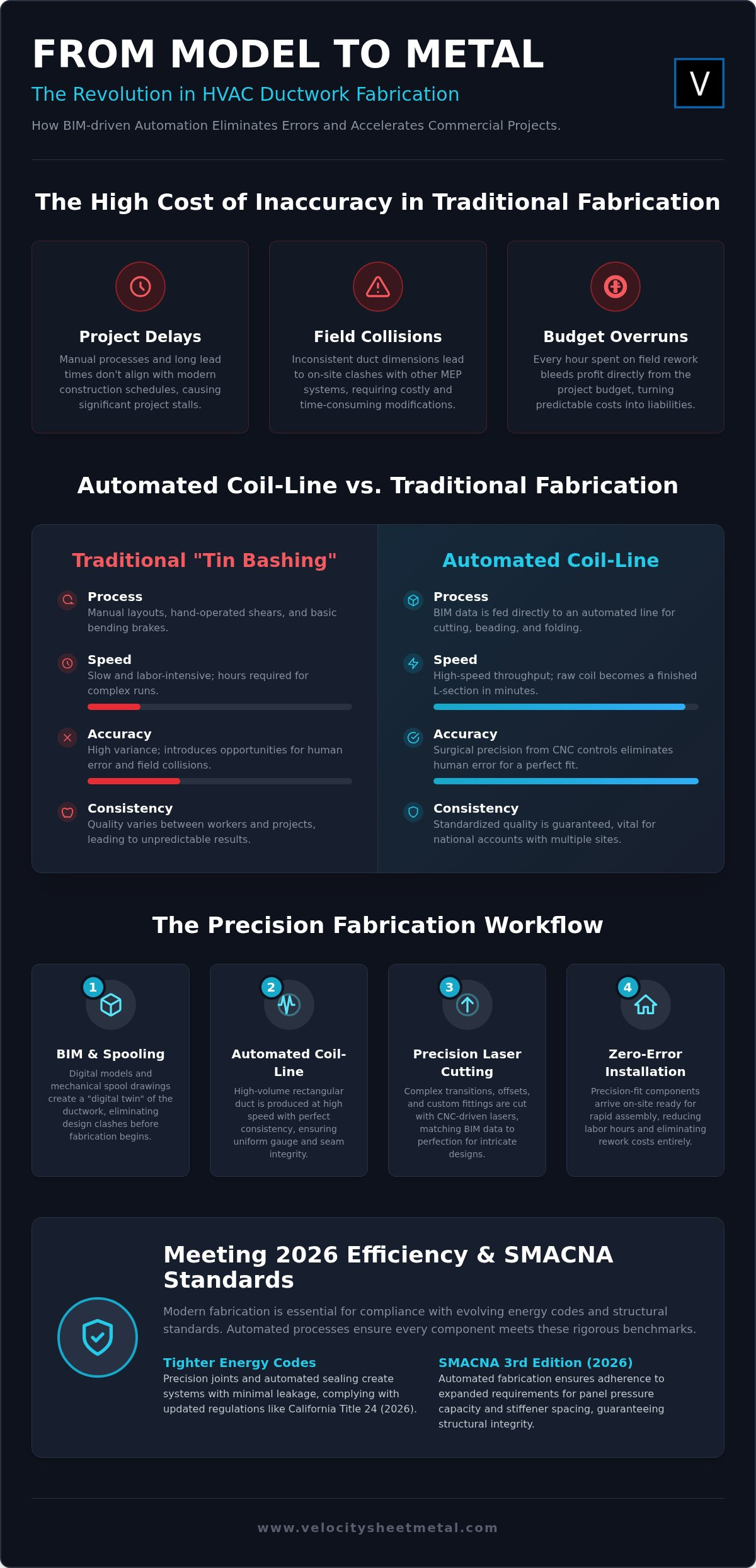
Custom commercial HVAC ductwork has moved far beyond the era of manual "tin bashing." Modern air distribution systems are now precision-engineered assets, designed to integrate seamlessly into complex Building Information Modeling (BIM) environments. In the past, shops relied on manual measurements and hand-cut fittings. Today, the industry demands a data-driven approach where every component is a direct physical manifestation of a digital twin. This evolution is driven by the need for speed and the refusal to accept field errors that stall high-stakes commercial construction. Precision is no longer a luxury; it is the essential bridge between a digital design and a profitable physical result.
Why 'Standard' Sizes Don't Fit Commercial Reality
Stock inventory belongs in residential attics, not high-rise mechanical rooms or industrial facilities. Modern HVAC ductwork in commercial settings must navigate dense MEP layouts where every inch of ceiling space is contested. Standardized, off-the-shelf components often force inefficient routing. This leads to increased static pressure and higher energy consumption over the life of the building. Custom transitions and specialized fittings solve these spatial puzzles immediately. By prioritizing precision-fit components, contractors move from frustrating field modifications to rapid assembly. This shift directly reduces on-site labor hours and eliminates the rework costs that typically erode project margins. From complex offsets to tight radius elbows, custom fabrication ensures the system fits the building, not the other way around.
Meeting 2026 Efficiency Standards
Meeting 2026 efficiency standards requires more than just better insulation. Precision joints and automated sealing are now essential to comply with updated energy codes, such as the 2026 updates to California Title 24. These regulations demand tighter systems with minimal leakage to ensure that conditioned air reaches its destination without waste. Adherence to SMACNA standards remains the non-negotiable baseline for any reputable project. The 3rd Edition updates to SMACNA standards, published in July 2026, have expanded requirements for panel pressure capacity and stiffener spacing. In the context of 2026 standards, SMACNA compliance represents a rigorous set of technical benchmarks for material gauge and joint integrity that ensures structural stability under specific pressure classes. By utilizing automated fabrication, you ensure that every piece of custom commercial HVAC ductwork meets these benchmarks before it even leaves the shop floor.
Automated Coil-Line vs. Traditional Fabrication
Traditional sheet metal shops often rely on manual layout, hand-operated shears, and basic bending brakes. This approach introduces variance. Every manual measurement is an opportunity for a field collision later in the project. In contrast, an automated coil-line processes raw metal with surgical precision. It's a shift from labor-intensive "tin bashing" to a streamlined, data-driven workflow. This transition is essential for producing coil line duct fabrication at scale. By removing the bottleneck of manual labor, you gain the capacity to handle large-scale developments with predictable delivery dates.
High-Volume Rectangular Duct Production
Speed defines the modern coil-line. A manual shop might take hours to layout and fold a complex run of rectangular duct. An automated line moves from raw coil to a leveled, beaded, notched, and folded L-section in minutes. This process ensures consistent gauge thickness and seam integrity across every foot of custom commercial HVAC ductwork. For national accounts managing multiple sites, this consistency is vital. It guarantees that the duct arriving at a site in one state matches the quality of a site three time zones away. The mechanics of the line allow for high-throughput production without sacrificing the structural requirements of the 2026 SMACNA standards.
Precision Laser Cutting for Custom Fittings
Standard rectangular runs are only half the battle in a modern MEP design. Complex builds require intricate transitions, offsets, and plenum boxes that stock inventory cannot provide. Where manual shears fail to hold tight tolerances, CNC-driven laser cutting excels. This technology allows for the creation of components that fit perfectly the first time. Integrating BIM and Spooling data directly into the laser cutter eliminates the risk of human error during the layout phase. If your project requires high-accuracy industrial parts, you should leverage precision laser cutting services to maintain tight construction schedules. These parts are then finished with CNC press brake bending to ensure every angle is exact.
Scalability is the ultimate benefit of this automated approach. It transforms the fabrication shop into a reliable partner that values your time as much as its own precision. By bridging the gap between a digital file and a tangible product, automation removes the guesswork from the procurement process. You can partner with an automated fabricator to ensure your next project stays on track and under budget. The result is a faster, cleaner installation that keeps your crew moving forward instead of fixing errors.
Eliminating Field Errors with BIM and Spooling
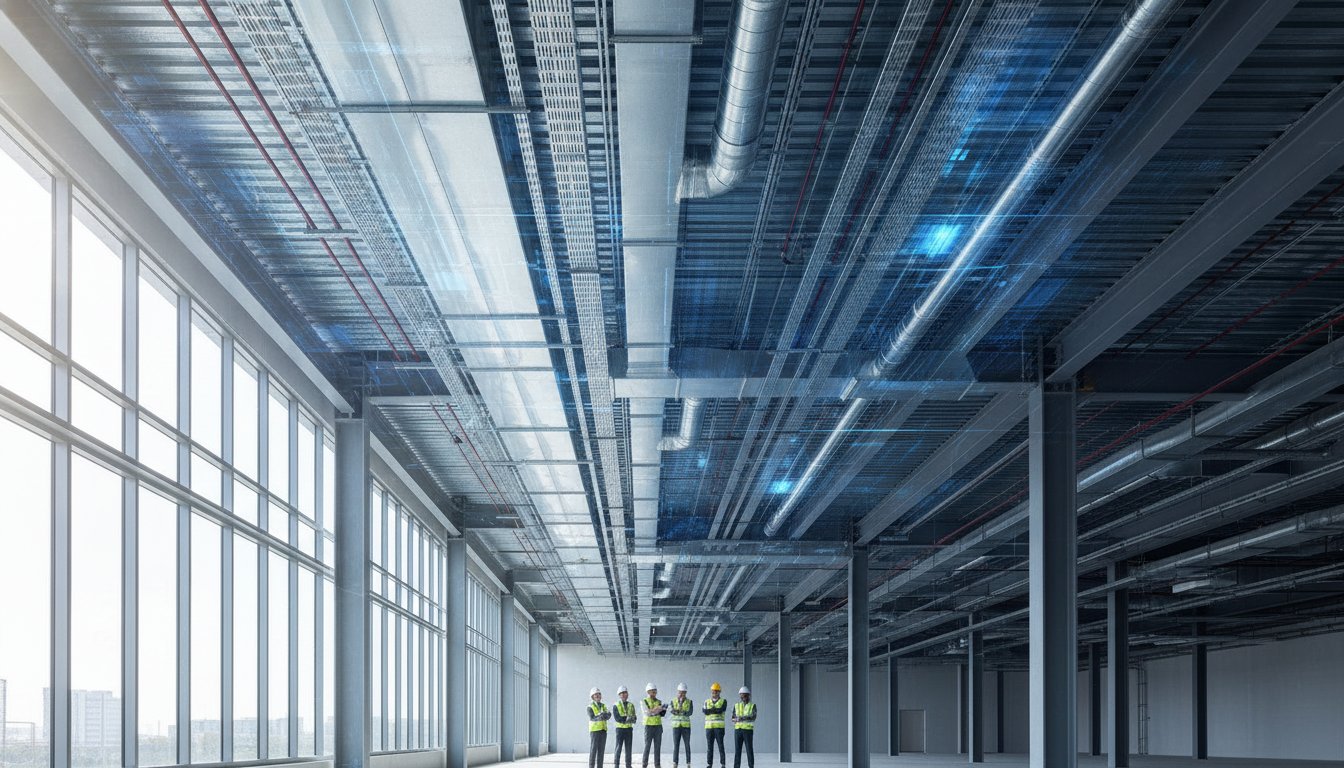
Building Information Modeling (BIM) serves as the digital backbone of modern construction. It is the difference between a project that flows and one that stalls. Velocity acts as the Authoritative Expert Operator in this space, positioning itself as the essential bridge between a digital file and a tangible product. We don't just fabricate; we coordinate. Mechanical spooling services translate complex 3D models into machine-ready files with zero data loss. This ensures that every section of custom commercial HVAC ductwork arriving at your site is a direct physical manifestation of the engineered design. It's about industrial pragmatism. We solve traditional problems with modern technology.
BIM Coordination: The End of Field Collisions
Digital coordination identifies conflicts before a single piece of metal is cut. It is a proactive approach to risk management that stops field rework before it starts. You find out that a duct path conflicts with a plumbing line or an electrical tray in the software, not on the ladder. The cost-saving reality is simple: it's significantly cheaper to move a digital duct than a physical one. By utilizing BIM clash detection for HVAC fabrication, you eliminate the reactive culture that kills project budgets. June 2026 industry reports show that MEP-specific software adoption has led to a 40% improvement in coordination efficiency and a 30% reduction in design errors. This data-driven workflow ensures that your project stays on schedule and avoids the administrative delays of the past.
Spool Drawings and Precise Assembly
Precision in the shop must translate to precision in the field. We convert complex designs into clear, numbered spool drawings for your installers. Every custom piece has a designated "home" in the mechanical room, creating a logical progression for the assembly team. This removes the guesswork from the site. Your crew spends less time on "measure and cut" tasks and more time on high-value installation. Pre-fabricated precision means the parts fit the first time, every time. This methodical approach mirrors a production line, moving from technical review to the logistics of delivery with surgical precision. It's a "can-do" attitude grounded in modern manufacturing reality. When the metal arrives, it's ready to go.
Material Standards and SMACNA Compliance
Selecting the right material for custom commercial HVAC ductwork is a technical decision that impacts system longevity and compliance. Galvanized steel remains the industrial standard for general air distribution due to its balance of structural strength and cost efficiency. However, high-pressure systems or specialized environments require a more rigorous approach to material gauge and joint construction. Adhering to the Sheet Metal and Air Conditioning Contractors' National Association (SMACNA) standards is the only way to ensure structural integrity under load. The SMACNA 3rd Edition updates, published on July 8, 2026, introduced expanded panel pressure capacity tables and new design capabilities for stainless steel at varying temperatures. These benchmarks dictate the minimum gauge requirements for different pressure classes, ensuring the ductwork doesn't oil-can or fail during operation.
Corrosion Resistance and Specialized Environments
Specific environments demand materials that go beyond standard galvanized coatings. You should specify stainless steel for laboratory exhaust, hospital surgical suites, or coastal facilities where salt air accelerates oxidation. Commercial kitchen exhaust systems require even more specialized attention, typically demanding 16-gauge carbon steel or 18-gauge stainless steel with continuously welded seams to meet fire safety codes. These mission-critical environments often involve high-global warming potential (GWP) refrigerant systems that, as of January 1, 2026, require stricter leak detection and reporting. Aluminum ductwork remains the primary choice for weight-sensitive roof loads or MRI suites where non-ferrous materials are mandatory. In these applications, maintaining seal class integrity is paramount. High-pressure industrial systems must meet stringent leakage tests to ensure that every CFM of conditioned air reaches its destination.
Quality Assurance and Testing
Precision in material selection must be matched by precision in fabrication. Velocity maintains internal standards for seam strength and dimensional accuracy that often exceed basic code requirements. We use CNC press brake bending to achieve perfect fitting angles that manual methods cannot replicate. This level of accuracy is critical for ensuring that transitions and elbows align perfectly with the digital model established during the BIM phase. For a deeper look at industry requirements, review our HVAC duct fabrication for mechanical contractors guide. Our process moves from raw metal to a tested, compliant component with surgical precision. This methodical approach ensures that your project meets the 2026 Title 24 building codes from day one.
To start your next high-performance build with compliant, precision-fit metal, request a fabrication quote from Velocity today.
Strategic Procurement: National Fabrication and Logistics
Procurement isn't just about buying metal. It's about securing a supply chain that matches your construction velocity. Relying on a patchwork of local shops for national accounts creates dangerous variability. It introduces different fabrication tolerances, varying lead times, and inconsistent seam quality. A single-source partner eliminates these inconsistencies. You get the same precision-fit custom commercial HVAC ductwork across every project site, regardless of the location. This centralization streamlines the entire MEP workflow from digital design to physical delivery. It allows your team to focus on installation rather than vendor management.
Standardizing Quality Across National Accounts
Consistency is the foundation of long-term facility management. When every building in a national portfolio uses the same ductwork standards, maintenance and filtration upgrades become predictable. You maintain a single point of contact for BIM coordination and production updates. This removes the administrative friction of managing dozens of small-scale vendors. Standardized fabrication means your spool drawings follow a uniform logic across every project. It ensures that your internal engineering teams don't have to relearn a new shop's quirks for every new build. We act as the authoritative bridge that keeps your standards high and your timelines short.
Logistics: From Shop Floor to Job Site
Shipping metal across the country requires a dedicated freight strategy. It's not enough to just load a trailer. We use protective packaging and specialized loading techniques to ensure that your order arrives in the same condition it left our automated coil-line. Every piece of duct is tagged and numbered according to the spool drawings we've already coordinated in the BIM phase. This logistical advantage allows your field crew to begin assembly immediately upon delivery. There's no "measure and cut" delay on-site. If field changes occur, our on-demand production capacity allows for rapid response and shipping of custom components to keep the job moving.
Velocity brings over 50 years of combined management experience to every project. We understand that in commercial construction, speed is a metric of success. We don't just ship parts; we deliver pre-fabricated solutions that are ready for the mechanical room. Our "can-do" pragmatism is grounded in the reality of modern manufacturing. We cut through administrative delays and focus on delivery. Partner with Velocity for your next high-volume commercial project and experience the efficiency of a tech-driven fabrication partner.
Accelerate Your Project Timeline with Precision
The transition from a digital MEP model to a physical installation shouldn't be a source of project risk. By integrating BIM coordination with automated coil-line fabrication, you eliminate the field collisions that typically stall commercial construction. This data-driven approach ensures that every section of custom commercial HVAC ductwork fits the first time; every time. You move from the design phase to the logistics of delivery with surgical precision, backed by 50+ years of combined management experience. Whether you're managing a single high-rise or a portfolio of national accounts, standardized quality and nationwide shipping keep your schedule predictable. It's about bridging the gap between a digital file and a tangible product without the administrative delays of the past.
Your next build deserves a partner that values speed as much as accuracy. Let's get to work on a solution that keeps your crew moving forward instead of fixing errors. Streamline your project with precision HVAC ductwork from Velocity Sheet Metal. We are ready to deliver the reliability your project demands.
Frequently Asked Questions
What is the difference between coil-line and manual duct fabrication?
Automated coil-line fabrication replaces manual layout with CNC-driven precision. While traditional shops rely on hand-operated shears and manual bending brakes, a coil-line processes metal directly from raw coils. This results in superior throughput and consistent seam integrity across every foot of duct. It's the only way to produce high-volume rectangular duct without the risk of human error. This automation ensures your project stays on schedule by delivering predictable production timelines.
How does BIM coordination reduce total project costs for mechanical contractors?
BIM coordination identifies mechanical, electrical, and plumbing conflicts in a digital environment before fabrication begins. It is a proactive risk management tool that prevents the labor-intensive rework typical of uncoordinated builds. By resolving clashes in the model, contractors avoid the emergency field modifications that cause budget overruns. This digital-first approach ensures that the fabrication phase supports, rather than hinders, the overall project profitability and construction speed.
Does Velocity Sheet Metal provide on-site installation for commercial ductwork?
No, Velocity Sheet Metal focuses exclusively on precision fabrication and does not provide on-site HVAC installation services. We act as the essential bridge between your digital design files and the final physical product. Our role is to ensure that your metal arrives at the job site pre-fabricated, tagged, and ready for your crew to install. This specialization allows us to maintain a high degree of technical capability in the workshop.
What materials are available for custom commercial ductwork?
We fabricate ductwork using galvanized steel, stainless steel, and aluminum to meet various environmental and pressure requirements. Galvanized steel is the standard for most commercial applications; however, stainless steel is specified for corrosion-sensitive areas like laboratories. Aluminum is available for weight-sensitive projects or non-ferrous environments. Every material choice helps you comply with the 2026 EPA regulations regarding leak detection for systems using high-GWP refrigerants, which now require stricter reporting for systems over 15 pounds.
Do you provide shipping for projects across the entire country?
Yes, we offer comprehensive nationwide shipping capability for all our products. Velocity Sheet Metal specializes in serving national accounts that require standardized quality across multiple project sites. We ensure that custom commercial HVAC ductwork fabricated for a facility in one region matches the exact specifications and quality of a project located thousands of miles away. Our logistics team coordinates freight to align with your specific construction schedule, ensuring distance never compromises your timeline.
What are the standard lead times for custom curb adapters in 2026?
Lead times for custom curb adapters are optimized to meet the fast-paced demands of 2026 commercial construction schedules. We utilize automated laser cutting and CNC bending to accelerate the production of these critical components. Because we specialize in on-demand part production, we can often respond to field changes faster than traditional shops. You should contact our technical team with your specific unit requirements to receive an accurate production and delivery estimate for your location.
How do spool drawings improve the installation process on-site?
Spool drawings translate complex 3D models into clear, numbered assembly instructions for your field team. Every piece of custom ductwork is assigned a unique identifier that corresponds to a designated home in the mechanical room. This methodical approach reduces on-site measure and cut time and ensures a zero-error installation. It transforms a complex logistical puzzle into a predictable, sequential assembly process that keeps your installers moving forward without expensive field modifications.
Are all Velocity duct products SMACNA compliant?
Yes, all Velocity duct products are fully SMACNA compliant. We build to the standards set by the Sheet Metal and Air Conditioning Contractors' National Association, including the 3rd Edition updates published in July 2026. These standards ensure that our fabrication meets specific pressure classes and structural benchmarks for panel capacity and stiffener spacing. Adherence to these benchmarks is a mandatory part of our quality assurance process for every order that leaves our facility.