Complex Sheet Metal Fabrication: The 2026 Industrial Guide to Precision and Scale
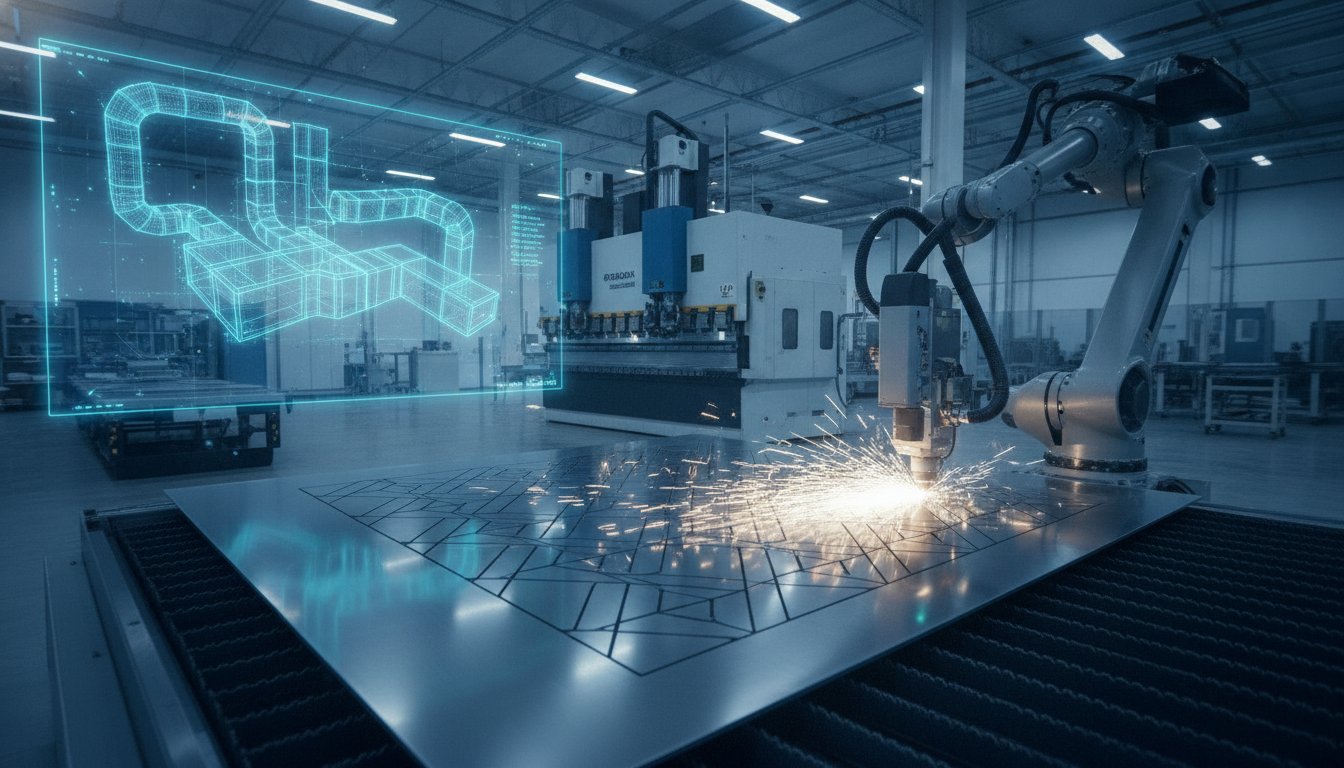
In 2026, the gap between a digital design and a physical assembly isn't closed by manual rework; it's closed by a data-driven workflow. Precision in complex sheet metal fabrication has shifted from a specialized luxury to a baseline requirement for national infrastructure and OEM accounts. You've likely felt the frustration of inconsistent quality from standard job shops that lack the technical depth to manage high-tolerance assemblies. When parts don't fit, lead times slip and field costs explode.
We agree that "close enough" is a recipe for project failure in a market facing a 400,000-welder shortage and tightening margins. This guide promises to help you master the technical requirements and digital workflows necessary to execute high-tolerance projects at scale. We'll preview how BIM coordination and automated coil-lines eliminate field collisions and ensure every part fits perfectly. From digital spool drawings to nationwide logistics, you'll learn to build a scalable production engine that turns complex designs into tangible results without the typical administrative delays.
Key Takeaways
- Understand how multi-process production and tight tolerances define the modern industrial standard for complex sheet metal fabrication.
- Learn how fiber laser cutting and CNC press brake bending eliminate material waste while ensuring repeatable accuracy for heavy-gauge components.
- Discover the role of BIM coordination in detecting field collisions digitally to ensure a perfect fit before any metal is cut.
- Identify the critical differences between a standard manual job shop and a specialist capable of integrating digital workflows with automated precision.
- Master the logistics of national-scale production using automated coil lines to support high-volume rectangular duct requirements across the country.
What Defines Complex Sheet Metal Fabrication in 2026?
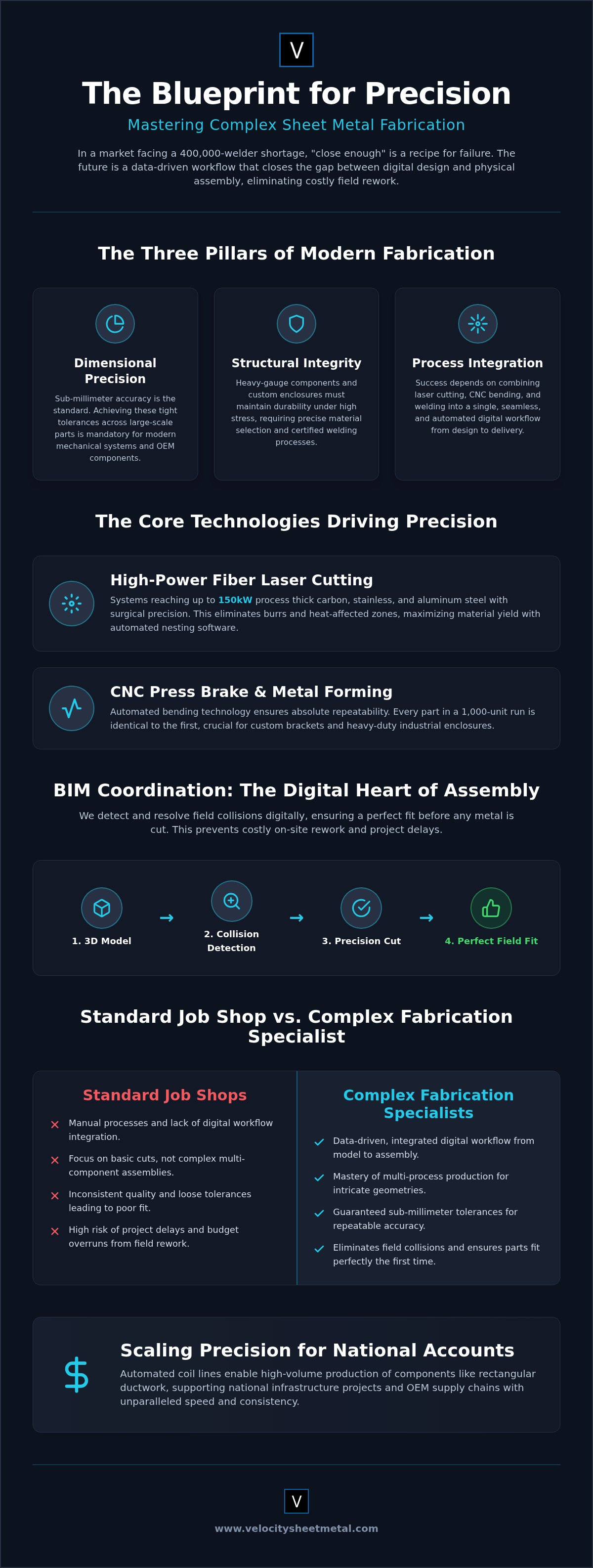
In 2026, complex sheet metal fabrication isn't just a service; it's a data-driven engineering discipline. It involves multi-process production that handles intricate geometries and sub-millimeter tolerances. Unlike standard job shops that focus on basic cuts, a complex specialist manages the entire lifecycle of a component. This includes everything from the initial digital spooling to the final assembly of heavy-gauge parts. The industry has moved toward a digital-first approach where the physical product is a precise reflection of a 3D model. Precision is no longer optional. It's the baseline.
Standard job shops often struggle with the coordination required for high-stakes industrial projects. They might produce a single part well, but they lack the infrastructure to handle the complex sheet metal fabrication required for multi-component assemblies. Modern sheet metal processing requires high-power fiber lasers and automated CNC forming to maintain consistency across thousands of units. This level of technical depth separates a simple bracket from a critical industrial component that must fit perfectly into a national infrastructure project.
The Three Pillars of Complexity
Complexity is built on three fundamental requirements. These ensure a project survives the transition from design to the field:
- Dimensional precision: Sub-millimeter accuracy is the standard. Achieving these tolerances across large-scale parts is mandatory for modern mechanical systems.
- Structural integrity: Enclosures must hold up. Heavy-gauge components and custom enclosures must maintain durability under high stress, requiring precise material selection.
- Process integration: Speed requires a single flow. Success depends on combining laser cutting, CNC bending, and welding into one automated workflow.
Industrial Applications for Complex Components
Demand for high-precision parts is surging. OEMs require repeatable accuracy for heavy machinery parts to ensure long-term reliability. In the HVAC sector, custom transition fittings and curb adapters must be engineered to exact specs. This prevents energy loss and air leakage in commercial buildings. National commercial projects rely on high-volume production where every unit is a perfect clone of the master design. Scalability is only possible when a fabricator uses automated coil lines and BIM coordination to manage the production flow. We bridge the gap between a digital file and a tangible, high-performance product.
Precision Technologies: Laser Cutting and CNC Forming
High-power fiber lasers have redefined the speed and accuracy of industrial production. In 2026, systems reaching up to 150kW allow for rapid processing of thick carbon steel while maintaining surgical edge quality. This technology is the backbone of complex sheet metal fabrication, enabling us to move from raw material to finished part without the burrs or heat-affected zones seen in traditional methods. By integrating automated nesting software, we maximize sheet yield. This isn't just about saving material; it's about optimizing the entire production line to ensure that national accounts receive their components on time, every time.
Advanced Laser Cutting Capabilities
Precision requires material versatility. Whether you're working with aluminum, stainless steel, or carbon steel, our systems handle varying thicknesses with ease. We execute tight tolerances that meet the strict specifications of engineers and OEMs, ensuring that every part fits the first time. Adhering to SMACNA industry standards provides a framework for quality that standard job shops often overlook. This level of technical rigor supports on-demand part production, allowing for a seamless transition from a digital file to a physical component. For more on how we manage these specifications, explore our guide to precision laser cutting services.
CNC Press Brake and Metal Forming
Repeatability is the true test of a fabrication partner. CNC press brake bending ensures that every part in a 1,000-unit run is identical to the first. This level of consistency is essential for the complex sheet metal fabrication of custom brackets and heavy-duty enclosures used in industrial equipment. By leveraging automated bending technology, we significantly reduce the risk of common press brake forming defects like cracking or over-bending. This process-oriented approach allows us to maintain structural integrity in heavy-gauge components while keeping production moving at a fast pace. It's a methodical way to ensure that your assemblies are ready for immediate installation.
If you're looking for a partner that prioritizes this level of accuracy, our precision metal forming team is ready to review your project specifications and get to work immediately.
BIM Coordination: The Digital Heart of Complex Assembly
BIM coordination is the central nervous system of any high-stakes industrial build. It moves far beyond simple 3D visualization by identifying physical clashes before a single sheet is loaded onto the laser or coil-line. In the context of complex sheet metal fabrication, this digital foresight is what prevents expensive field re-works and cascading lead time delays. By utilizing a rigorous "digital-to-physical" workflow, we ensure that intricate HVAC systems and mechanical assemblies fit perfectly upon arrival. This process is essential for BIM for sheet metal fabrication because it drastically reduces material waste and unnecessary labor hours.
Mechanical Spooling and Drawing Accuracy
Design intent is only the starting point for a complex project. Mechanical spooling takes that high-level intent and translates it into machine-ready shop drawings. These drawings break down massive, multi-faceted assemblies into manageable, fabricated sections that are optimized for shipping and rapid installation. During this phase, we apply the physics of fundamental metal forming processes to ensure every bend and flange is physically achievable. High-level accuracy in BIM clash detection for HVAC fabrication allows contractors to install systems with zero field collisions. It effectively turns a chaotic job site into an orderly assembly line where parts snap together as intended.
Integrating BIM with Automated Production
The real power of BIM lies in its direct connection to the factory floor. We use direct-to-machine data transfers to push spool drawings straight to our automated coil-lines and laser cutters. This eliminates the manual entry errors that often plague standard job shops. For large-scale national commercial projects, real-time coordination means we can adjust designs on the fly and push those updates to production instantly. This digital integration keeps project timelines tight and ensures strict budget adherence. It's the most efficient way to scale complex sheet metal fabrication across multiple job sites without losing precision. We act as the essential bridge between the digital file and the tangible, installed product, ensuring that what you see in the model is exactly what you get in the field.
Standard Job Shops vs. Complex Fabrication Specialists
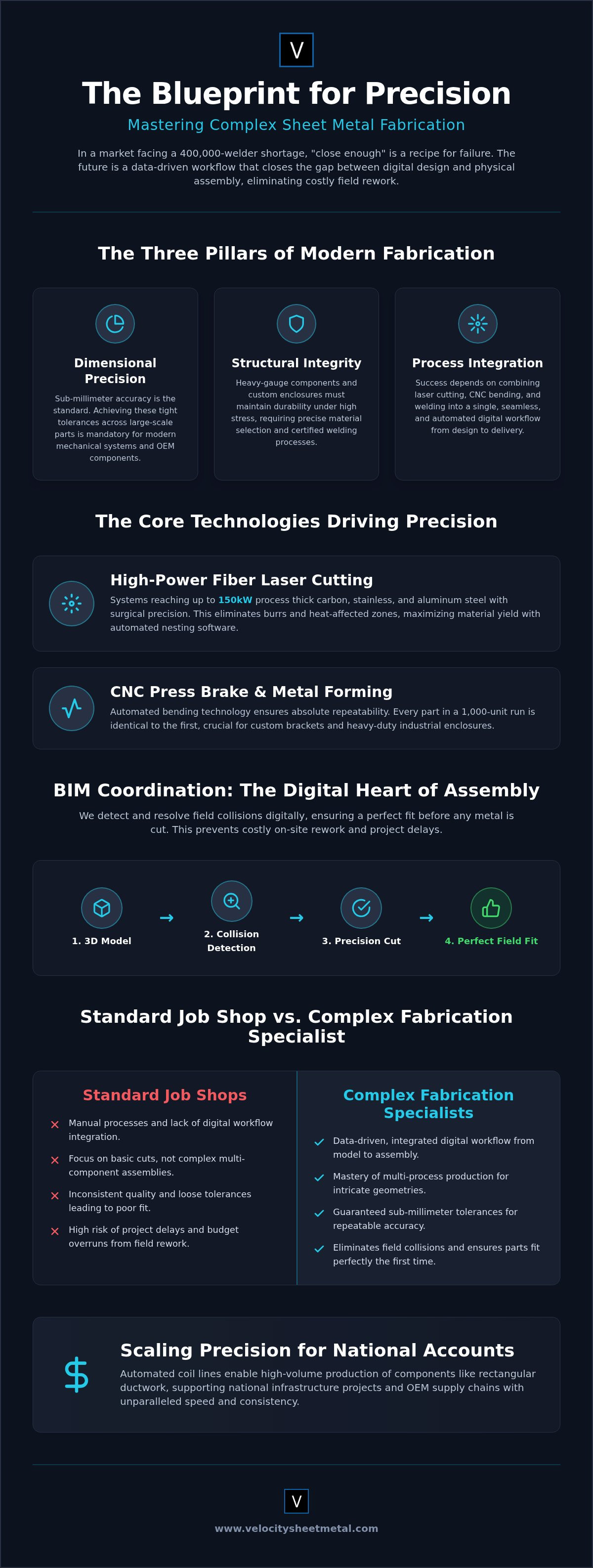
Choosing a fabrication partner is a decision that dictates the profitability of your entire project. Standard job shops often rely on manual processes that fail when pushed to handle high-volume, intricate assemblies. In contrast, specialists in complex sheet metal fabrication use a vertically integrated approach. They combine advanced machinery with digital oversight to move a project from design to delivery without the typical friction of manual rework. For mechanical contractors, this difference is most visible in HVAC duct fabrication for mechanical contractors who require national scale and pinpoint accuracy. We move you from a conceptual file to a physical product ready for immediate installation.
Key Evaluation Metrics for Procurement
Procurement officers must look beyond the initial quote to find true value. Evaluation begins with automation. Does the shop use an automated coil line for rectangular duct, or is every piece hand-formed? Digital maturity is the next hurdle. A capable partner must ingest BIM models and output spool drawings directly to the factory floor. Finally, consider scalability. A local shop might handle a single building, but a specialist supports national accounts with standardized quality across the country. This ensures your components meet the same rigorous specs whether they're heading to a data center or a commercial high-rise.
The Risk of Choosing the Wrong Partner
The wrong partner introduces hidden costs that don't appear on a purchase order. Field collisions and re-fabrication are the primary killers of project budgets. If a shop lacks automated rectangular duct production, you face lead time volatility that ripples through your entire construction schedule. Regional inconsistencies also pose a threat. Relying on multiple small shops for a national project leads to varying quality standards and mismatched fittings. A single, tech-savvy partner eliminates these variables by providing a controlled, transparent, and repeatable process. It's the only way to maintain the complex sheet metal fabrication standards required in 2026.
Logistics are the final piece of the puzzle. Complex assemblies require sophisticated shipping strategies to ensure they arrive undamaged and on time. We manage the entire lifecycle of your order, from the first digital review to nationwide delivery. This logistical precision allows you to maintain momentum on-site without waiting for delayed or defective parts. If you're ready to upgrade your supply chain, partner with a fabrication specialist that prioritizes speed and precision.
Scaling Precision: Automated Coil Lines and National Accounts
Precision at scale requires more than just skilled hands; it requires automated infrastructure. In 2026, the automated coil line is the definitive solution for high-volume rectangular duct production. It transforms raw coils into finished, notched, and folded ductwork with minimal human intervention. This setup represents the ultimate expression of complex sheet metal fabrication for the HVAC and industrial sectors. By removing manual variability, we ensure that every section of duct meets the exact pressure class and dimensional requirements specified in your BIM model. We move your project from a digital concept to a high-volume reality at a pace that manual shops simply cannot match.
Automated Coil-Line Efficiency
Speed never compromises accuracy in an automated workflow. High-speed production allows for the rapid output of rectangular duct without sacrificing the tight tolerances required for modern mechanical systems. By automating the shearing and forming processes, we significantly reduce labor costs and shorten lead times for large-scale commercial projects. Consistency is baked into the code. Every piece, from the first to the thousandth, is an identical match to the master design. This predictability allows mechanical contractors to hit aggressive milestones on national infrastructure builds, knowing that every component will fit perfectly upon arrival.
Supporting National Accounts Nationwide
Scale is irrelevant without standardized quality across every job site. Velocity Sheet Metal supports national accounts by applying the same rigorous production standards to every order, regardless of the final destination. We bridge the gap between high-end engineering and logistical reality. For OEMs with national distribution needs, our on-demand part production ensures a steady supply of precision components. We bring over 50 years of combined management experience to the table. This expertise ensures that custom curb adapters and specialized fittings are engineered for durability and shipped with surgical precision.
Logistics are the final barrier to scale. We manage the entire logistical chain for custom curb adapters and high-volume ductwork, ensuring that nationwide shipping doesn't become a bottleneck. This is critical for national accounts that require synchronized delivery schedules across multiple regions. By centralizing production through our automated systems, we eliminate the quality drift often found when using multiple regional vendors. It's clear that coil line duct fabrication is the future of the industry. It provides the only viable path to balancing extreme precision with the massive volume required for 2026 industrial projects. We deliver complex sheet metal fabrication at a national scale while maintaining a firm grip on the details that matter most.
Securing Your Industrial Supply Chain for 2026
The gap between a 3D model and a successful installation is closed by precision and data. Success in complex sheet metal fabrication requires moving beyond the limitations of manual job shops. By integrating BIM coordination with high-speed automation, you eliminate field collisions and lead time delays. We've built our infrastructure to handle the most demanding requirements, from intricate laser-cut parts to high-volume rectangular duct.
Our BIM-integrated workflows ensure that every spool drawing translates perfectly to the factory floor. With automated coil-line efficiency and dedicated national account support, we provide the scale and reliability your projects demand. We act as the essential bridge between your digital files and a tangible, high-performance product. It's time to build with confidence and speed. Request a Quote for Your Complex Fabrication Project today. Let's get to work on your next high-tolerance assembly.
Frequently Asked Questions
What qualifies as complex sheet metal fabrication?
Complex sheet metal fabrication involves multi-process production that handles intricate geometries and sub-millimeter tolerances. It moves beyond simple cutting by integrating digital modeling with advanced machinery to produce components like custom enclosures or specialized fittings. This discipline requires a seamless workflow between design, laser cutting, and precision bending to ensure structural integrity across large-scale industrial assemblies. It's the standard for projects where "close enough" isn't an option.
How does BIM coordination improve the fabrication process?
BIM coordination acts as a digital shield against field collisions by identifying physical clashes before production begins. It allows us to translate 3D models into machine-ready files, ensuring that complex HVAC systems fit perfectly on-site. This digital-to-physical workflow reduces material waste and labor hours significantly. By resolving spatial conflicts in a virtual environment, we maintain project momentum and ensure that every fabricated component snaps into place without manual rework.
Can you ship complex HVAC assemblies nationwide?
Yes, we provide comprehensive nationwide shipping for all complex HVAC assemblies and precision parts. Our logistics network is optimized to handle high-volume orders, from automated rectangular duct to custom curb adapters. We ensure that standardized quality is maintained across the country, supporting national accounts with reliable delivery schedules. This centralized production model eliminates the inconsistencies often found when managing multiple regional vendors for a single national project.
What are the lead times for custom curb adapters?
Lead times for custom curb adapters vary based on project complexity and volume, but our automated workflow is designed for maximum speed. By utilizing CNC laser cutting and precise forming technology, we cut through the administrative delays typical of standard shops. We recommend contacting our team with your specific requirements to receive a firm delivery schedule. Our focus on industrial pragmatism means we prioritize your timeline to keep your project moving.
Do you provide mechanical spool drawings for contractors?
We provide detailed mechanical spool drawings that translate design intent into shop-ready fabrication files. This service is essential for contractors who need to reduce installation time and eliminate field errors. Our spool drawings break down large assemblies into manageable sections optimized for shipping and rapid assembly. By integrating these drawings directly with our automated machinery, we ensure that every part matches the model with surgical precision.
What materials can your precision laser cutting service handle?
Our precision laser cutting service utilizes high-power fiber lasers to process a wide range of industrial materials. We handle aluminum, stainless steel, and carbon steel with thicknesses that meet the rigorous demands of OEMs and mechanical contractors. These systems are capable of maintaining sub-millimeter tolerances while producing clean, burr-free edges. This versatility ensures that we can support diverse applications, from lightweight architectural components to heavy-gauge structural parts for national infrastructure.
How does an automated coil line differ from traditional duct fabrication?
An automated coil line differs from traditional fabrication by replacing manual shearing and folding with a high-speed, synchronized system. It transforms raw metal coils into finished rectangular duct with minimal human intervention, ensuring every piece is an identical match. This automation is a cornerstone of complex sheet metal fabrication, reducing labor costs and lead times while improving accuracy. Unlike manual shops, our coil line uses direct-to-machine data transfers to eliminate human entry errors.
Do you support national accounts for OEM part production?
We specialize in supporting national accounts for OEM part production by providing standardized quality across the entire United States. Our 50 years of combined management experience allows us to manage high-volume requirements with consistent production standards. Whether you need on-demand laser cutting or repeatable CNC bending, we act as a reliable partner that scales with your growth. This centralized approach ensures that your components meet the same rigorous specifications across every region.