Standardized HVAC Ductwork for National Chains: A Guide to Scalable Procurement

Why are you still treating every new location like a custom engineering experiment? For most national brands, the transition to A2L refrigerants and the strict safety requirements of ASHRAE 15-2024 have made the old way of building too risky. You already know the pain of regional fabrication quality that varies between subcontractors and field collisions that stall multi-site rollouts. It's an inefficient cycle that eats into your margins and pushes back grand openings. HVAC ductwork isn't just a building component; it's a product that must be manufactured with precision.
We agree that your infrastructure should be a repeatable, "plug-and-play" asset, not a source of field-level headaches. This guide shows you how to leverage standardized HVAC ductwork for national chains to eliminate field variables and accelerate your construction timelines. You'll learn how automated coil-line production and BIM coordination create a zero-waste installation process with predictable procurement costs. We will walk through the transition from digital concept to physical delivery, ensuring your next project remains controlled, transparent, and repeatable.
Key Takeaways
- Eliminate regional quality gaps by shifting from custom field fabrication to a uniform, factory-controlled production system across all sites.
- Use BIM coordination and spool drawings to identify design collisions before they reach the job site, preventing expensive rollout delays.
- Transition from fragmented local procurement to a national fabrication model for scalable volume and a single point of accountability.
- Discover how standardized HVAC ductwork for national chains creates a "plug-and-play" infrastructure that reduces field labor and waste.
- Follow a strategic roadmap to establish master mechanical specifications that align with modern A2L refrigerant safety standards and automated coil-line capabilities.
The Scaling Challenge: Why National Chains Require Standardized HVAC Ductwork
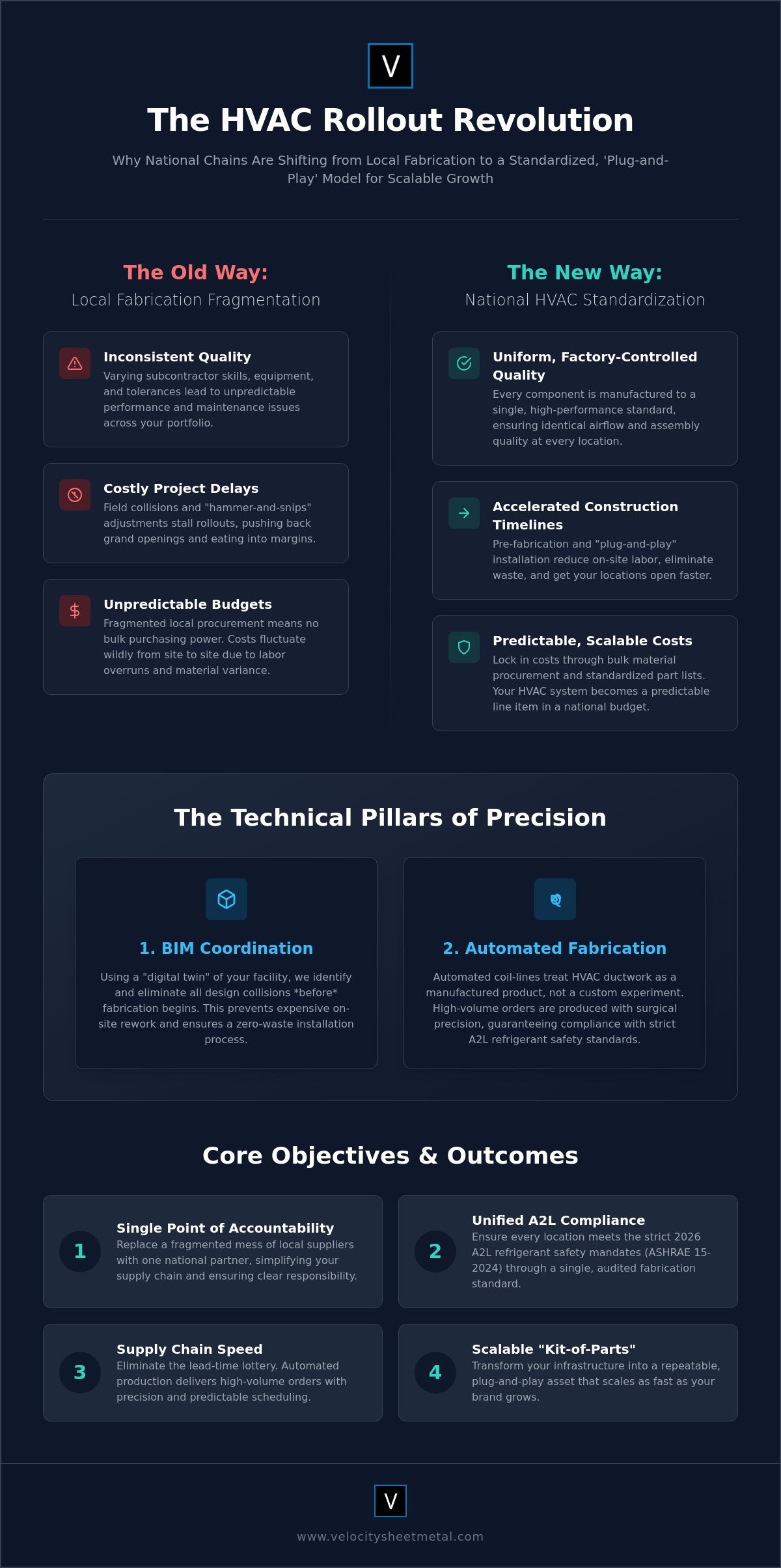
National expansion demands more than just a common blueprint; it requires a repeatable industrial product. When a brand opens 50 locations across ten states, relying on a patchwork of regional fabrication shops introduces a dangerous level of fragmentation. Standardized HVAC ductwork for national chains solves this by treating the mechanical infrastructure as a uniform system rather than a series of local projects. This "kit-of-parts" logic ensures that every facility, whether it is in Florida or Oregon, receives the exact same airflow performance and assembly quality. By centralizing these standards, companies move away from reactive field adjustments and toward a proactive manufacturing model.
Fragmented procurement is the enemy of the fast-track rollout. When every local subcontractor uses their own preferred gauges, seam types, and connection methods, the national brand loses control over its own assets. This inconsistency leads to unpredictable maintenance headaches and variable energy costs across the portfolio. Centralized standards allow for bulk material purchasing and unified engineering specifications. It turns the mechanical system into a predictable line item in a national budget. You aren't just buying metal; you are buying a scalable procurement strategy that eliminates the variables that stall construction timelines.
The High Cost of Local Fabrication Variance
Local shops operate with different equipment, varying labor skills, and inconsistent tolerances. A slight variation in metal gauge or seam integrity might seem minor in a single building, but it impacts the longevity of the entire HVAC ductwork system across a national fleet. When parts don't fit perfectly, field teams spend expensive hours on "field-fitting" adjustments. These labor hours add up. Worse, localized procurement creates data silos. You lose the ability to track performance across your portfolio or optimize your design based on real-world fabrication data. Precision at the factory level prevents the "hammer-and-snips" mentality that drives up costs on the job site.
Core Objectives of National Standardization
The goal is simple: identical performance metrics regardless of the building footprint or geographic climate. By reducing the number of fabrication partners, you simplify the supply chain and gain a single point of accountability. It's about moving from a fragmented mess to a unified engineering specification that scales as fast as your brand does. Key objectives include:
- Unified Compliance: Ensuring every component meets national building codes and the 2026 A2L refrigerant safety mandates through a single fabrication standard.
- Supply Chain Speed: Eliminating the lead-time lottery by using automated coil-lines that produce high-volume orders with surgical precision.
- Predictable Budgeting: Locking in costs through bulk material procurement and standardized part lists that don't change from site to site.
Stop treating your HVAC systems like custom one-offs. The project doesn't start at the job site; it starts at the automated coil-line. Precision fabrication is the essential bridge between a digital design file and a tangible, high-performing product.
The Technical Pillars: BIM Coordination and Automated Fabrication
Precision is the foundation of scalability. You cannot achieve standardized HVAC ductwork for national chains through manual labor alone. It requires a technical workflow that begins in a virtual environment long before a single sheet of galvanized steel is cut. By utilizing a digital twin, national accounts can lock in their mechanical specifications, ensuring that every fitting and straight run is optimized for both airflow and installation speed. This shift from "build and adjust" to "design and manufacture" is what separates modern national rollouts from traditional construction projects.
The transition to A2L refrigerants in 2026 makes this technical precision even more critical. Automated systems ensure that all ductwork meets the specific sealing and pressure requirements mandated by ASHRAE Standard 90.1. When your infrastructure is built to a single, high-performance standard, you eliminate the performance gaps that typically plague multi-site portfolios. It's about moving the technical burden from the field to the factory floor.
BIM Integrated Fabrication: Model to Machine
Standardization lives in the data. Professional mechanical BIM services allow national chains to create a master specification that accounts for every structural constraint. BIM coordination identifies potential collisions with plumbing or electrical lines in the design phase, not during the middle of an expensive installation. Once the model is clash-free, spool drawings translate these complex designs into machine-ready instructions. This direct pipeline from software to CNC machinery reduces scrap through optimized digital nesting. You pay for the product, not the waste. If you are ready to modernize your workflow, you can partner with an expert operator who understands these digital requirements.
Automated Coil-Line Advantages for National Accounts
Consistency is the primary product of automation. For high-volume projects, coil line duct fabrication is the only way to ensure that every rectangular section is identical to the last. This automated process guarantees SMACNA pressure class compliance across every unit manufactured for your brand. There is no room for human error in seam closure or flange alignment. Beyond quality, the speed advantage is undeniable. Automated lines can process thousands of pounds of steel daily, meeting aggressive rollout deadlines that would bury a traditional local shop. Precision laser cutting complements this by repeating complex fittings with zero variance, ensuring a "plug-and-play" fit every time.
- Zero Variance: Every piece matches the digital spool drawing to the millimeter.
- Rapid Output: Automated lines move as fast as your construction schedule demands.
- Code Compliance: Integrated software ensures every part meets current 2026 safety and energy standards.
Don't let manual fabrication slow down your expansion. The technical pillars of BIM and automation provide the predictability you need to scale without compromise. When the model matches the machine, the job site becomes an assembly point rather than a fabrication zone.
Comparing Procurement Models: National Fabrication vs. Local Fragmentation
Proximity is often mistaken for efficiency. Many national brands default to local job-shops because they are "just down the street" from the construction site. While local shops offer short-range shipping, they almost always lack the capacity to handle national volume or the technology to maintain identical tolerances across multiple states. Standardized HVAC ductwork for national chains requires a single point of accountability. When you centralize fabrication with a national partner, you replace a dozen different quality standards with one high-precision manufacturing process. This model shifts the focus from local convenience to national predictability.
The real metric for success isn't the shipping invoice; it's the total cost of quality. A local shop might save you a few hundred dollars in freight, but a single field collision caused by poor fabrication can cost thousands in labor delays. National fabricators use automated coil-lines and precision laser cutting to ensure every part fits the first time. This "plug-and-play" infrastructure reduces your reliance on highly skilled field labor. Instead of craftsmen cutting and fitting metal on a scissor lift, your team becomes an assembly crew installing a pre-engineered kit. You trade variable field expenses for a fixed, predictable shipping cost.
The 'Hidden' Costs of Local Job-Shops
Fragmentation creates technical drift. One regional shop might use a specific sealing method while another uses an entirely different approach, leading to inconsistent leakage rates across your portfolio. These variations make it impossible to hit unified performance targets. Most local shops also lack the overhead to provide comprehensive BIM coordination, leaving the "clash detection" to your installers in the field. This creates a capacity risk. If a local shop hits its limit during your peak rollout season, your entire schedule stalls. Relying on SMACNA HVAC ductwork standards is essential, but local interpretation of those standards varies wildly without a centralized fabrication partner.
Benefits of a Unified National Supply Chain
A unified supply chain turns your mechanical infrastructure into a streamlined administrative process. Instead of managing 50 different invoices and 50 different sets of lead times, your national account department deals with one partner. This level of control allows for precise construction scheduling that isn't at the mercy of regional shop backlogs. We provide:
- Ready-to-Install Kits: Ductwork is bundled and labeled by zone, arriving at the job site ready for immediate hanging.
- Administrative Efficiency: Unified billing and documentation for every location in your rollout.
- Lead Time Certainty: Automated production lines provide a guaranteed output that matches your expansion velocity.
Stop managing dozens of individual fabrication projects. Start managing a single, high-performance product line. When you choose standardized HVAC ductwork for national chains, you aren't just buying metal; you are buying the ability to scale without the traditional friction of local construction variables.

Implementing a Standardized HVAC Program: A Roadmap for National Accounts
Transitioning from a fragmented procurement model to a manufacturing-first strategy requires a methodical sequence. You cannot simply order standardized HVAC ductwork for national chains and expect it to fit without a structured roadmap. Implementation starts at the executive level, where you define the standards that will govern every location in your rollout. This process moves the complexity from the active construction site back into the controlled environment of the fabrication facility. By following a phased approach, you turn your mechanical infrastructure into a predictable, scalable asset.
- Phase 1: Establish a Master Mechanical Specification. Define the metal gauges, seam types, and pressure classes for all building types. This becomes the single source of truth for every regional project.
- Phase 2: Integrate BIM Coordination Early. Clashes should be resolved during the prototype design phase. A digital twin ensures that the "kit-of-parts" logic works across diverse footprints.
- Phase 3: Select a Strategic Fabrication Partner. You need a partner with automated coil-line capacity and proven nationwide shipping capabilities to maintain expansion velocity.
- Phase 4: Develop a Spooling Strategy. Break the design into manageable sections. Spool drawings guide the automated machinery and provide a clear map for the field assembly teams.
Designing for Manufacturability
Standardization is most effective when the design is simplified for automated production. Collaborate with your engineering team to reduce the number of unique fittings and complex offsets. By creating a library of standard parts, you speed up the design phase for future sites and ensure that your fabrication partner can run high-volume batches with zero downtime. This includes standardizing transition fittings and custom curb adapters for rooftop units. When the design favors the machine, the production speed increases and the cost per unit drops.
Logistics and On-Site Execution
The final step of the roadmap is the physical delivery of the product. A "floor-by-floor" or "zone-by-zone" packaging strategy ensures that field crews aren't sorting through a mountain of metal to find a single elbow. Every piece of ductwork should arrive with a standardized label that corresponds directly to the BIM spool drawing. This level of organization reduces on-site sorting time and allows for just-in-time delivery. We coordinate nationwide shipping to align with your specific construction milestones, ensuring the metal arrives exactly when the hangers are ready. If you are ready to eliminate the chaos of regional procurement, request a technical review of your national specifications today.
Velocity Sheet Metal: Your National Partner for Precision HVAC Standardization
Scaling a national brand requires a partner who operates at the speed of manufacturing, not the pace of traditional construction. Velocity Sheet Metal provides the automated infrastructure that allows you to treat your mechanical systems as a repeatable product. Our facility is designed for high-volume consistency. We utilize an automated coil-line to ensure every piece of rectangular duct meets the same rigorous standard, regardless of the destination. By bridging the gap between digital BIM files and tangible, precision-cut physical products, we eliminate the guesswork that typically plagues multi-site rollouts.
Strategic nationwide shipping is a core component of our service model. We don't just fabricate; we manage the logistics of delivery to any project site in the US. This ensures that your procurement team has a single point of accountability for standardized HVAC ductwork for national chains. We move your project from a digital concept to a physical result with surgical precision. This keeps your construction schedule on track and your budget predictable.
Expertise in High-Volume Commercial Fabrication
Success in national MEP projects depends on the depth of your partner's industrial experience. We leverage over 50 years of combined management experience to solve the complex needs of national accounts. Our facility specializes in precision laser cutting services for custom components and complex fittings. We position ourselves as "Authoritative Expert Operators" who are equally comfortable in a high-level design meeting and on the factory floor. We cut through the typical administrative delays of the industry. It's about acting as a tech-savvy partner obsessed with detail and delivery.
Streamlining Your National Rollout
We solve traditional industrial problems with modern technology. Our BIM coordination and spooling services prevent costly field collisions before they happen. This turns the job site into a simple assembly point rather than a fabrication zone. Our on-demand production capabilities adapt to your changing construction schedules, providing the flexibility you need during rapid expansions. We move your project from the initial digital input through technical review to the final logistics of delivery. Contact Velocity Sheet Metal today to discuss your strategy for standardized HVAC ductwork for national chains and see how our automated workflow can accelerate your next rollout.
Accelerate Your National Expansion with Industrial Precision
National rollouts fail when they rely on custom, site-specific work that varies by region. By adopting standardized HVAC ductwork for national chains, you transform your mechanical infrastructure into a predictable, high-performance asset. This transition eliminates the quality gaps of local fragmentation and replaces them with a factory-controlled "kit-of-parts" logic. You gain total control over your construction timelines and eliminate the expensive field collisions that stall grand openings.
Our automated coil-line ensures high-volume accuracy while full BIM coordination and spooling services bridge the gap between design and physical reality. With strategic nationwide shipping, your mechanical components arrive ready for immediate installation at any US location. Standardizing your systems isn't just about the metal; it's about the speed of your expansion. By centralizing procurement, you move from a reactive "clash-and-fix" model to a proactive, manufacturing-first approach that delivers results across every zip code.
Scale your national rollout with Velocity's automated HVAC fabrication solutions.
We are ready to build a faster, more reliable supply chain with you today.
Frequently Asked Questions
What is standardized HVAC ductwork for national chains?
Standardized HVAC ductwork for national chains is a uniform mechanical fabrication system designed to be replicated across every location in a brand's portfolio. Instead of treating each site as a unique engineering project, this model uses a "kit-of-parts" approach with fixed specifications for metal gauges, seams, and fittings. It moves the complexity from the job site to an automated factory environment to ensure consistent performance and rapid installation.
How does BIM coordination improve national HVAC rollouts?
BIM coordination creates a "digital twin" of your mechanical design to identify and resolve structural collisions before fabrication begins. By clashing the ductwork against plumbing and electrical lines in a virtual space, you eliminate the need for expensive field adjustments. This proactive approach ensures that every component fits perfectly the first time, which is essential for maintaining aggressive multi-site construction schedules.
Can standardized ductwork be shipped nationwide effectively?
Yes, centralized fabricators utilize strategic nationwide shipping to deliver precision-cut ductwork directly to any US project site. By bundling and labeling components by zone or floor, these kits arrive ready for immediate assembly. This logistical efficiency often outweighs the risks and costs associated with local job-shop fragmentation, providing a single point of accountability for your entire national rollout.
Does standardization increase the initial cost of HVAC fabrication?
Standardization may involve a higher initial investment in BIM coordination and prototype design, but it significantly reduces the total cost of quality. By eliminating field-fitting labor and reducing material waste through automated nesting, the overall project cost becomes more predictable. You trade the variable expenses of on-site rework for the fixed, transparent costs of precision manufacturing and bulk material procurement.
What are the benefits of using a centralized fabricator for multi-site projects?
A centralized fabricator provides a unified quality standard and streamlined administrative overhead for your national account department. You deal with one partner, one set of lead times, and one invoicing process across all locations. This model ensures that your 2026 A2L refrigerant safety compliance and SMACNA standards are applied identically to every facility in your portfolio, regardless of geographic location.
How does automated coil-line production ensure consistency?
Automated coil-line production removes human error from the fabrication process by using programmed instructions to cut, notch, and bead rectangular duct sections. Every piece is identical to the last, ensuring that pressure classes and seam integrity are maintained across high-volume orders. This level of repeatability is impossible to achieve through manual labor or fragmented regional shops, making it the gold standard for national scalability.
What is the difference between a custom fitting and a standardized fitting?
A custom fitting is designed on-site to solve a specific field problem, often leading to inconsistent airflow and higher labor costs. A standardized fitting is a pre-engineered component included in your brand's master mechanical specification. These fittings are optimized for automated production and precision laser cutting, ensuring they fit the "plug-and-play" infrastructure of your prototype buildings without requiring manual field adjustments.
How do I start a standardization program for my restaurant or retail chain?
Start by establishing a master mechanical specification that defines the standards for all your building types. You should then integrate BIM coordination during the prototype design phase to lock in your "kit-of-parts" logic for standardized HVAC ductwork for national chains. Finally, partner with an authoritative expert operator who possesses the automated capacity and nationwide shipping logistics to execute your rollout. This sequence moves your infrastructure from custom construction to a scalable industrial product.