Custom Metal Brackets Manufacturing: The 2026 Industrial Guide
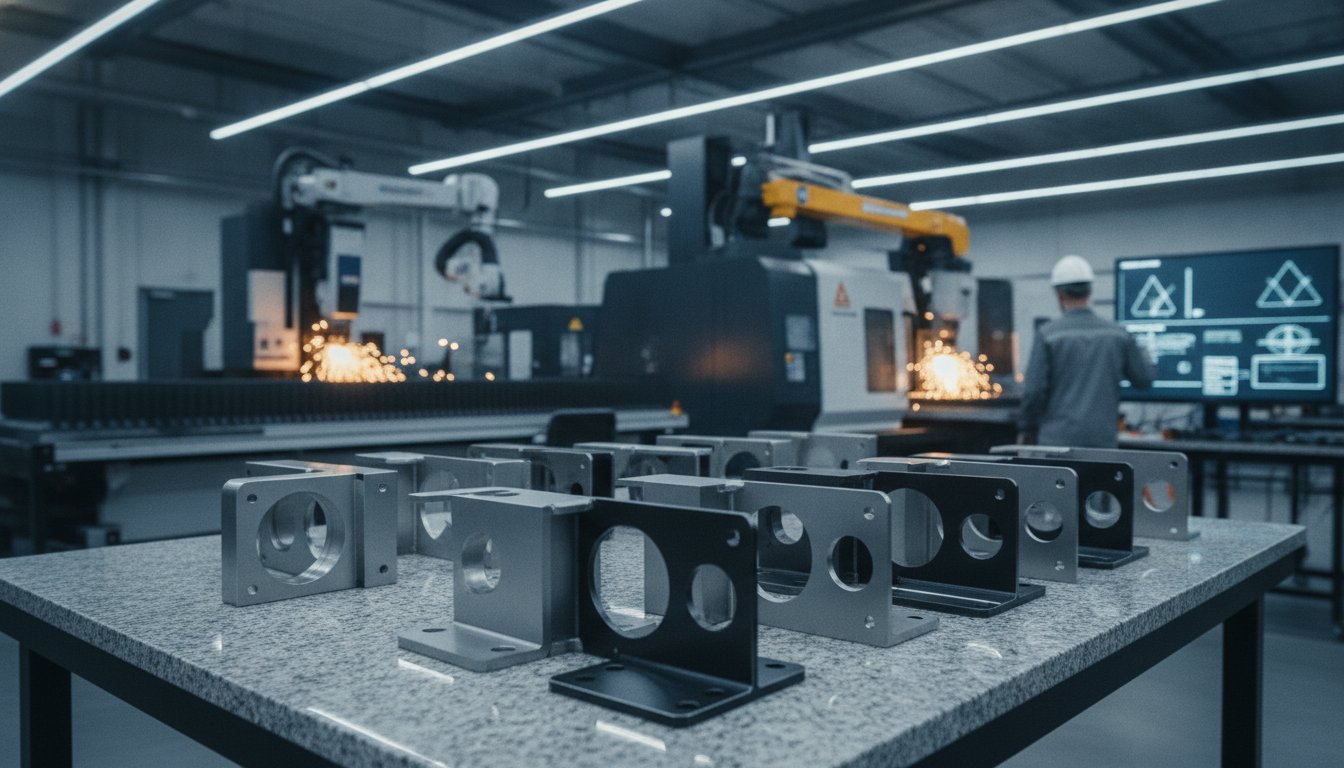
A single millimeter of error in a mounting bracket can halt a multi-million dollar HVAC installation. You've likely dealt with the frustration of field collisions caused by inaccurate dimensions or the long lead times that throw project schedules into chaos. It's a common bottleneck in industrial procurement where poor design for manufacturability leads to unnecessary material waste and mounting costs. You shouldn't have to choose between speed and surgical accuracy.
Mastering custom metal brackets manufacturing in 2026 requires a shift from traditional shop drawings to integrated digital workflows. This guide provides the technical roadmap you need to produce high-precision parts that fit perfectly the first time. You'll learn how to streamline procurement from digital file to physical part while maintaining scalable production for national accounts.
We'll examine the latest industrial standards, including BIM-to-CAM synchronization and the impact of 30 kW fiber laser technology. From navigating Build America, Buy America (BABA) compliance to optimizing hole-to-bend ratios for CNC press brakes, this guide covers the essential processes for modern industrial fabrication. Let's get to work on refining your production pipeline.
Key Takeaways
- Identify the economic tipping point between laser cutting and stamping to select the most cost-effective path for your specific production volume.
- Synchronize BIM coordination with custom metal brackets manufacturing to prevent field collisions and ensure perfect fitment on the first try.
- Select the optimal material and gauge thickness to balance structural load requirements with project-specific weight and cost constraints.
- Implement DFM protocols that eliminate material waste and accelerate the transition from digital CAD files to physical industrial components.
- Leverage standardized production and on-demand shipping to scale bracket procurement for national accounts and large-scale infrastructure.
The Critical Role of Custom Metal Brackets in Industrial Infrastructure
Industrial infrastructure isn't built on large-scale components alone. It's held together by the precision of custom metal brackets manufacturing. These parts are the structural linchpins for heavy mechanical systems, ensuring that massive HVAC units and industrial ductwork remain secure under extreme stress. Off-the-shelf hardware often falls short of modern OEM specifications. Standard L-brackets lack the specific load-bearing geometry or material thickness required for specialized installations. When a generic bracket fails, it isn't just a part replacement; it's a system-wide shutdown.
Modern manufacturing has evolved beyond simple L-shapes. Today, brackets are complex, multi-functional assemblies designed to integrate into Building Information Modeling (BIM) workflows. Engineers now demand parts that accommodate specific sheet metal fabrication processes and gauges to ensure long-term durability. This precision eliminates the need for field modifications. Mechanical contractors move straight from unboxing to installation, bypassing the delays of on-site drilling. Generic hardware fails for several reasons:
- Inadequate gauge thickness for heavy industrial loads.
- Lack of specialized coatings for corrosive environments.
- Incompatibility with high-vibration mechanical equipment.
- Dimensional drift that causes field collisions during assembly.
HVAC and Mechanical Support Systems
In high-performance HVAC environments, brackets do more than just hang ductwork. They must manage vibration isolation and account for thermal expansion within the system. Custom-designed supports prevent the harmonic resonance that can damage sensitive equipment over time. For national accounts, standardizing these bracket types is a strategic move. It ensures consistent maintenance protocols across multiple facilities. High-precision CNC press brake bending allows for repeatable accuracy, so every bracket in a large-scale order fits its designated mounting point perfectly.
OEM and Industrial Component Requirements
Original Equipment Manufacturers (OEMs) require internal mounting brackets that fit within tight tolerances of heavy machinery enclosures. Material compatibility is a non-negotiable factor. In corrosive or high-heat environments, switching from galvanized steel to 304 or 316 stainless steel is essential for longevity. Integrating custom metal brackets manufacturing into the OEM design phase reduces the risk of assembly errors. These custom components are often integrated directly into larger spool drawings. By utilizing BIM coordination, we ensure that every mounting hole and flange alignment is verified before the first piece of metal is cut. This digital-to-physical synchronization is what keeps modern industrial projects on schedule and under budget.
Advanced Manufacturing Processes: Laser Cutting vs. Metal Stamping
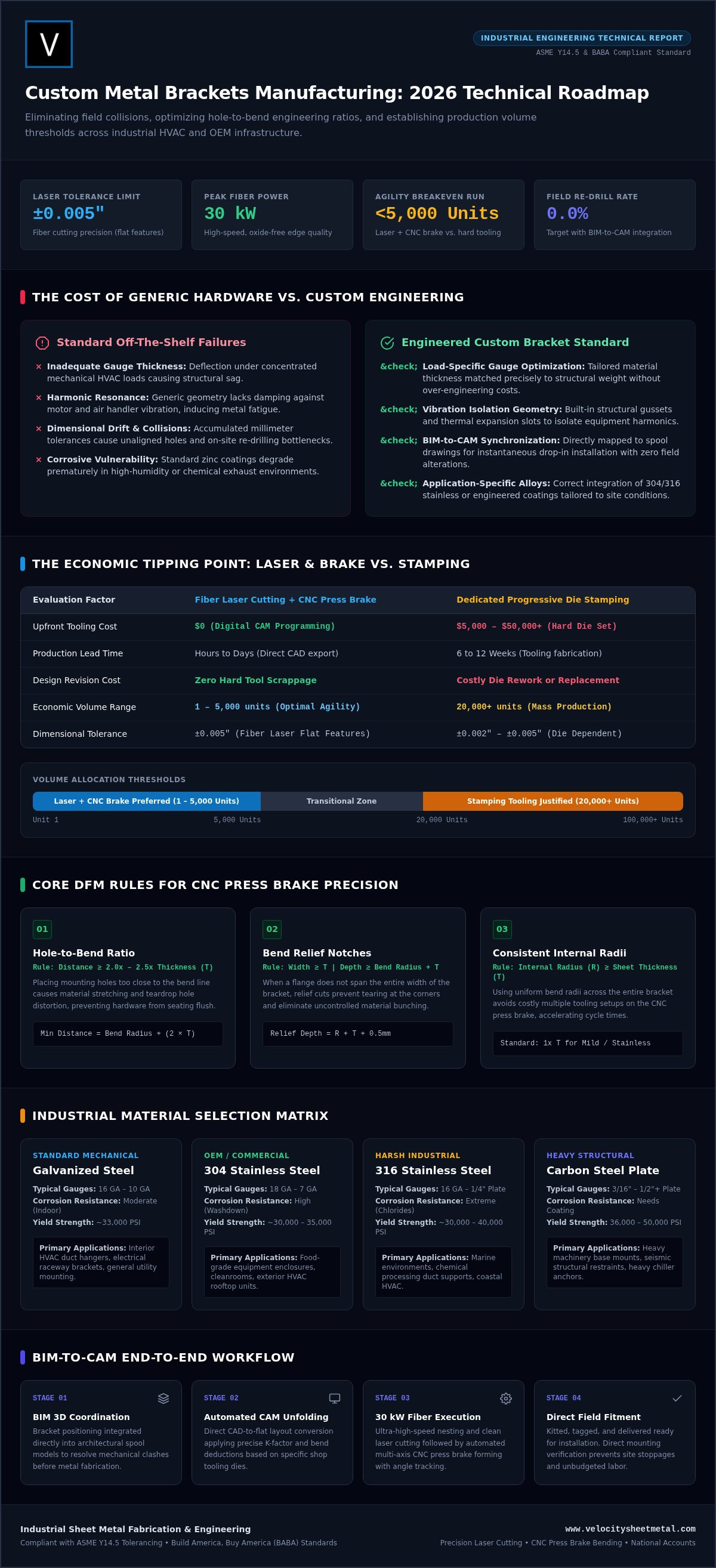
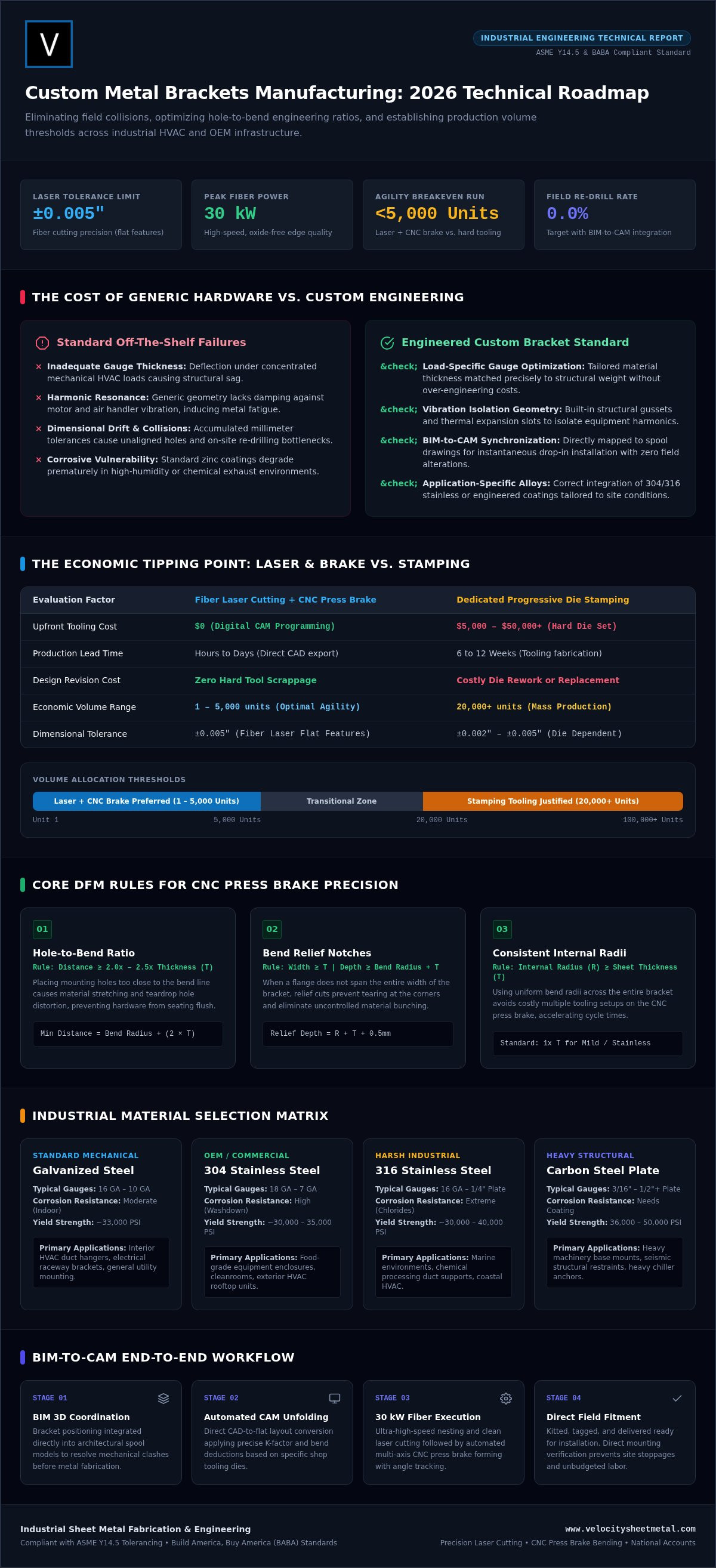
Selecting the right fabrication method is a calculation of volume versus agility. In custom metal brackets manufacturing, the decision typically falls between precision laser cutting paired with CNC bending or dedicated metal stamping. Stamping is built for massive scale. It requires hard tooling and dies that cost anywhere from $5,000 to over $50,000. For production runs exceeding 20,000 units, that investment pays off in lower per-part costs. However, industrial HVAC and OEM projects often demand smaller, highly specific batches. For orders under 5,000 units, the laser-and-brake workflow is the undisputed winner. It eliminates tooling delays and allows for immediate design adjustments without scrapping expensive dies.
Precision Laser Cutting for Brackets
Speed is the primary advantage of precision laser cutting services. We move from a digital CAD file to a physical part in hours. Modern 20 kW and 30 kW fiber lasers achieve tight tolerances of ±0.005 inches on flat features, meeting the rigorous ASME Y14.5 dimensioning and tolerancing standards required for industrial safety. This process handles everything from thin gauges to thick plate with surgical accuracy.
High-power fiber laser technology in 2026 produces clean, oxide-free edges that are ready for immediate powder coating or welding. By utilizing automated coil lines to produce standardized blanks, we maximize material yield and reduce the prep time for complex bracket profiles.
CNC Press Brake Bending and Forming
Once the profile is cut, CNC metal forming services take over to execute multi-bend geometries. Bending heavy gauge materials like stainless steel or galvanized G90 isn't just about force; it's about physics. We use digital angle measurement and real-time compensation to manage material springback. This ensures that a 90-degree bend stays at 90 degrees across an entire national production run.
While flat features hold tight tolerances, formed dimensions typically span ±0.015 to ±0.030 inches due to mill thickness variations. This level of repeatability is essential for custom metal brackets manufacturing where precision is non-negotiable. If you're looking to streamline your next project, our team at Velocity Sheet Metal is ready to provide the technical expertise needed for high-precision results.
Material Selection and Precision Tolerances for Custom Brackets
Material selection is the foundation of structural reliability. In custom metal brackets manufacturing, the choice of substrate determines the lifecycle and performance of the entire assembly. We balance structural integrity with weight and cost by analyzing the specific environment of the installation. For standard industrial applications, carbon steel provides high strength at a lower price point, though it requires secondary finishes like powder coating or hot-dip galvanization to prevent oxidation. Aluminum offers a high strength-to-weight ratio and natural corrosion resistance, making it ideal for weight-sensitive HVAC components.
Precision tolerances are the bridge between a digital model and a successful field installation. We maintain tight linear and angular tolerances to ensure every bracket aligns perfectly with pre-drilled holes in BIM-coordinated systems. While flat laser-cut features hold ±0.005 inches, formed dimensions account for material variations. Predicting how these metals behave under stress relies on NIST research on sheet metal deformation and material performance. This data allows us to anticipate plastic deformation and ensure structural reliability during high-tonnage forming operations.
Heavy Gauge Bending Capabilities
Executing heavy gauge sheet metal bending requires more than raw power. We must account for material grain direction; bending against the grain increases strength but can lead to cracking if the radius is too tight. Our engineers calculate the K-factor for every job to develop precise flat patterns. This calculation compensates for the material stretching on the outer radius and compressing on the inner radius. It's the only way to ensure the final formed part matches the intended design dimensions.
Corrosion Resistance in Mechanical Environments
Environmental exposure dictates the necessary grade of protection. For rooftop HVAC applications, we utilize G90 galvanized steel, which features a thicker zinc coating than standard G60 for superior moisture resistance. In food-grade or chemical processing environments, 304 or 316 stainless steel is mandatory to prevent pitting and contamination. We also offer anodizing for aluminum parts to provide a durable, non-conductive surface. Mechanical deburring is a non-negotiable step in our process to ensure industrial safety and a flush fitment during assembly. Removing sharp edges prevents technician injury and allows brackets to sit perfectly against mating surfaces without interference.
Optimizing Bracket Design for Manufacturability (DFM) and BIM
Design for Manufacturability (DFM) is the bridge between an abstract concept and a physical part. In custom metal brackets manufacturing, the goal is to eliminate administrative delays and fabrication errors before the metal hits the laser. By integrating Building Information Modeling (BIM), we move beyond simple drawings into a live, coordinated environment. This proactive approach identifies potential field collisions during the design phase, not during the installation. It's the difference between a project that stays on schedule and one that gets bogged down in expensive field modifications.
Most manufacturers provide static CAD files, but true efficiency requires BIM clash detection for HVAC fabrication. We work at LOD 400, ensuring every bracket includes exact material gauge, k-factor compensations, and CNC cut-paths. This level of detail allows for automated clash detection against other MEP systems, saving hundreds of man-hours in rework. Utilizing spool drawings allows our team to track bracket placement across large-scale national projects, ensuring that every component is accounted for before it leaves the shop floor.
Digital-to-Physical Workflows
Converting 3D models into flat patterns is a precise science. We use advanced nesting software to maximize material yield, significantly reducing waste on high-volume national projects. Digital spooling allows us to label and sort every bracket according to its specific location in the BIM model. When the parts arrive on-site, they aren't just a pile of metal; they're a sequenced kit ready for immediate assembly. This streamlined workflow moves the reader quickly from the initial digital concept to the final physical result.
Designing for Speed and Efficiency
Standardization is the key to scaling production for national accounts. By using consistent hole patterns and flange lengths across your bracket designs, you minimize machine setup time and lower production costs. Avoid over-specifying tolerances where standard sheet metal limits suffice, as this only adds cost without improving function. For 2026, the industrial standard for digital file submission favors STEP files for 3D geometry and DXF files for flat-pattern cut paths to ensure seamless CAM integration. Maintaining a consistent bend radius across all bracket types ensures our CNC press brakes operate at peak speed without frequent tool changes. This methodical approach to design ensures that your procurement process remains lean and your delivery timelines stay predictable.
Ready to optimize your production pipeline? Contact Velocity Sheet Metal to integrate BIM coordination and precision DFM into your next project.
Scaling Production: National On-Demand Bracket Manufacturing
Scaling production for multi-site industrial projects requires more than just high-volume machines. It demands a centralized, digital-first approach to custom metal brackets manufacturing. Velocity Sheet Metal supports national accounts by acting as the essential bridge between a digital file and a tangible product, regardless of the project's location. This centralized model removes the variability of using different regional shops, ensuring that a bracket fabricated today matches the exact specifications of one produced a year from now. We provide the consistency needed for large-scale infrastructure rollouts where every component must be field-ready upon arrival.
Logistics are handled with surgical precision to meet aggressive construction schedules. We move parts from our automated production lines to your job site using a tiered shipping strategy. This ranges from small parcel delivery for urgent, high-precision brackets to palletized freight for heavy-duty duct supports. By leveraging on-demand production, we help contractors eliminate the need for large on-site inventories. You don't have to manage "dead stock" or worry about material damage in the field. Instead, you receive the exact parts you need, exactly when the project timeline requires them.
Standardization for National Accounts
We help national accounts maintain quality control by creating a master catalog of custom brackets. This digital library stores your specific geometries, material preferences, and tolerance requirements for instant recall. Whether you're using galvanized G90 for rooftop units or 316 stainless steel for chemical environments, the output remains consistent across all project sites. Streamlining procurement with repeat-order digital libraries reduces administrative delays and ensures that your facility standards are met every time. It's a methodical process that moves your organization from fragmented purchasing to a unified, scalable supply chain.
Partnering for Rapid Project Execution
On-demand fabrication is the only way to support the tight timelines of modern industrial construction. Our BIM-integrated shop speeds up the mechanical contractor workflow by providing parts that are already sequenced and labeled for the field. This synchronization reduces the labor hours spent on-site sorting through hardware or making manual adjustments. When your bracketry arrives, it fits the first time. For comprehensive support on your next project, contact Velocity Sheet Metal for a quote on custom HVAC duct fabrication and precision support components. We're ready to get to work immediately, providing the technical capability and speed your national accounts demand.
Scaling Your Industrial Production Pipeline
Precision in 2026 isn't just about the cut; it's about the coordination. You've seen how selecting the right material and mastering DFM can eliminate field collisions and material waste. Choosing between laser cutting and stamping depends on your specific volume, but the synchronization between BIM and the factory floor remains the constant factor for project success. High-precision custom metal brackets manufacturing is the essential bridge between a digital design and a structural reality.
Velocity Sheet Metal provides the technical capability needed to turn your CAD files into physical parts with surgical accuracy. With our BIM-integrated fabrication shop and over 50 years of combined manufacturing expertise, we ensure your components are field-ready the moment they arrive. We offer national shipping for standardized quality across all your project sites. Don't let administrative delays or inaccurate dimensions stall your progress. It's time to streamline your procurement from digital file to physical part.
Request a Quote for Custom Precision Brackets today and let's get to work on your next industrial rollout. We're ready to deliver the reliability your national accounts demand.
Frequently Asked Questions
What is the typical lead time for custom metal bracket manufacturing?
Lead times for custom metal brackets manufacturing depend on the order volume and design complexity. Standard orders for laser-cut and CNC-bent components are typically processed faster than traditional stamped parts because they don't require expensive hard tooling. We focus on on-demand part production to keep your project moving. Submitting clean STEP or DXF files allows our team to provide a firm production timeline immediately after the initial technical review.
Can you manufacture brackets from BIM models or spool drawings?
Yes, we specialize in manufacturing directly from BIM models and spool drawings. Our team utilizes BIM coordination to ensure every bracket is field-ready and perfectly aligned with your mechanical systems. This digital-to-physical workflow eliminates the manual data entry errors that often occur with 2D drawings. We work at LOD 400 to include exact material gauges and bend compensations, ensuring that the physical part matches your digital twin exactly.
Which material is best for outdoor HVAC mounting brackets?
G90 galvanized steel and austenitic stainless steel are the primary choices for outdoor HVAC applications. G90 offers a heavy zinc coating that provides superior moisture resistance compared to standard G60. For coastal or high-chloride environments, 316 stainless steel is the benchmark for preventing pitting corrosion. Aluminum is also a viable option for weight-sensitive rooftop units due to its natural oxide layer, though it requires specific gauge considerations for structural loads.
What are the maximum thickness limits for CNC press brake bending?
Our CNC press brake bending capabilities handle a wide range of industrial gauges, from thin sheet metal to heavy plate. The maximum thickness depends on the material type and the required bend radius. While high-power fiber lasers can cut carbon steel up to 40mm, the bending process is governed by the tonnage required for the specific flange length. We typically form heavy-gauge components for industrial duct supports and structural machinery mounts with high repeatability.
Do you offer nationwide shipping for large-scale industrial projects?
Velocity Sheet Metal provides comprehensive nationwide shipping for all industrial projects. We manage the logistics for national accounts to ensure standardized quality across multiple project sites. Whether you need small parcel delivery for specialized brackets or palletized freight for large-scale ductwork supports, our shipping network maintains the production schedule. This allows mechanical contractors to receive field-ready parts exactly when they are needed, reducing the need for on-site inventory storage.
How do I calculate the load-bearing capacity for a custom bracket design?
Calculating load-bearing capacity requires analyzing material yield strength, gauge thickness, and the specific geometry of the bracket. We recommend following ASME standards for dimensioning and tolerancing to ensure structural reliability. Factors like the distance from the mounting point to the load and the presence of gussets or stiffeners significantly impact the final capacity. Our DFM review process helps identify if your design meets the necessary structural requirements for its intended mechanical application.
What is the difference between laser cutting and waterjet cutting for brackets?
Laser cutting is the industrial standard for 2026 due to its superior speed and precision on common sheet metal gauges. It utilizes a high-power fiber beam to produce clean, oxide-free edges ready for immediate assembly. Waterjet cutting is typically reserved for extremely thick plates or materials that are sensitive to heat-affected zones. For most custom metal brackets manufacturing needs, fiber laser technology offers a more cost-effective and efficient path from digital file to physical part.
Do you provide standardized brackets for national account facility maintenance?
We partner with national accounts to create master catalogs of standardized brackets for facility maintenance and rollouts. This ensures that every replacement part or new installation maintains the same material grade and dimensional accuracy across the country. By storing your specific designs in our digital library, we streamline the procurement process for repeat orders. This consistency reduces maintenance complexity and ensures that your hardware standards are upheld at every location in your network.