Aluminum HVAC Ductwork Fabrication: Precision Engineering for Modern Systems

Designing an HVAC system for a coastal facility or a century-old retrofit shouldn't feel like a compromise between structural integrity and longevity. Aluminum HVAC ductwork fabrication is a strategic engineering decision that addresses high-moisture corrosion and strict weight limitations simultaneously. You've likely dealt with the headache of rusted galvanized steel in humid environments or the realization that a roof simply can't support traditional heavy-gauge duct. Field collisions caused by poor fabrication tolerances only make the job harder and more expensive.
Precision-engineered aluminum ductwork optimizes system performance while cutting structural load and eliminating installation errors through automated technology. This article explores how modern fabrication moves from digital BIM coordination to physical coil-line production with surgical accuracy. You'll discover how to leverage aluminum's unique properties to create systems that are easier to install and built to last. It's about bridging the gap between a complex design and a seamless field installation. We focus on the shift from digital concepts to physical results, ensuring your project stays on schedule and within technical specifications.
Key Takeaways
- Evaluate the technical advantages of aluminum for specialized environments, from coastal facilities to high-moisture laboratories.
- See how automated aluminum HVAC ductwork fabrication utilizes coil-lines and laser cutting to deliver precision fittings at industrial scale.
- Use BIM coordination and spool drawings to identify and resolve structural collisions before fabrication starts.
- Apply current SMACNA standards to your gauge selection for optimal durability and static pressure performance.
- Streamline national project logistics by leveraging standardized production and nationwide shipping capabilities.
The Strategic Value of Aluminum HVAC Ductwork in 2026
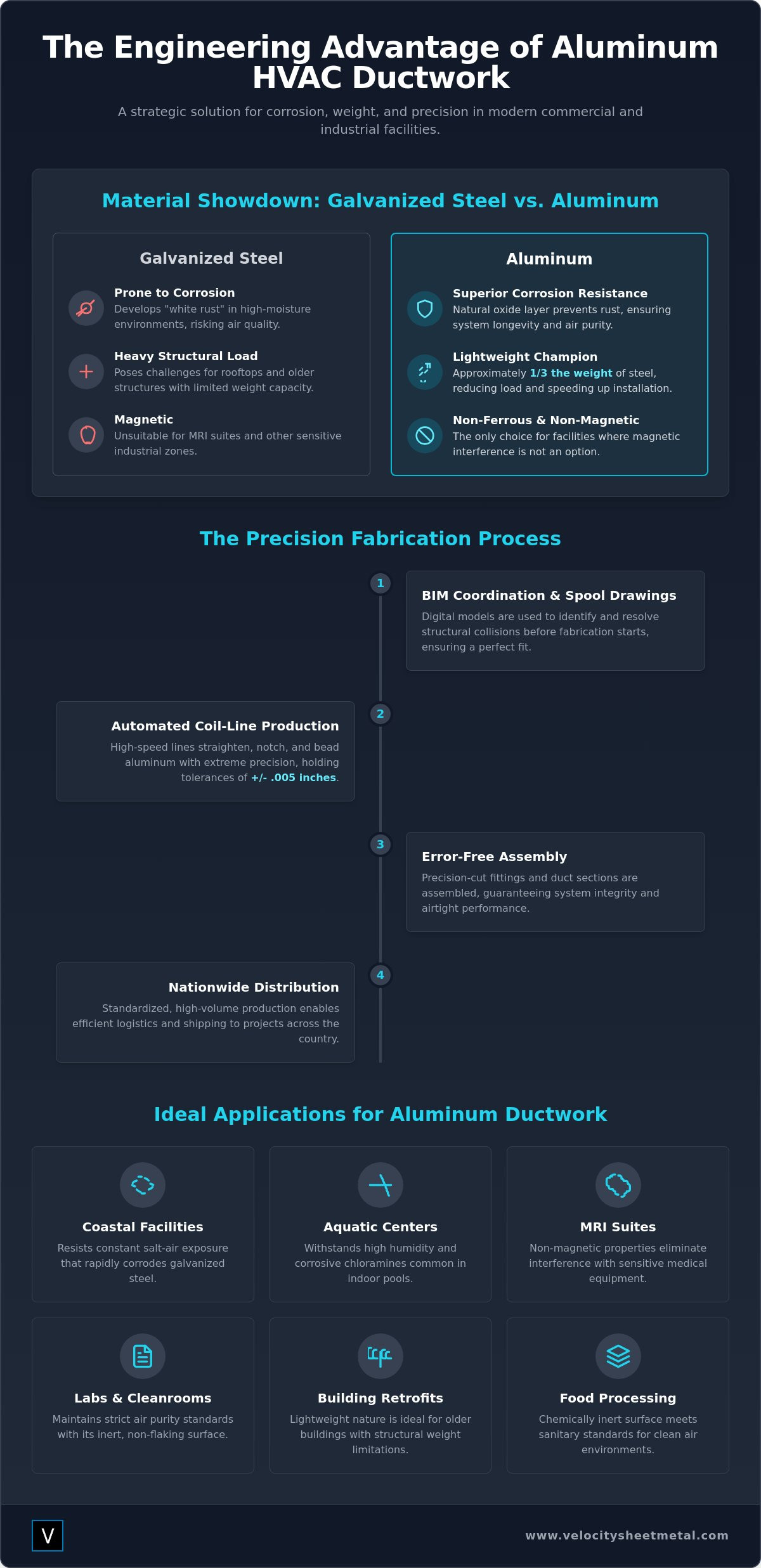
Modern engineering demands more than just standard galvanized steel. Aluminum HVAC ductwork is a premium, corrosion-resistant, and lightweight solution for air distribution. It serves as a vital alternative to traditional materials in environments where moisture or magnetism would cause system failure. Aluminum HVAC ductwork fabrication involves processing high-grade aluminum alloys to create HVAC ductwork that outlasts and outperforms steel in specific commercial use cases. This isn't just a material swap; it's a strategic design choice.
Certain facilities make aluminum a non-negotiable requirement. Coastal buildings face constant salt-air exposure. Indoor aquatic centers deal with high humidity and chloramines. Research laboratories require strict air purity. In these zones, traditional steel fails prematurely. Aluminum remains stable. Its non-ferrous properties also make it the only choice for MRI suites and sensitive industrial zones where magnetic interference must be eliminated. You can't risk steel in a room where a multi-million dollar magnet is operating.
Corrosion Resistance and Air Quality
Aluminum naturally forms a thin, protective oxide layer when exposed to air. This barrier prevents further oxidation, making the metal highly resistant to the corrosive effects of moisture and chemicals. Unlike galvanized steel, aluminum won't develop "white rust" or zinc-based corrosion that can flake off into the airstream. This makes it a top-tier choice for sanitary applications. Food processing plants and pharmaceutical cleanrooms rely on this stability to maintain strict indoor air quality standards. It's clean, durable, and chemically inert.
Structural Load and Installation Speed
The weight-to-strength ratio of aluminum provides a massive advantage for rooftop units and large-scale commercial retrofits. Aluminum is roughly one-third the weight of galvanized steel. This weight reduction directly translates to lower structural stress on roofs and ceilings. It simplifies the design of support systems and reduces the need for heavy-duty hanging hardware. Speed is the byproduct of efficiency. Lighter ductwork means your crew moves faster, and your structural engineer has fewer headaches.
- Reduced Structural Load: Ideal for older building retrofits with limited weight capacity.
- Lower Labor Costs: Lighter sections are easier to maneuver, speeding up high-volume commercial installations.
- Safety: Lower weight reduces the risk of strain-related injuries during field assembly.
When you're dealing with massive rectangular duct runs, every pound saved matters. Precision aluminum HVAC ductwork fabrication ensures that these lightweight sections fit perfectly the first time. This eliminates the need for heavy field modifications and keeps the project moving at full speed. It's a pragmatic solution for modern, high-efficiency systems.
Precision Engineering: The Aluminum Ductwork Fabrication Process
Precision isn't an accident. It's the result of a controlled, automated workflow that transforms raw metal into high-performance components. While manual shops struggle with variability, modern aluminum HVAC ductwork fabrication relies on industrial-grade technology to maintain airtight performance. This process moves rapidly from raw aluminum coil to finished rectangular sections. Every notch, bead, and fold is executed with surgical precision to ensure a perfect fit in the field. There's no room for guesswork when you're dealing with high-velocity systems.
Speed and repeatability are non-negotiable for large-scale commercial projects. When you're managing thousands of linear feet, manual errors lead to costly field collisions and air leakage. We eliminate these risks by utilizing high-speed production lines that hold tolerances within +/- .005. This level of accuracy ensures that every joint seats correctly and every fitting aligns with the BIM model. It's the difference between a system that leaks and one that operates at peak efficiency from day one.
Automated Coil-Line Production
The heart of high-efficiency production is the automated coil line. These systems straighten, notch, and bead aluminum sheets in a single, continuous pass. This method ensures consistent structural integrity across the entire duct run. By definition, coil line duct fabrication is the industry standard for high-volume rectangular production, offering a level of uniformity that manual labor simply can't replicate. It turns raw material into structural components in seconds, not hours. This speed allows us to meet aggressive project timelines without sacrificing quality.
Custom Laser Cutting and CNC Bending
Standard duct runs are only half the battle. Complex transition fittings require a different level of finesse. We utilize industrial lasers to achieve clean, burr-free edges on 3003 and 5052 aluminum alloys. Unlike automated plasma cutters that can leave dross or heat-affected zones, laser cutting provides the cleanest possible finish for intricate geometries. This is critical for maintaining laminar airflow in sensitive environments.
Once cut, these parts move to CNC press brake bending stations. This technology allows for precise angles on heavy-gauge aluminum components and specialized brackets. We focus on three core pillars of fitting production:
- Alloy Selection: Using 3003 for standard corrosion resistance and 5052 for high-strength marine applications.
- CNC Accuracy: Repeatable bends that ensure every fitting matches the shop drawing exactly.
- Edge Quality: Laser-cut components that require zero field grinding or cleanup.
Whether you need a thousand feet of straight duct or a dozen custom offsets, the goal remains the same: seamless integration. If you're ready to see how precision parts can accelerate your next project, you can explore our fabrication capabilities to learn more about our technical workflow. This automated approach bridges the gap between digital design and physical reality, cutting down on-site labor and maximizing system efficiency.
BIM Coordination and Spool Drawings for Aluminum Systems
Digital precision prevents physical failure. Effective aluminum HVAC ductwork fabrication begins long before the first coil is loaded onto the line. By utilizing Building Information Modeling (BIM), we create a comprehensive 3D visualization of the entire duct path. This allows us to identify and resolve clashes, which are collisions with structural steel, electrical conduits, or plumbing, months before a single piece of metal arrives at the job site. It's much cheaper to move a digital duct than it is to rework a physical one in the field.
Our workflow moves directly from the coordinated model to the fabrication floor. We generate mechanical spool drawings that serve as the exact blueprint for our automated equipment. This model-to-machine approach is the cornerstone of modern aluminum HVAC ductwork fabrication. It ensures that every notch and flange is positioned with surgical accuracy. By eliminating the manual translation of 2D blueprints, we significantly reduce scrap material and guarantee that every component fits its designated space perfectly. This isn't just about drawing; it's about manufacturing intelligence.
Mechanical Contractor BIM Support
We act as a technical extension of your engineering team. The transition from 2D blueprints to 3D coordinated models is where most project delays are born. We bridge that gap by taking your design intent and refining it into a fabrication-ready model. This ensures that even the most complex custom transition fittings fit the first time. We focus on the details that matter: flange clearances, hanger placements, and insulation thicknesses. You get a coordinated system that's ready for immediate install, not a pile of parts that requires field-hacking.
Spooling for Rapid Field Assembly
Efficiency in the shop must translate to efficiency on the ladder. Spooling involves breaking down the 3D model into manageable, logical sections, often called spools, that are labeled and kitted for organized delivery. Each spool corresponds to a specific area of the building. This allows your field crew to unpack and install in a sequential, predictable manner. This process drastically reduces on-site labor and assembly time.
The link between precision laser cutting services and spool drawing accuracy is absolute. When the laser cuts a part based on a spool drawing, it includes all necessary holes, notches, and identification marks. This kitted approach transforms a chaotic job site into a streamlined assembly line. It's a pragmatic solution that keeps your project on schedule and your labor costs under control. We deliver parts that are ready to work, exactly when they're needed.

Industry Standards and Performance Specifications
Compliance isn't optional in high-performance mechanical systems. Every project involving aluminum HVAC ductwork fabrication must adhere to the Sheet Metal and Air Conditioning Contractors National Association (SMACNA) standards. As of July 2026, the industry relies on the Rectangular Industrial Duct Construction Standards, 3rd Edition. These guidelines dictate the specific gauge thicknesses required to prevent wall deflection and ensure structural stability. Because aluminum has a lower modulus of elasticity than steel, gauge selection is critical. Larger duct spans require thicker material to maintain the same pressure rating as their galvanized counterparts.
Connection techniques are just as vital as the metal itself. We utilize TDF (Transverse Duct Flange), TDC (Transverse Duct Connector), and traditional slip-and-drive joints based on the specific pressure class. Thermal expansion is a unique challenge for aluminum. It expands roughly twice as much as steel. Our engineering process accounts for this movement; we ensure that joints don't buckle or fail when temperatures fluctuate. It's about building a system that remains airtight for decades.
Static Pressure and Leakage Classes
Static pressure determines the leakage class of a system. Achieving a Class A seal rating is the standard for maximum energy efficiency. The U.S. Department of Energy reports that typical duct systems can lose 20% to 30% of conditioned air through leaks. We use rigorous testing protocols to verify performance under both positive and negative pressure loads. Precision fabrication ensures that every joint seats perfectly, minimizing air loss and maximizing the efficiency of the air handling unit. It's a pragmatic approach to reducing operational costs.
Material Grades for HVAC
We select material grades based on the specific application. 3003-H14 is the standard choice for most HVAC projects due to its workability and corrosion resistance. When high-strength industrial exhaust or marine environments are involved, we shift to 5052-H32 for its superior durability. You can also specify an embossed finish to reduce glare in exposed ceiling designs or stick with a standard mill finish for concealed runs. These alloys provide the necessary resistance to chemical fumes that would quickly compromise galvanized steel.
If you're managing a project with strict performance specs, get a quote for SMACNA-compliant ductwork to ensure your system meets every engineering requirement. We bridge the gap between complex specifications and a finished, high-performance product.
Scaling Production: National Distribution for High-Volume Projects
Scaling a project shouldn't mean sacrificing precision. High-volume aluminum HVAC ductwork fabrication requires more than just local capacity; it demands a standardized, tech-driven infrastructure. Multi-state developers and industrial giants need a partner that can maintain identical quality across a dozen project sites simultaneously. This requires moving from manual shop drawings to a centralized, digital-first production model. We bridge the gap between a digital file and a tangible product, ensuring that your national accounts receive the same level of engineering excellence regardless of the job site location.
Logistics are the backbone of high-volume delivery. Shipping large-scale rectangular and spiral ductwork nationwide isn't just about moving metal; it's about managing a timeline. We leverage our automated production capabilities to stay ahead of rapid construction schedules. By standardizing our output, we eliminate the variability often found in regional shops. This predictability is essential for 2026 infrastructure projects where labor shortages and material scarcity make every delay a major financial risk. You need a partner that values your time as much as its own precision.
National Account Consistency
Consistency is the cure for administrative delays. We streamline the procurement process for multi-state developers by using a single point of truth: the digital BIM file. Whether a project is a coastal facility or a high-tech laboratory, the fabrication tolerances remain identical. We eliminate the guesswork. Our automated coil-line ensures that every rectangular section meets the same SMACNA standards discussed earlier in this guide. This uniformity reduces field rework and keeps multi-million dollar construction timelines on track across your entire portfolio.
On-Demand Parts and Curb Adapters
Construction moves fast, and rooftop unit replacements often reveal unforeseen structural gaps. This is where on-demand part production becomes a project-saver. We use custom laser cutting to produce precision curb adapters that bridge the gap between old roof openings and modern aluminum units. It's about speed and accuracy. We transform raw aluminum into a custom solution in hours, not weeks. This rapid response supports your field crew when they encounter the unexpected, keeping the installation moving toward completion. It's a pragmatic solution for a fast-paced industry.
The infrastructure of 2026 demands a tech-forward fabrication partner. With the global HVAC ductwork market projected to reach $8.92 billion this year, the competition for efficiency is fierce. You need a partner that acts as a reliable bridge between your design and the finished system. We provide the speed, accuracy, and national reach required for modern industrial systems. Get a precision quote for your aluminum ductwork project today.
Advancing Your Mechanical Infrastructure with Precision
Success in modern mechanical contracting depends on the seamless transition from a digital model to a physical installation. Precision aluminum HVAC ductwork fabrication provides the essential balance of corrosion resistance and weight reduction required for the most demanding environments. By integrating BIM coordination expertise with automated coil-line production, you eliminate field collisions and ensure every fitting meets strict SMACNA standards. This isn't just about moving air; it's about engineering systems that perform at peak efficiency from day one.
We act as your technical partner, providing the speed and accuracy necessary to keep high-volume national projects on schedule. Our national shipping capabilities ensure that precision-engineered components arrive exactly when your field crew is ready to install. Don't let manual errors or administrative delays compromise your next project. It's time to leverage automated technology for a faster, more reliable workflow. Request a Quote for Custom Aluminum Ductwork Fabrication and let's get to work on your next high-performance system.
Frequently Asked Questions
Is aluminum ductwork more expensive than galvanized steel?
Aluminum carries a higher raw material cost per pound than galvanized steel. However, the total project cost often balances out through reduced labor and structural requirements. Because aluminum is roughly one-third the weight of steel, it's faster to install and requires less heavy-duty hanging hardware. Its long-term resistance to corrosion also eliminates the need for expensive future replacements in high-moisture environments.
Can aluminum ductwork be used for grease exhaust in commercial kitchens?
Aluminum is not suitable for commercial grease exhaust systems. NFPA 96 standards require grease ducts to be constructed from carbon steel or stainless steel due to the extreme temperatures associated with kitchen fires. Aluminum has a significantly lower melting point than steel; it cannot provide the necessary fire resistance for these specific applications. It remains best suited for supply, return, and general exhaust air.
What are the SMACNA standards for aluminum duct gauge thickness?
SMACNA standards require aluminum to be thicker than galvanized steel to achieve the same structural rigidity. Because aluminum has a lower modulus of elasticity, it usually requires a gauge thickness that is roughly two sizes heavier than a comparable steel duct. For example, if a design calls for 24-gauge steel, the aluminum equivalent might require .032 or .040 inch thickness to meet the same pressure class and deflection limits.
How does BIM coordination help reduce the cost of aluminum fabrication?
BIM coordination identifies structural clashes in a digital environment before any metal is cut. By resolving these conflicts early, we eliminate the scrap material and expensive field rework that occur when parts don't fit. This "model-to-machine" workflow is a core part of aluminum HVAC ductwork fabrication. It ensures that every custom transition is manufactured with surgical precision, which drastically reduces on-site labor hours and prevents project delays.
Does aluminum ductwork require special insulation?
Aluminum ductwork works with standard fiberglass duct wrap, mineral wool, or elastomeric foam insulation. No specialized material is required just because the substrate is aluminum. However, the metal's natural reflectivity can provide a slight thermal advantage in certain uninsulated applications. Your choice of insulation should be based on the specific R-value requirements and local building codes for your project's climate zone.
What is the lead time for custom aluminum transition fittings?
Automated fabrication drastically shortens traditional lead times for custom components. By using high-speed laser cutting and digital spool drawings, we move parts from the design phase to the shipping dock much faster than manual shops. While specific timelines depend on the total project volume, the elimination of manual layout and hand-cutting allows for rapid, on-demand production of even the most complex geometries.
How do you prevent galvanic corrosion when connecting aluminum to other metals?
Preventing galvanic corrosion requires the use of dielectric isolators or non-conductive gaskets between dissimilar metals. When aluminum comes into direct contact with galvanized steel in the presence of moisture, an electrochemical reaction occurs that degrades the aluminum. We use stainless steel fasteners, specialized coatings, or rubberized gaskets to break this electrical circuit. This pragmatism ensures the integrity of the joint for the life of the system.
Is aluminum ductwork suitable for high-pressure HVAC systems?
Aluminum is fully compatible with high-pressure systems when fabricated to the correct specifications. Successful aluminum HVAC ductwork fabrication for high-pressure loads relies on selecting the appropriate gauge and using reinforced jointing methods like TDF or TDC. When engineered according to SMACNA pressure classes, aluminum provides the same airtight performance and structural stability as steel while offering superior weight and corrosion advantages.