2026 HVAC Ductwork Fabrication Guide for Contractors
In 2026, the most profitable mechanical contractors aren't the ones with the largest field crews; they're the ones with the smartest fabrication partners. High-stakes commercial projects no longer leave room for the manual "measure twice, cut once" approach. You know the frustration of field collisions leading to expensive rework or watching a project timeline slip because a local shop cannot handle a massive rectangular duct order. It's a bottleneck that eats your margins and strains your reputation with general contractors.
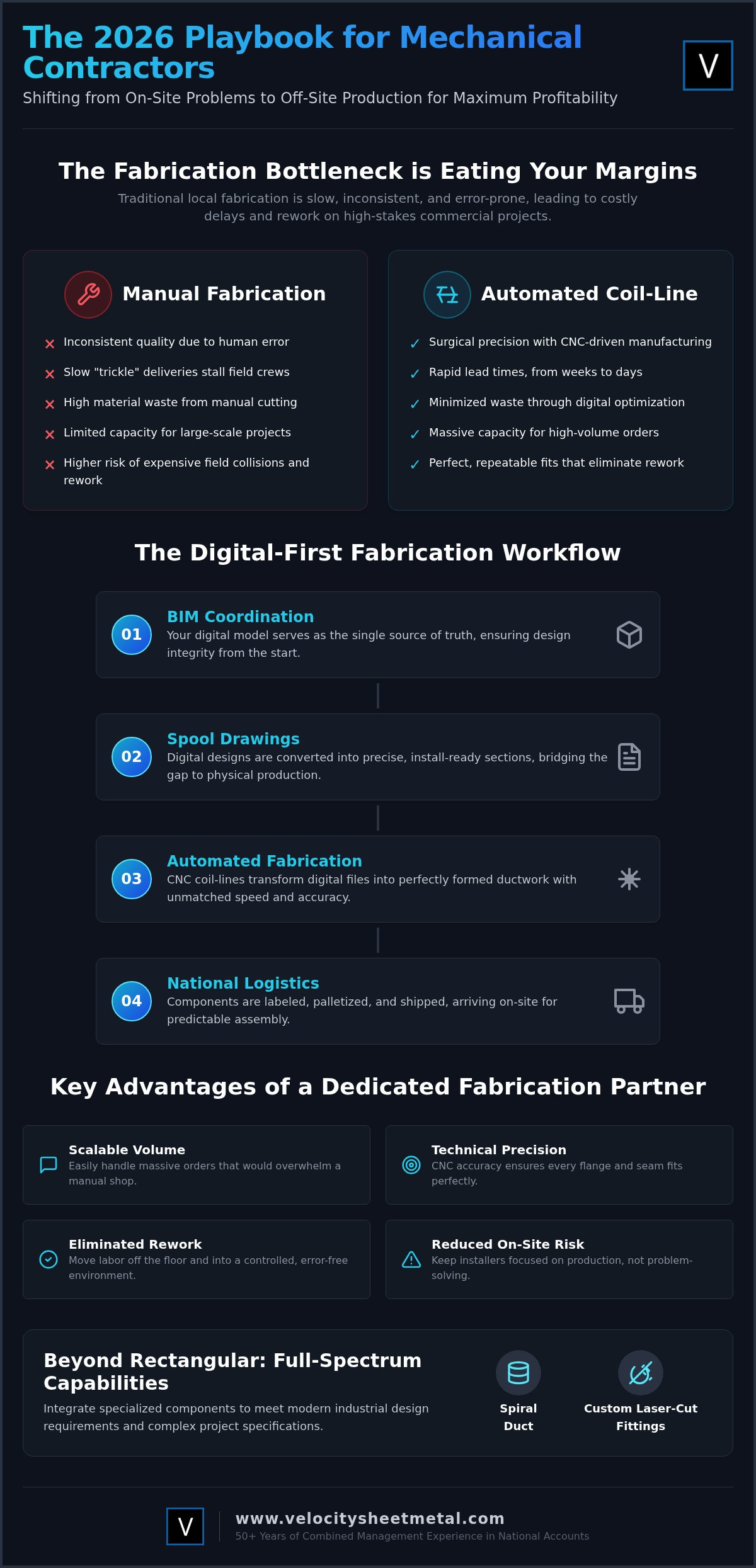
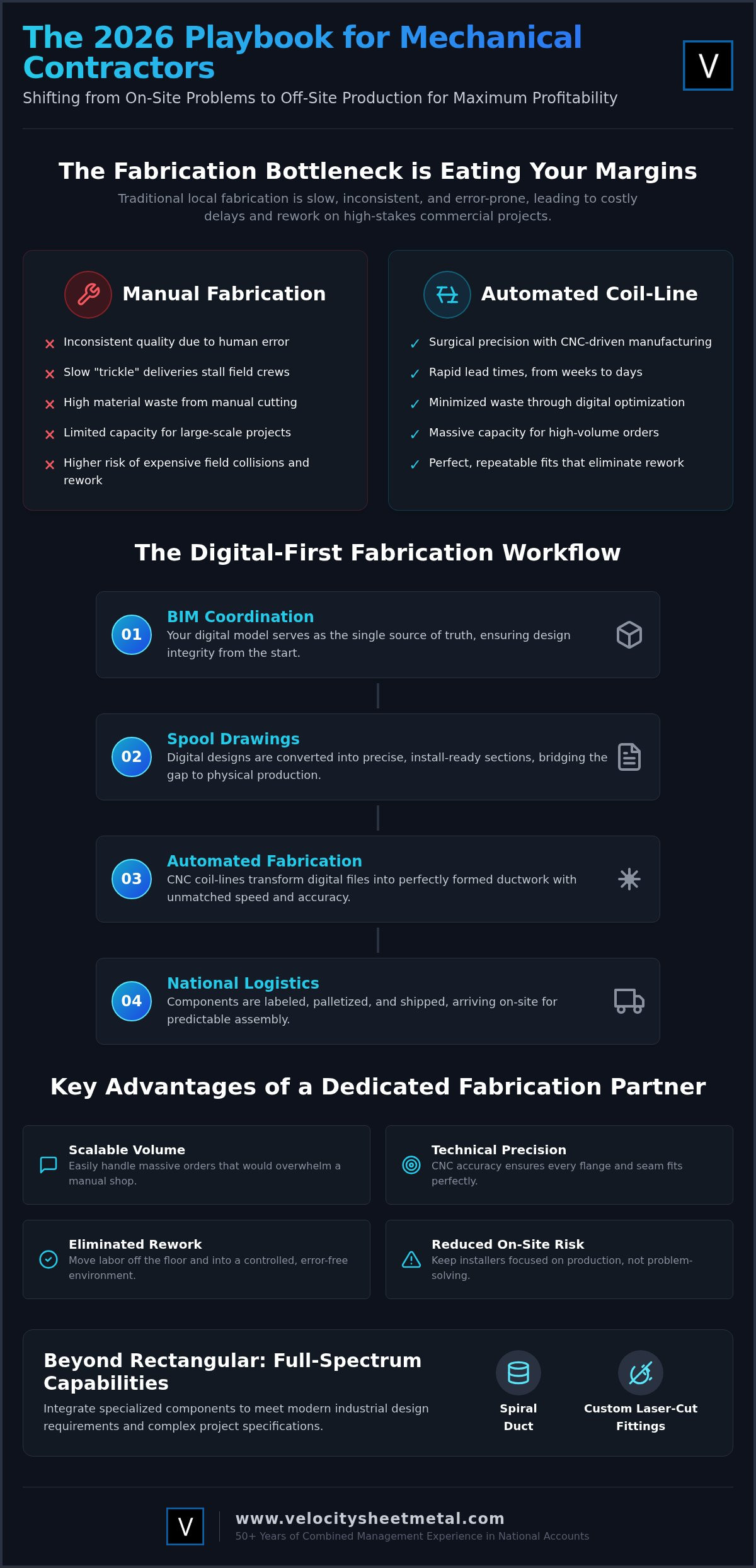
Reliable HVAC ductwork for mechanical contractors now depends on a digital-first strategy that bridges the gap between a BIM file and the job site. This guide shows you how to leverage automated fabrication and precision spooling to move labor off the floor and into a controlled environment. We'll demonstrate how to achieve a workflow that delivers predictable lead times and eliminates the quality inconsistencies of traditional shops.
We will preview the technical shift toward coil-line automation, the necessity of seamless BIM-to-fabrication integration, and the logistics of national shipping for large-scale procurement. From initial coordination to final delivery, you'll learn how to streamline your supply chain and keep your installers focused on production, not problem-solving.
Key Takeaways
- Shift your production strategy from the job site to the shop to maximize efficiency on high-volume 2026 commercial projects.
- Leverage CNC-driven automated coil-lines to secure HVAC ductwork for mechanical contractors with unmatched precision and faster lead times.
- Use BIM coordination and spool drawings to bridge the gap between digital design and physical installation while eliminating field rework.
- Integrate specialized components like spiral duct and custom laser-cut fittings to meet modern industrial design requirements and complex specifications.
- Streamline your procurement process with standardized national logistics designed to support large-scale mechanical accounts and OEM partners.
Scaling HVAC Ductwork Production for Mechanical Contractors
The era of the job-site fabrication shop is over. In 2026, mechanical contractors face tighter project windows and a shrinking pool of skilled field labor. Success now requires moving as much work as possible off-site into controlled, automated environments. The procurement of HVAC ductwork for mechanical contractors has shifted from a secondary task to a primary strategic advantage. When you outsource high-volume duct runs, you aren't just buying metal; you're buying time.
Automated coil-lines process thousands of pounds of galvanized steel while a field crew is still clearing the slab. This speed allows for a critical balance: using standardized rectangular duct for the long runs while reserving skilled labor for complex custom fittings. By the time the first hangers are up, the duct is already arriving on-site, labeled and ready for assembly. This transition turns an installation into a predictable assembly process, significantly lowering your total labor cost per pound of installed metal.
The Problem with Traditional Local Fabrication
Small-scale local shops often lack the infrastructure to keep pace with modern commercial demands. They hit capacity limits quickly, leading to "trickle" deliveries that stall your installation crews. Inconsistency is another silent profit killer. If different regional shops provide duct for different floors of a national project, the tolerances rarely match. Manual labor in these shops drives up the unit price and increases the risk of human error. You pay for their inefficiency through field rework and delayed schedules that you can't afford.
Transitioning to a Dedicated Fabrication Partner
A fabrication-only partner acts as a technical extension of your team without the conflict of interest found in shops that also perform installation. We focus entirely on the manufacturing process. With 50+ years of combined management experience, we understand the nuances of national account requirements. Standardizing your HVAC ductwork for mechanical contractors across multiple job sites ensures that every piece of metal meets the same high-precision spec, regardless of where the project is located.
Working with a dedicated partner provides several operational advantages:
- Scalable Volume: Automated coil-lines handle massive orders that would crush a manual shop.
- Technical Precision: CNC-driven manufacturing ensures every flange and seam is identical for a perfect fit.
- Reliable Logistics: Coordinated shipping keeps your project moving with predictable delivery windows.
- BIM Integration: Direct translation from your digital files to our shop floor eliminates manual data entry errors.
By shifting the burden of production to a high-capacity facility, you free up your internal resources to focus on project management and field execution. It's about working smarter, not just harder, to protect your margins in a competitive market.
Automated Coil-Line vs. Manual Fabrication: Speed and Precision
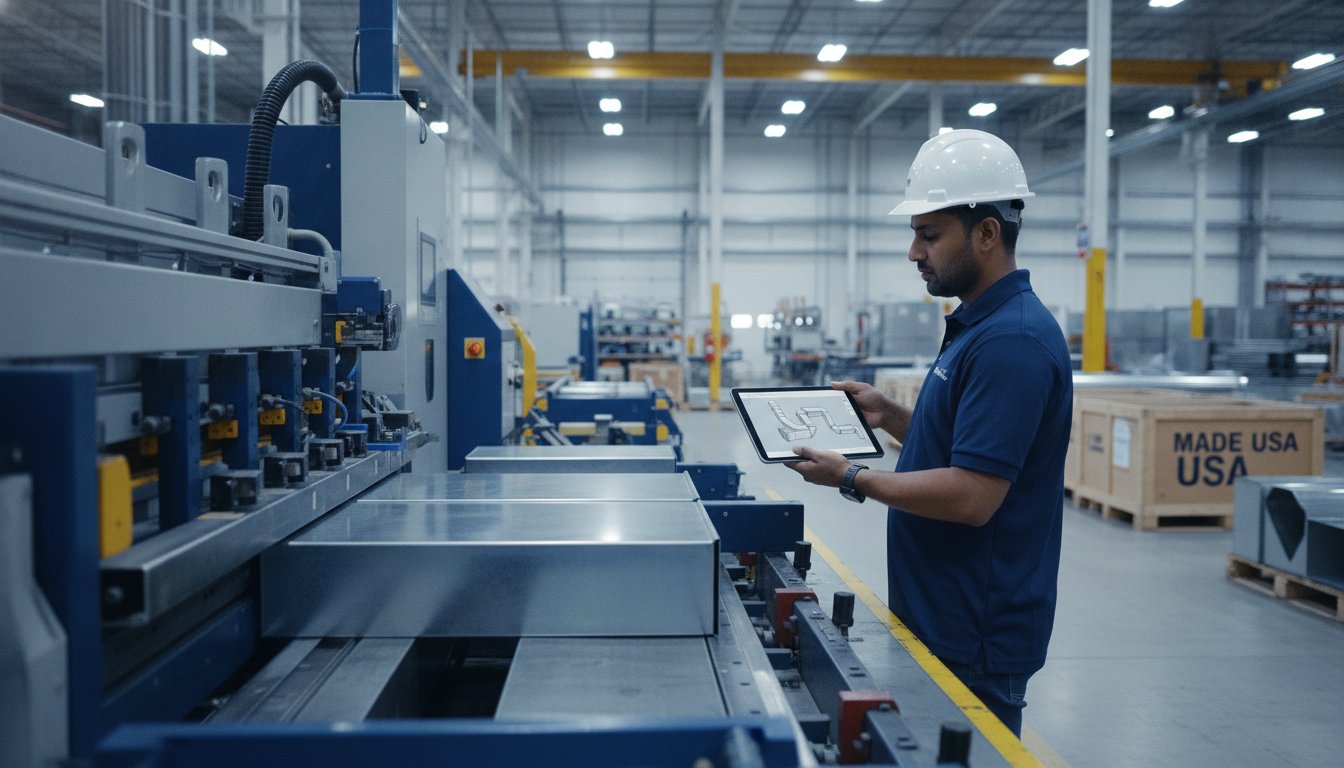
Precision in 2026 isn't a luxury; it's a baseline requirement. Traditional manual shops rely on tape measures and hand snips. These methods introduce human error at every joint. In contrast, automated coil-lines transform procurement for HVAC ductwork for mechanical contractors by removing the variability of manual labor. Raw galvanized steel enters the machine from master coils. Finished, notched, and beaded duct exits the other side with surgical accuracy.
CNC-driven manufacturing holds tolerances that manual fabrication simply cannot match. Every piece is perfectly square. Every flange is consistent. This level of precision reduces material waste by optimizing the layout on the coil, ensuring you pay for installed duct rather than scrap metal. For high-volume rectangular duct orders, this automation slashes lead times from weeks to days, keeping your project on its critical path.
Understanding the Coil-Line Process
The process begins with heavy master coils. The line decoils, levels, and shears the metal to exact lengths based on digital input. It automatically notches corners and forms Pittsburgh or Snaplock seams. Integrated systems attach flanges and add reinforcement beads in a single pass. This continuous flow creates L-sections or full-wrap duct ready for immediate assembly. These automated lines are essential for 2026 commercial standards because they handle the sheer volume that modern mechanical projects demand without sacrificing quality.
Manual Fabrication: When is it Still Relevant?
Automation handles the high-volume straight runs, but skilled fabricators remain vital for the "last mile" of the project. Complex transition fittings, multi-way offsets, and custom plenum boxes still require a human touch. We integrate these custom components with our coil-line production to provide a complete package. Our fabricators use custom laser cutting to create precise patterns for these unique pieces, ensuring they fit perfectly with the automated straight runs. If your project involves intricate mechanical room layouts, you can rely on our precision fabrication services to bridge the gap between standard runs and custom requirements.
Skilled fabricators also serve as the final layer of quality control. They verify that every custom fitting matches the spool drawings before it leaves the floor. This hybrid approach; combining the raw speed of a coil-line with the technical expertise of a master fabricator; ensures that HVAC ductwork for mechanical contractors is both fast and flawless.
BIM Coordination and Spooling: Eliminating Field Collisions
BIM isn't just a visualization tool; it's the operational brain of the modern fabrication shop. For 2026 projects, BIM coordination is what makes HVAC ductwork for mechanical contractors truly scalable. It moves beyond simple 3D modeling into full machine integration. By aligning digital files with our fabrication software, we eliminate the guesswork that traditionally leads to expensive field collisions. This digital-to-physical bridge ensures that every piece of metal fits the first time it's hoisted into the hangers. You can dive deeper into these digital processes in our comprehensive guide on BIM for sheet metal fabrication.
The Value of Mechanical Spooling Services
Mechanical spooling services provide the actionable data needed for fast assembly on high-volume projects. Spool drawings translate complex, high-level designs into specific shop tasks that our automated equipment can execute. We use these drawings to identify clashes with structural steel, plumbing, or electrical runs before any metal is sheared. It's a shift from reactive problem-solving to proactive design optimization. When the shop floor and the engineering team share the same digital data, communication becomes surgical. This level of precision allows us to manufacture complex systems that slot into place with zero field modification, protecting your schedule from the delays of manual measurement.
Digital-to-Physical Workflow Efficiency
The efficiency of a modern digital workflow relies on the direct export of CAD files to CNC plasma and laser cutters. This automation removes the risk of manual transcription errors that often occur in traditional shops. Every fitting, offset, and plenum box matches the building's digital twin exactly. To further compress project timelines, we leverage several key strategies:
- Direct Data Export: CAD data flows straight to CNC machines for immediate production.
- Clash Detection: Digital models reveal conflicts with other trades before production starts.
- Precision Labeling: Every piece is tagged with a unique identifier for its exact location on the job site.
- Kitted Delivery: Duct arrives organized by zone to minimize field sorting and handling.
By moving the logistical burden from your field crew to our facility, we reduce the "clash-and-rework" cycle that often plagues large commercial sites. Your installers spend their time hanging metal rather than troubleshooting fitment issues. This transition from a "build and fix" mindset to a "model and install" workflow is the fastest way to improve your project's bottom line. It turns a chaotic job site into a controlled assembly environment where every component has a predetermined place.
Beyond Rectangular: Spiral Duct and Custom Components
Rectangular duct remains the backbone of commercial airflow, but modern industrial aesthetics and high-velocity requirements are pushing contractors toward more diverse solutions. Procurement of HVAC ductwork for mechanical contractors in 2026 often involves a strategic mix of shapes and materials. While automated coil-lines handle the high-volume straight runs, spiral and round systems offer distinct aerodynamic and architectural advantages. You can explore our full range of manufacturing capabilities in our HVAC duct fabrication for mechanical contractors guide.
Spiral Duct and Fittings Systems
Round duct delivers superior airflow efficiency by reducing friction loss and air leakage. In high-pressure systems, spiral duct requires fewer joints and hangers than rectangular counterparts. This translates directly to lower field labor costs and faster installation times. We standardize our spiral fittings for national distribution, ensuring that every elbow, tee, and reducer meets exact SMACNA standards. Comparing spiral to rectangular reveals a clear winner for industrial airflow; round duct handles higher velocities with less noise and vibration. It's the ideal choice for exposed ceilings where performance and aesthetics must coexist.
Custom Laser Cutting for HVAC Solutions
Standard ductwork is only half the battle on a complex mechanical project. Large-scale jobs frequently require specialized components that a standard shop can't produce with high accuracy. We utilize precision laser cutting to fabricate custom curb adapters for rooftop units, ensuring a leak-proof fit between the equipment and the roof. Our CNC press brake bending allows us to form heavy-gauge brackets, enclosures, and plenum boxes with repeatable precision. This isn't just about cutting metal; it's about engineering solutions that fit the first time.
This technical capability extends to OEM and mechanical components that demand tight tolerances. Whether you need on-demand production of specialized mounting hardware or custom-engineered transition fittings, our laser-driven workflow eliminates the variability of manual shearing. We act as the technical bridge between your digital design and a physical product. If you need high-precision components delivered to your job site, request a fabrication quote today to keep your project on schedule.
Streamlining National Procurement and Logistics
Logistics isn't just about trucks; it's about timing. For national mechanical contractors, the challenge isn't finding metal; it's finding a partner who can synchronize production with a nationwide schedule. High-volume HVAC ductwork for mechanical contractors requires a logistics strategy that treats the shipping dock as an extension of the assembly line. We coordinate national shipping for large-scale accounts, ensuring that whether your project is on the East Coast or the West Coast, the tolerances and quality remain identical. This methodical approach keeps your project moving without the delays of regional shop variability.
Standardizing production for OEMs and national accounts eliminates the regional variance problem. When you work with multiple local shops, you get multiple sets of standards. By centralizing the fabrication of HVAC ductwork for mechanical contractors, you ensure that every curb adapter, spiral fitting, and rectangular run follows the exact same CNC-driven protocol. This consistency reduces administrative overhead and simplifies procurement. It moves your team away from managing dozens of vendors toward a single, reliable point of contact that understands the urgency of a commercial job site.
Evaluating Fabrication Partner Reliability
Choosing the right partner requires looking past the price per pound. You need to assess technical capability and combined industry experience. With 50+ years of management expertise, we've seen the pitfalls of low-bid shops that lack the automation to scale. A reliable partner must demonstrate strict compliance with SMACNA and industrial standards while maintaining the speed of a modern tech firm. Ask about their BIM-to-fabrication workflow and their ability to handle rapid prototyping for custom mechanical components. If they can't bridge the digital-to-physical gap seamlessly, they'll eventually become a bottleneck in your supply chain. Reliable delivery depends on controlled, repeatable processes, not manual guesswork.
Taking Action: The Path to Smarter Procurement
The most successful contractors in 2026 are moving away from the bid-per-job mindset. Instead, they're building strategic fabrication partnerships that allow for on-demand part production and predictable lead times. This model supports rapid prototyping and keeps your field crews focused on installation rather than fabrication. It's time to stop treating sheet metal as a commodity and start treating it as a precision-engineered component of your project's success. To see how our automated facility can support your next project, contact Velocity Sheet Metal for a fabrication quote and experience a streamlined procurement process built for speed and technical precision.
Optimizing Your 2026 Fabrication Strategy
Success in the coming year requires a departure from traditional, fragmented supply chains. By moving production off-site and into an automated environment, you eliminate the bottlenecks that stall large-scale installations. We've explored how BIM coordination and automated coil-line technology turn complex designs into repeatable, high-precision results. This shift doesn't just reduce field labor; it provides the predictability you need to hit aggressive project milestones across the country.
High-quality HVAC ductwork for mechanical contractors is the foundation of a profitable project. With over 50 years of combined management experience and national shipping capabilities, we act as the essential bridge between your digital files and a physical product. Our facility is ready to scale with your demand, providing everything from standard rectangular runs to precision laser-cut fittings. It's time to stop troubleshooting in the field and start installing with confidence.
Get a Precision Fabrication Quote for Your Next Project and see how a dedicated fabrication partner can streamline your workflow today.
Frequently Asked Questions
Why should mechanical contractors outsource ductwork fabrication?
Outsourcing fabrication allows you to shift field labor into a controlled, high-speed manufacturing environment. It removes the overhead of maintaining a private shop and specialized machinery. By leveraging a dedicated partner, you reduce field labor costs and keep your installers focused on production rather than fabrication. This strategic shift is essential for maintaining margins on competitive 2026 commercial bids.
What are the benefits of automated coil-line rectangular duct production?
Automated coil-lines deliver unmatched speed and precision. These systems transform raw galvanized steel coils into finished L-sections or full-wrap duct in a continuous flow. This automation ensures tighter tolerances and consistent quality that manual fabrication can't match. It also significantly reduces material waste by optimizing the layout on the coil, leading to faster lead times for high-volume rectangular duct orders.
How does BIM coordination reduce HVAC project costs?
BIM coordination identifies clashes between HVAC ductwork for mechanical contractors and other trades before production begins. By resolving these conflicts in a digital twin, you eliminate the expensive "clash-and-rework" cycle on the job site. This process ensures that every piece of metal fits the first time. It turns a chaotic installation into a predictable assembly process, significantly reducing total project labor hours.
Can Velocity Sheet Metal handle custom laser-cut HVAC fittings?
Yes, we utilize high-precision laser cutting for complex custom components. This technology allows us to fabricate intricate transition fittings, curb adapters, and plenum boxes with surgical accuracy. Our laser-driven workflow ensures these custom parts integrate perfectly with automated straight runs. It's an ideal solution for specialized mechanical room layouts or OEM components that demand tight tolerances and repeatable quality.
Do you provide on-site HVAC installation services?
We don't perform on-site installation services. We are a pure fabrication partner, which means we never compete with our clients for field contracts. Our focus remains entirely on technical precision, automated manufacturing, and national logistics. This clear division of labor allows us to act as a reliable, tech-savvy extension of your own operation without any conflict of interest.
How do you handle shipping for national mechanical accounts?
We offer national shipping capabilities designed for high-volume accounts. Our logistics team coordinates deliveries to match your project's phasing across the country. We standardize our production processes so that every shipment meets the same quality specifications, regardless of where the job site is located. This methodical approach ensures that national contractors receive consistent, reliable ductwork for every floor and every project.
What materials are available for custom HVAC ductwork?
We primarily utilize galvanized steel for our automated coil-line and custom laser-cut components. Our facility handles the heavy-gauge materials required for SMACNA-compliant commercial and industrial systems. From master coils for straight runs to specialized sheets for custom fittings, we select materials that ensure structural integrity and optimal airflow. This focus on industrial standards ensures consistency across all your national project sites.
What is the lead time for high-volume rectangular duct orders?
Lead times for high-volume orders depend on the specific project scope and our current production schedule. Our automated coil-line technology allows us to process metal faster than traditional manual shops, providing a significant speed advantage. We establish clear delivery milestones during the initial coordination phase. This ensures your HVAC ductwork for mechanical contractors arrives on-site in sync with your project's critical path.