Top HVAC Ductwork Manufacturers: How to Compare Suppliers in 2026

What if a supplier on a list of top HVAC ductwork manufacturers doesn’t actually manufacture ductwork? Search results can group manufacturers, distributors, and general HVAC suppliers together, even though each plays a different role. That distinction matters when your project depends on specific fabrication capabilities, consistent production, BIM coordination, or delivery to multiple locations.
Choosing a partner takes more than comparing capability claims. Confirm who makes the ductwork, whether the supplier’s production fits your scope, how it coordinates with project teams, and what delivery coverage it can support. This guide offers practical criteria for building a qualified shortlist in 2026.
You’ll learn how to distinguish manufacturers from distributors and compare production fit, coordination, consistency, and delivery. We’ll also look at where Velocity Sheet Metal may fit, including its automated rectangular duct, spiral and round duct with fittings, BIM coordination, and nationwide shipping. Before selecting any partner, confirm that its actual scope meets your project requirements.
Key Takeaways
- Check whether a prospective partner fabricates ductwork or distributes products made by others before comparing quotes.
- Evaluate the top HVAC ductwork manufacturers against your project’s duct types, drawing needs, revision process, and repeat-order requirements.
- Match the supplier type to the work: use a manufacturer for fabrication, a distributor for sourced products, and confirm the specific scope of any integrated partner.
- Build a useful RFQ with approved drawings, specifications, quantities, revisions, and delivery requirements so responses are easier to compare.
- Consider Velocity Sheet Metal for automated rectangular duct and related fabrication capabilities. Confirm project fit, and remember it does not provide on-site HVAC installation.
What separates HVAC ductwork manufacturers from distributors and general suppliers?
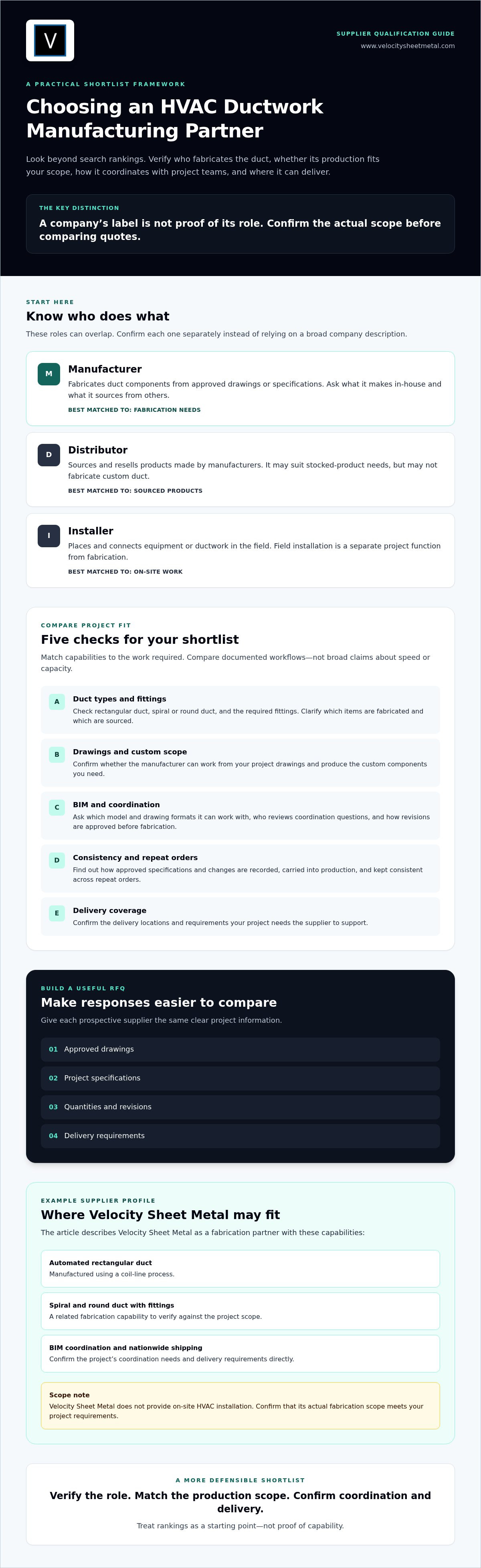
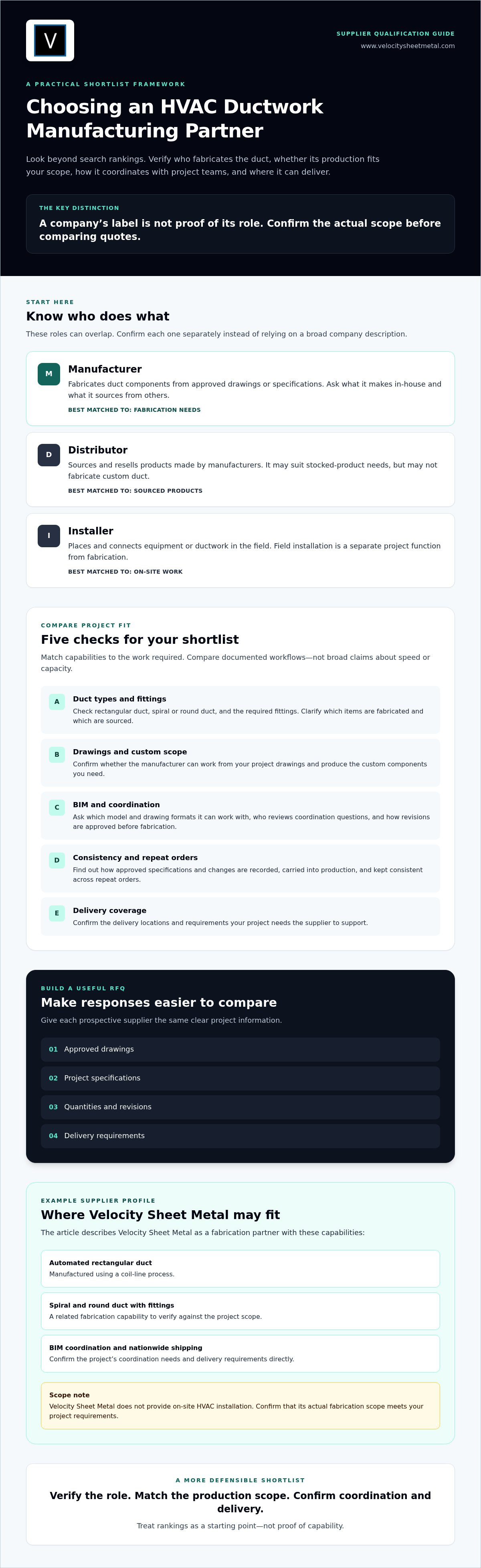
A supplier’s place in search results doesn’t tell you whether it makes ductwork. For a project team, the useful distinction is operational: who fabricates the components, who sources and resells them, and who installs them in the field. These roles can overlap, so verify the actual scope instead of relying on a company’s label.
This distinction affects how you handle custom geometry, repeat orders, and drawing changes. A fabrication partner may be able to work from project-specific drawings and explain how revisions are passed to production. A distributor may be the right fit for stocked products, but may not fabricate custom duct. Neither role is automatically better. Choose based on the work you need covered.
A ranked list alone won’t show whether a supplier fabricates duct or fits your project. Treat rankings as a starting point, not proof of capability. Build a shortlist by confirming each candidate’s production scope and project fit.
What does an HVAC ductwork manufacturer actually do?
A ductwork manufacturer turns approved drawings or specifications into fabricated duct sections and fittings. Its work may include standard configurations, project-specific components, or both. Equipment distribution focuses on supplying products made by manufacturers, while field installation is a separate project function. Capabilities vary, so ask each candidate what it fabricates and what it sources from others.
For example, Velocity Sheet Metal manufactures coil-line automated rectangular duct, along with spiral and round duct and fittings. That establishes its role as a fabrication partner, but you should still confirm that its specific capabilities match your project requirements.
Why do search results mix manufacturers and HVAC distributors?
Broad HVAC search pages often serve purchasing needs by listing equipment, parts, and supplies from multiple brands. That can help buyers locate products, but it doesn’t prove the listed business fabricates duct. General contractor suppliers may also carry HVAC-related products without offering duct manufacturing. Check the business’s stated services and ask directly: Who makes the duct, and where does fabrication take place?
Quick definition: A manufacturer fabricates duct components; a distributor sources and resells products; an installer places and connects equipment or ductwork in the field. One company may handle more than one role, but confirm each role separately.
Make this check before comparing quotes or judging a supplier against other top HVAC ductwork manufacturers. Confirm who controls fabrication, who handles drawing questions, and whether repeat orders can follow the project’s approved requirements. Clear answers give you a more defensible shortlist than a broad search ranking.
Which capabilities should you compare when shortlisting HVAC ductwork manufacturers?
Start with the work your project requires, then test each manufacturer’s capabilities against it. A broad product list isn’t enough. Compare duct types, custom fabrication scope, drawing support, revision control, and the ability to reproduce approved requirements across repeat orders. This gives you evidence of fit, not just a list of claims.
How should you evaluate duct types and production fit?
Match the scope item by item: rectangular duct, spiral or round duct, and the required fittings. If the project combines duct types or includes custom components, ask which work the manufacturer produces and which items it sources elsewhere. For repeat orders, confirm how approved specifications and changes are recorded and carried into production. Compare the documented workflow rather than relying on unverified claims about speed or capacity.
What should you ask about BIM coordination and quality consistency?
Before sending project files, confirm which model and drawing formats the supplier can work with, who reviews coordination questions, and how revisions are approved before fabrication. Ask what project records you’ll receive and how the manufacturer keeps production standards consistent across repeat orders or national-account work. For context on why duct sealing matters to system performance, see Energy Star’s guidance on the importance of well-sealed ductwork.
Use a simple comparison to keep supplier discussions focused:
| Criterion | Evidence to request | Why it matters |
|---|---|---|
| Duct types and fittings | Written confirmation against your scope | Shows whether the supplier can cover the required mix. |
| Custom fabrication | Examples of comparable components or scope descriptions | Clarifies fit for project-specific geometry. |
| Drawing and revision workflow | Accepted file formats, review steps, and approval process | Reduces ambiguity about which version reaches production. |
| Repeat-order consistency | Description of how specifications and revisions are retained | Helps assess continuity across project phases and locations. |
Velocity Sheet Metal’s stated capabilities include coil-line automated rectangular duct, spiral and round duct with fittings, and BIM coordination and spool drawings. Its national-account partnerships focus on standardized quality and consistent production standards. Confirm that the duct types, file workflow, and documentation align with your project. For a deeper RFQ framework, review the HVAC duct fabrication procurement guide. You can also review Velocity Sheet Metal’s fabrication capabilities as part of your comparison. Assess every candidate for project fit before deciding which of the top HVAC ductwork manufacturers belongs on your shortlist.
How do leading ductwork supplier types compare for commercial projects?
Commercial projects can involve several supplier models, and the label alone won’t tell you who owns fabrication, coordination, or order follow-through. Compare the role each company will play against your scope. The table outlines typical distinctions, but confirm actual responsibilities with each prospective partner before shortlisting the top HVAC ductwork manufacturers.
| Supplier type | Potential project fit | Confirm before proceeding |
|---|---|---|
| Duct manufacturer | Project-specific duct fabrication and direct discussion with the producer about fabrication requirements. | Which duct types and components it makes, what it sources elsewhere, and who handles drawing questions and revisions. |
| Distributor | Sourcing standard products or coordinating access to a broader range of HVAC supplies. | Whether duct is stocked or sourced, which business fabricates it, and who owns order coordination if requirements change. |
| Integrated fabrication partner | A manufacturer that also supports relevant drawing or model coordination alongside fabrication. | Which coordination tasks are included, how approved information reaches production, and where fabrication responsibility sits. |
When is a duct manufacturer a better fit than a distributor?
Direct contact with the producer can be useful when the scope includes custom geometry, project-specific components, or repeat orders tied to approved drawings. It gives the project team a clear path to ask how requirements move into fabrication. A distributor may be a better fit for standard product sourcing or a broader supply list. Ask each candidate who makes the duct, who owns the scope, and how orders and revisions are coordinated. One company may handle multiple roles, but don’t assume it does.
Read supplier pages according to the role they describe. Product and brand access may suit a purchasing need, while a multi-category supply business may support a broader supply list. Neither description alone establishes in-house duct fabrication. Market research services serve a different purpose from project-level duct supply. These businesses may meet different needs, but a general description isn’t enough to qualify a company as a duct manufacturer.
Where does Velocity Sheet Metal fit in a national shortlist?
Velocity Sheet Metal is a manufacturer to investigate when automated rectangular duct is central to the project. It also offers spiral and round duct with fittings, plus BIM coordination and spool drawings. The company serves customers nationally, and its national-account partnerships focus on standardized quality and consistent production standards. Confirm the specific scope, drawing workflow, and delivery requirements for your project. For more context on its production approach, read about coil-line duct fabrication.
Use the same questions for every candidate. This keeps the comparison focused on confirmed capabilities rather than unsupported rankings or broad claims. To review the manufacturer’s stated offerings, visit Velocity Sheet Metal’s fabrication capabilities.
How can you qualify HVAC ductwork manufacturers before issuing an RFQ?
A well-prepared RFQ makes supplier responses easier to compare and exposes gaps before production begins. Use the same information and questions with every candidate, including the top HVAC ductwork manufacturers on your shortlist. Define what you need, verify the supplier’s scope, and confirm how files and delivery will be managed.
What information should an HVAC ductwork RFQ include?
Build the request around the project’s current, approved information. Identify what’s included, and ask vendors to flag missing or conflicting details rather than fill gaps with assumptions. Include:
- Scope: duct categories, fittings, custom components, and any items excluded from the request.
- Project documents: approved drawings, applicable specifications, revision identifiers, and required coordination.
- Order details: quantities, project phasing, packaging requirements, and delivery locations.
- Delivery expectations: required delivery windows and any constraints the supplier needs to account for.
Ask each manufacturer to identify the drawings and revision level it used to prepare its response. This helps catch mismatched documents before they become production questions.
How can you check production and delivery alignment?
Before comparing responses, confirm who reviews submitted files, who communicates questions or revisions, and how production information is approved. Ask for examples of relevant work and a clear explanation of how specifications carry into repeat orders. For national-account projects, ask how the supplier maintains consistent production standards across orders. Request evidence related to your scope. Don’t assume a certification, process, or capability unless the supplier confirms it and provides relevant documentation.
Review logistics as carefully as fabrication. Confirm the proposed delivery locations, order phasing, and packaging approach against the RFQ. If a supplier serves customers nationally, verify that its delivery plan works for your project rather than assuming coverage settles the details.
If model coordination is part of your scope, clarify how models, drawings, and revisions move from review to approved production information. This guide to BIM coordination for sheet metal fabrication offers further context on that handoff.
Compare confirmed scope, documentation, repeat-order controls, and logistics side by side. Ready to discuss whether your project requirements align with Velocity Sheet Metal’s fabrication and BIM coordination capabilities? Discuss your ductwork project requirements.
Why include Velocity Sheet Metal when selecting a ductwork manufacturing partner?
Velocity Sheet Metal is worth evaluating when your scope calls for fabricated ductwork, particularly automated rectangular duct, its primary offering. Automated production may suit projects with defined specifications and repeat-order needs, but fit depends on your drawings, quantities, and production requirements. Confirm those details with the team rather than relying on a general capability description.
Which project requirements align with Velocity Sheet Metal’s offerings?
Beyond rectangular duct, Velocity Sheet Metal offers spiral and round duct with fittings, curb adapters, custom laser cutting, and CNC press brake bending. The company also provides BIM coordination and spool drawings. These capabilities may suit projects where duct fabrication and related sheet metal work need to be considered together. Confirm which offerings apply to your scope and ask what drawings or model information are needed to assess fit.
Velocity Sheet Metal serves customers nationally and supports national accounts with standardized quality and consistent production standards. For projects spanning multiple locations, ask how delivery locations, order phasing, and repeat requirements will be handled. Those specifics matter more than an assumption based on stated coverage.
What is the next step for a qualified project inquiry?
Prepare the project scope, current drawings, specifications, quantities, revision status, and delivery requirements before discussing the work. If BIM coordination or spool drawings are relevant, identify the model and documentation needs as well. A clear package helps the manufacturer understand what you’re asking it to fabricate and which details still need confirmation.
Keep the role clear during supplier selection: Velocity Sheet Metal is a manufacturer and fabrication partner, not an on-site HVAC installer. It does not provide on-site HVAC installation. If your project requires field installation, confirm that scope with a separate provider.
Include Velocity Sheet Metal among the top HVAC ductwork manufacturers you evaluate when its stated fabrication capabilities align with your project. Share your requirements and confirm scope, file needs, and logistics directly. Discuss your ductwork project with Velocity Sheet Metal.
Build a Shortlist You Can Stand Behind
The strongest shortlist isn’t based on rankings alone. Separate fabricators from distributors, match each partner’s confirmed capabilities to your ductwork scope, and compare how drawings, revisions, repeat orders, and delivery requirements are handled. A clear RFQ turns those questions into responses you can assess side by side.
Velocity Sheet Metal may fit projects centered on automated rectangular duct, its primary offering. The company also provides nationwide shipping and national-account support focused on consistent production standards. Its management team brings more than 50 years of combined industry experience. Confirm that its capabilities, file requirements, and logistics align with your project before making a selection.
Use these criteria to evaluate the top HVAC ductwork manufacturers for your needs, then take the next step with a project scope and current documents in hand. Discuss your ductwork project with Velocity Sheet Metal to determine whether its manufacturing capabilities fit. A well-qualified partner starts with clear requirements and direct answers.
Frequently Asked Questions
How do I find the right HVAC ductwork manufacturer for a commercial project?
Shortlist the top HVAC ductwork manufacturers by matching confirmed capabilities to your project scope. Check duct types, custom fabrication, drawing and revision workflows, repeat-order controls, and delivery requirements. Ask for evidence of relevant work and confirm who fabricates each item instead of relying on a broad supplier label. Then send the same RFQ information to each candidate so you can compare responses consistently.
What is the difference between an HVAC duct manufacturer and a distributor?
A duct manufacturer fabricates duct components, while a distributor sources and resells products made by manufacturers. A distributor may be useful for standard product sourcing or a broader supply list, but its catalog doesn’t prove it makes ductwork. Ask who fabricates the components, where fabrication takes place, and who handles questions or revisions. Some businesses perform more than one role, so confirm the scope directly.
What should I include in an HVAC ductwork RFQ?
Include the project scope, required duct types and fittings, approved drawings, specifications, quantities, and current revision status. Also state project phasing, packaging needs, delivery locations, and any required drawing or model coordination. Ask the manufacturer to identify missing or conflicting information before production. Send each vendor the same document set, and ask which drawing revisions it used to prepare its response.
Can one manufacturer produce both rectangular and spiral ductwork?
Yes, some manufacturers offer both, but capabilities vary and should be confirmed for the specific project. Ask whether the supplier fabricates the required rectangular and spiral duct itself, and whether it can also provide the fittings in your scope. Velocity Sheet Metal lists coil-line automated rectangular duct as its primary offering and also offers spiral and round duct with fittings. Confirm project fit and requirements directly.
How does BIM coordination help with HVAC duct fabrication?
BIM coordination helps teams review ductwork in relation to project model information before fabrication. A coordinated workflow can clarify geometry, identify questions for the design or project team, and keep approved drawing revisions aligned with production information. Ask which files the manufacturer accepts, who reviews them, and how changes are approved. Velocity Sheet Metal offers BIM coordination and spool drawings; confirm the specific deliverables your project needs.
Can HVAC ductwork manufacturers support projects across multiple locations?
Some manufacturers can support projects across multiple locations, but verify shipping coverage and order coordination for the locations in your scope. Ask how the supplier will handle delivery requirements, project phasing, and repeat orders. Velocity Sheet Metal serves customers nationally, provides nationwide shipping, and supports national accounts with standardized quality and consistent production standards. Confirm your project’s logistics and requirements directly.
Does Velocity Sheet Metal install HVAC ductwork on-site?
No. Velocity Sheet Metal manufactures and fabricates ductwork but does not provide on-site HVAC installation. Its offerings include automated rectangular duct, spiral and round duct with fittings, BIM coordination and spool drawings, and other fabrication capabilities. If your project requires field installation, arrange that scope separately with an appropriate provider. Keep fabrication and installation responsibilities clear in project documents and supplier discussions.