On-Demand Metal Part Production: Scalable Custom Enclosures for 2026
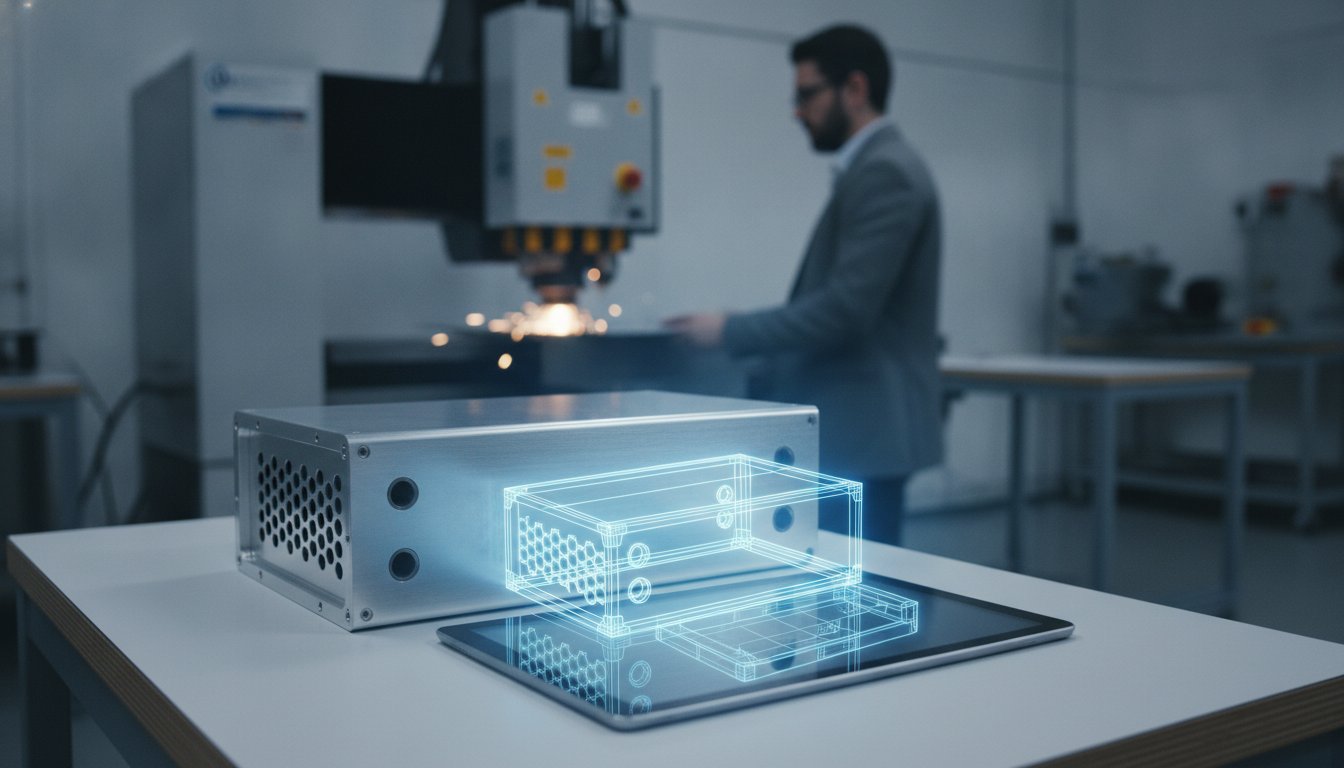
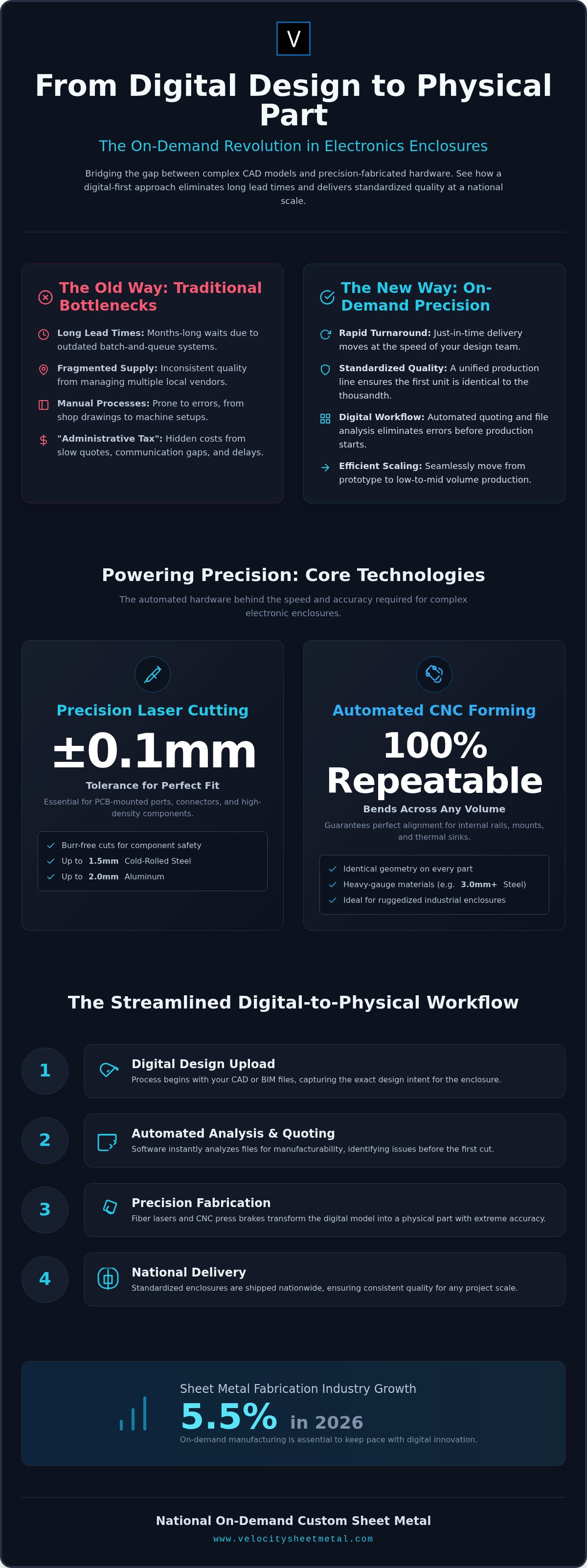
The traditional manufacturing model is failing to keep pace with digital innovation. In 2026, the sheet metal fabrication industry is growing by 5.5%, yet many engineers still face the same old bottlenecks. You've likely dealt with the frustration of long lead times and the disconnect between a perfect CAD model and a physical part that just doesn't fit. Sourcing custom sheet metal enclosures for electronics shouldn't feel like a gamble. It should be a precise, repeatable process that moves at the speed of your design team.
We're here to bridge that gap. This article explores how on-demand manufacturing transforms complex digital designs into precision-fabricated enclosures at a national scale. You'll learn how to establish a seamless digital-to-physical workflow that ensures standardized quality across every unit, regardless of volume. We'll examine the benefits of automated technology and domestic sourcing to ensure rapid turnaround and schedule certainty. From the first laser cut to nationwide delivery, we'll show you how to scale production with surgical precision.
Key Takeaways
- Transition from traditional batch-and-queue models to a digital-first manufacturing approach that delivers parts directly from CAD files.
- Leverage precision laser cutting and CNC press brake bending to meet the tight tolerances required for complex electronic interface ports.
- Scale your project efficiently by moving from rapid thermal prototypes to low-to-mid volume production with standardized national quality.
- Streamline your workflow by optimizing BIM files and using mechanical spooling to break down complex assemblies into ready-to-fabricate components.
- Access a reliable national supply chain for custom sheet metal enclosures for electronics with standardized fabrication and nationwide shipping.
What is On-Demand Metal Part Production for Electronics?
On-demand metal part production is a digital-first manufacturing model where custom enclosures are fabricated directly from CAD or BIM files as needed. This approach acts as the essential bridge between a designer's digital intent and a physical industrial component. For decades, the industry relied on a "batch-and-queue" system. You ordered a massive inventory, waited months for delivery, and hoped your design didn't become obsolete before the last unit arrived. Today, that model is dead. On-demand production shifts the focus to just-in-time industrial delivery, ensuring your hardware housing matches your project's actual velocity.
Electronics require a specialized approach that goes beyond basic box-making. When you're sourcing custom sheet metal enclosures for electronics, you're managing critical technical variables. These include electromagnetic interference (EMI) shielding, complex thermal management pathways, and high-precision mounting points for sensitive circuit boards. Modern sheet metal fabrication has evolved to meet these needs with surgical accuracy, integrating the engineering requirements of the digital file directly into the automated production line.
The Evolution of Industrial Fabrication
The days of manual shop drawings and endless email chains are over. Automated quoting and digital file reviews have replaced the slow, error-prone processes of the past. By adopting 2026 automation standards, advanced fabricators have slashed the administrative lead times that once stalled projects for weeks. Software now analyzes digital files instantly to identify manufacturability issues before the first laser fires. This "just-in-time" capability is vital for modern electronics supply chains, allowing teams to iterate on designs without the penalty of wasted inventory or long production delays.
Traditional Shops vs. On-Demand Speed
Traditional fabrication shops often impose an "administrative tax" on every order. This tax manifests as manual machine setups, fragmented communication, and unpredictable shipping schedules. These bottlenecks kill momentum for national projects. On-demand models eliminate these frictions by using integrated digital workflows. Instead of managing multiple local vendors, you leverage a centralized system that maintains consistent quality across every unit. Custom sheet metal enclosures for electronics produced through an on-demand model benefit from a unified production line. It ensures the first unit is identical to the thousandth, providing the reliability and speed required for the aggressive release cycles of 2026.
Core Technologies Behind Precision Enclosure Fabrication
Precision in custom sheet metal enclosures for electronics isn't just about the final fit. It's about the long-term reliability of the internal systems. High-density electronic components leave zero room for error. We use a digital-to-physical workflow that starts with BIM coordination. This process identifies potential field collisions between components and the housing before production begins. By adopting on-demand metal manufacturing strategies, we bridge the gap between complex digital models and physical reality with industrial speed.
Laser Cutting for High-Density Electronics
Fiber lasers are the standard for 2026, delivering tolerances as tight as +/- 0.1mm. This level of accuracy is essential for custom sheet metal enclosures for electronics where connector cutouts must align perfectly with PCB-mounted ports. These lasers cut through 1.5 mm cold-rolled steel or 2.0 mm aluminum with extreme speed and precision. Every cut is burr-free. This is essential for protecting delicate internal wiring and preventing short circuits during assembly. If you need specific tolerance data for high-precision projects, check our precision laser cutting services guide for technical specifications.
CNC Forming and Heavy-Gauge Capabilities
Ruggedized electronics often need more than just a thin box. They require heavy-gauge materials that can survive industrial abuse. Our CNC press brakes provide the force and precision needed for these complex geometries. Automated forming ensures that every bend is identical across a national production run. This level of repeatability is impossible with manual setups. It guarantees that internal mounting rails and thermal sinks align perfectly every time. Whether you're using 3.0mm steel or specialized alloys, our equipment maintains the structural integrity of the housing without compromising the design's digital intent.
Material versatility is the final piece of the precision puzzle. We work with everything from galvanized steel for harsh industrial sites to aluminum 5052 for weight-sensitive portable gear. Each material has specific bend allowances and laser settings. We calibrate our machines to these nuances to prevent cracking or warping during the fabrication process. You can consult with our engineering team to determine the best material and gauge for your specific enclosure requirements. This technical foundation ensures your product performs as expected in the field, every single time.
Scaling from Prototype to National Production
Scaling isn't just about making more parts. It's about maintaining precision as the volume increases. Most shops can handle a single box. Few can handle a national rollout for a data center or a fleet of industrial sensors. We break this down into three distinct phases to ensure your project doesn't lose momentum as it grows. Phase 1 starts with rapid prototyping. You need to verify thermal airflow and component fitment before committing to thousands of units. This stage is where you catch collisions and refine your design. Phase 2 moves into low-to-mid volume production, often for specialized industrial equipment. Here, the focus shifts to repeatable quality. Phase 3 is the final step: high-volume scaling for national infrastructure projects and OEMs. At this level, cost per unit becomes as critical as the speed of delivery.
Advanced research into On-Demand Manufacturing of Electronics highlights the shift toward agile, scalable systems that bridge the gap between initial design and mass production. This approach allows you to balance the cost-per-unit trade-offs without sacrificing the speed that on-demand systems provide. You don't have to choose between a prototype shop and a mass-producer. You get both in a single, streamlined pipeline.
The Prototype-to-Production Pipeline
Standardizing a design for national distribution requires DFM feedback. Design for Manufacturing ensures every cutout and bend is optimized for automated machines. This reduces manual labor and cuts down on the administrative delays that plague traditional shops. By using digital-first fabrication, you eliminate the need for expensive, specialized tooling. This lowers the entry barrier for complex custom sheet metal enclosures for electronics, allowing you to move from a single unit to a full production run without restarting the engineering process. It's a seamless transition that keeps your hardware relevant in a fast-moving market.
National Account Management and Logistics
Managing a multi-state project is a logistical nightmare if you're using local, fragmented shops. You end up with inconsistent parts and varying lead times. We solve this through centralized fabrication and nationwide shipping. Standardized production means every enclosure arriving at a job site in Texas is identical to the one arriving in New York. On-demand production simplifies procurement for multi-state engineering firms. You don't have to manage five vendors. You manage one digital workflow. We handle the movement from the factory floor to regional centers, ensuring your custom sheet metal enclosures for electronics arrive on time and ready for installation. This level of coordination is essential for maintaining project schedules in 2026.
Streamlining the Digital-to-Physical Workflow
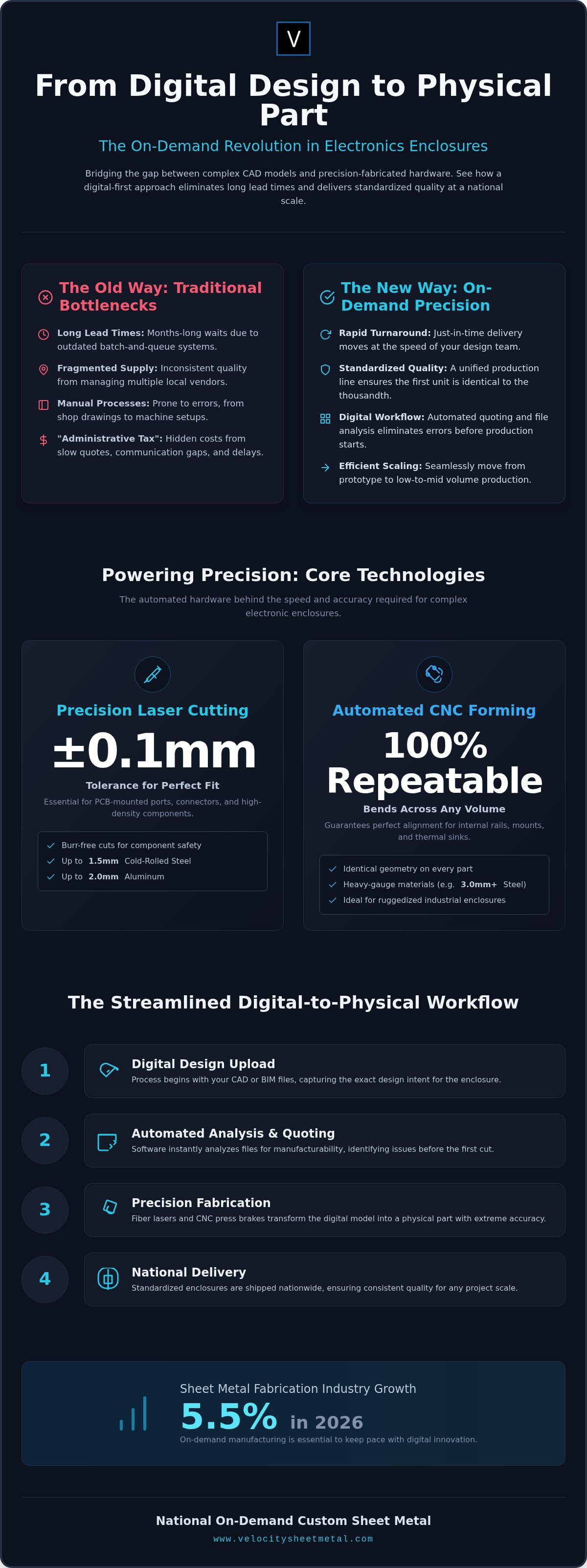
Efficiency in manufacturing is built on the quality of the digital input. A broken workflow leads to scrap metal and missed deadlines. To get custom sheet metal enclosures for electronics right the first time, you must streamline the path from the screen to the shop floor. This starts with optimizing your CAD or BIM files specifically for automated machinery. You aren't just designing a box; you're designing a high-speed sequence of laser cuts and bends. By refining the digital model early, you ensure the physical output matches your engineering intent without costly mid-production adjustments.
BIM Coordination and Spool Drawings
Implementing BIM for sheet metal fabrication is the most effective way to reduce material waste in complex assemblies. Mechanical spooling breaks down these large enclosure designs into manageable, ready-to-fabricate components. Spooling ensures that every mounting bracket and port aligns perfectly with internal electronics once the parts arrive at the job site. By utilizing digital clash detection, we resolve internal component conflicts before the first piece of metal is cut. This preemptive strike eliminates the field errors that typically derail industrial projects. For national accounts, this means a design perfected in the digital environment stays perfect throughout the entire production run.
File Preparation and Tolerance Standards
Digital files must be shop-ready to maintain 2026 production speeds. We recommend submitting DXF files for flat patterns and STEP or DWG files for 3D models. When you prepare your design, follow a strict checklist to ensure seamless manufacturability:
- Maintain a consistent wall thickness throughout the part to ensure uniform heat dissipation and structural integrity.
- Place holes at least 1.5 times the material thickness away from any bend lines to prevent hole distortion during forming.
- Ensure flange widths are compatible with standard CNC press brake tooling to avoid custom setup delays.
Understanding industrial tolerances is critical for high-density electronics. While fiber lasers achieve +/- 0.1mm, CNC bending typically operates within a +/- 0.5mm range. Designing with these physical realities in mind prevents assembly friction later. Once your files are optimized, use automated quoting to lock in your budget and project timeline immediately. This removes the administrative tax and guesswork from custom sheet metal enclosures for electronics procurement, moving your project from a digital concept to a physical reality in days.
Ready to move from design to delivery? Submit your BIM or CAD files now for a technical review and an automated quote that keeps your project on schedule.
Velocity Sheet Metal: National On-Demand Solutions
Velocity Sheet Metal isn't a local job shop. We are a high-capacity fabrication partner built for national scale. We bridge the gap between digital design and physical delivery using BIM-integrated workflows. When you're managing a rollout for custom sheet metal enclosures for electronics across several states, you can't afford quality drift. We solve this by centralizing production and utilizing efficient nationwide shipping. This ensures every unit meets the same rigid industrial standards, whether it's destined for a facility in Seattle or a data center in Miami. Our operation is designed to move at your speed, eliminating the typical administrative friction of traditional manufacturing.
Why National OEMs Choose Velocity
Consistency is the foundation of industrial reliability. National OEMs choose us because we maintain production standards that meet both rigorous engineering and HVAC requirements. We leverage over 50 years of combined industry experience on the factory floor to anticipate problems before they stall your project. Our logistics team streamlines the movement of parts for large-scale projects spanning multiple states. You don't have to worry about fragmented vendors or varying lead times. We act as a single, tech-savvy partner obsessed with precision and delivery. This authoritative approach ensures that your project remains on schedule and within budget, regardless of its geographic footprint.
Starting Your Custom Production Run
Our team treats every digital file as a blueprint for surgical precision. When you submit your CAD or BIM files, we perform a technical review to ensure the design is optimized for our automated laser cutting and CNC bending equipment. This collaborative process identifies potential issues early, such as flange width conflicts or hole placement errors. We don't just take orders; we operate as an extension of your engineering team to ensure the highest possible part quality.
Moving from a digital concept to a physical product is straightforward. You provide the files, and we provide an automated quote that locks in your project timeline. We consult with you on specialized material needs and tolerance requirements to ensure your custom sheet metal enclosures for electronics perform perfectly in the field. This streamlined workflow is the most efficient way to scale from a single prototype to a national production run.
Don't let traditional fabrication bottlenecks slow down your 2026 production schedule. Precision requires a partner who understands the reality of the factory floor as well as the complexity of a digital design. Partner with Velocity Sheet Metal for your next national production project.
Scale Your Electronic Production with Surgical Precision
The shift to on-demand manufacturing is a technical necessity for 2026. By integrating BIM coordination with automated fabrication, you eliminate the friction between a digital file and a physical product. You've seen how precision laser cutting and CNC bending ensure your custom sheet metal enclosures for electronics meet the tightest industrial tolerances. Scaling from a single prototype to a national rollout requires a partner who maintains standardized quality across every job site. Consistency is no longer a luxury; it's the baseline for industrial success.
Velocity Sheet Metal brings 50+ years of combined industry expertise to your project. Our automated fabrication technology and nationwide shipping capabilities provide the infrastructure you need to compete. We handle the logistics while you focus on the innovation. It's time to stop fighting traditional lead times and start moving at the speed of your design team. We are ready to act as the essential bridge for your next production run.
Request a Custom Quote for Your National Production Run
Let's get to work on your next industrial breakthrough together.
Frequently Asked Questions
What is the typical lead time for on-demand metal part production?
Lead times for on-demand production typically range from 3 to 12 days depending on the complexity of the part. Rapid prototyping is usually on the shorter end of that window. Large production runs take longer but remain significantly faster than traditional shops because we eliminate manual administrative delays. Automated quoting and digital file reviews allow us to move your project onto the factory floor immediately without waiting weeks for a manual estimate.
Can on-demand manufacturing handle high-volume enclosure runs?
On-demand manufacturing is fully scalable for high-volume custom sheet metal enclosures for electronics. Our automated coil-line technology and CNC press brakes are designed for repeatability across thousands of units. We don't just stop at prototypes. We partner with national OEMs to deliver consistent, standardized quality for large-scale infrastructure projects. This ensures every enclosure in your rollout is identical to the first, regardless of the total order volume.
How does BIM coordination improve the accuracy of custom electronic enclosures?
BIM coordination improves accuracy by identifying potential component collisions in the digital environment before fabrication begins. We use spool drawings to break down complex assemblies into precise parts. This ensures that every internal mounting bracket and external port aligns perfectly with your electronic hardware. It removes the guesswork from assembly and eliminates the need for expensive field modifications during installation, saving your team time and reducing material waste.
What materials are best for on-demand laser cutting of electronics housings?
The best materials for electronics housings include 1.5 mm cold-rolled steel for cost-effective indoor use and Aluminum 5052 for lightweight thermal conductivity. For corrosive or medical environments, we recommend Stainless Steel 304L or 316L. Each material is calibrated for our fiber lasers to ensure burr-free edges and tight tolerances. Choosing the right material impacts both the durability and the shielding effectiveness of your enclosure, so we match the metal to your specific environment.
Do you offer nationwide shipping for custom metal enclosures?
We provide comprehensive nationwide shipping for all custom sheet metal enclosures for electronics. Our logistics network is built to support national accounts with multiple job sites across the US. We coordinate the delivery from our factory floor directly to your regional centers or installation sites. This centralized approach ensures project schedule certainty and maintains a unified supply chain for multi-state engineering firms that require consistent parts across every location.
How do I prepare my CAD files for on-demand manufacturing?
Prepare your CAD files by submitting DXF for flat patterns and STEP or DWG for 3D models. Ensure your design uses consistent wall thickness and places holes at least 1.5 times the material thickness away from bend lines. Following these Design for Manufacturing (DFM) best practices allows our automated systems to process your files without manual intervention. This speeds up quoting and ensures your design is ready for immediate fabrication upon approval.
What are the cost benefits of on-demand production for national accounts?
On-demand production reduces the administrative tax associated with traditional procurement. National accounts benefit from standardized quality that eliminates the cost of field errors and part inconsistencies across different vendors. By using a digital-first workflow, you lower your inventory overhead and only produce what you need when you need it. This just-in-time delivery model maximizes your budget and streamlines procurement for large-scale national projects spanning multiple regions.
Is on-demand production suitable for ruggedized industrial electronics?
On-demand production is ideal for ruggedized industrial electronics. We use heavy-gauge materials and CNC press brake bending to create durable housings that survive harsh environments. Our BIM-integrated process ensures that even complex, reinforced geometries remain accurate. Whether you need impact resistance or specialized mounting for mobile industrial gear, our automated systems deliver the structural integrity required for high-stakes industrial applications where failure isn't an option.