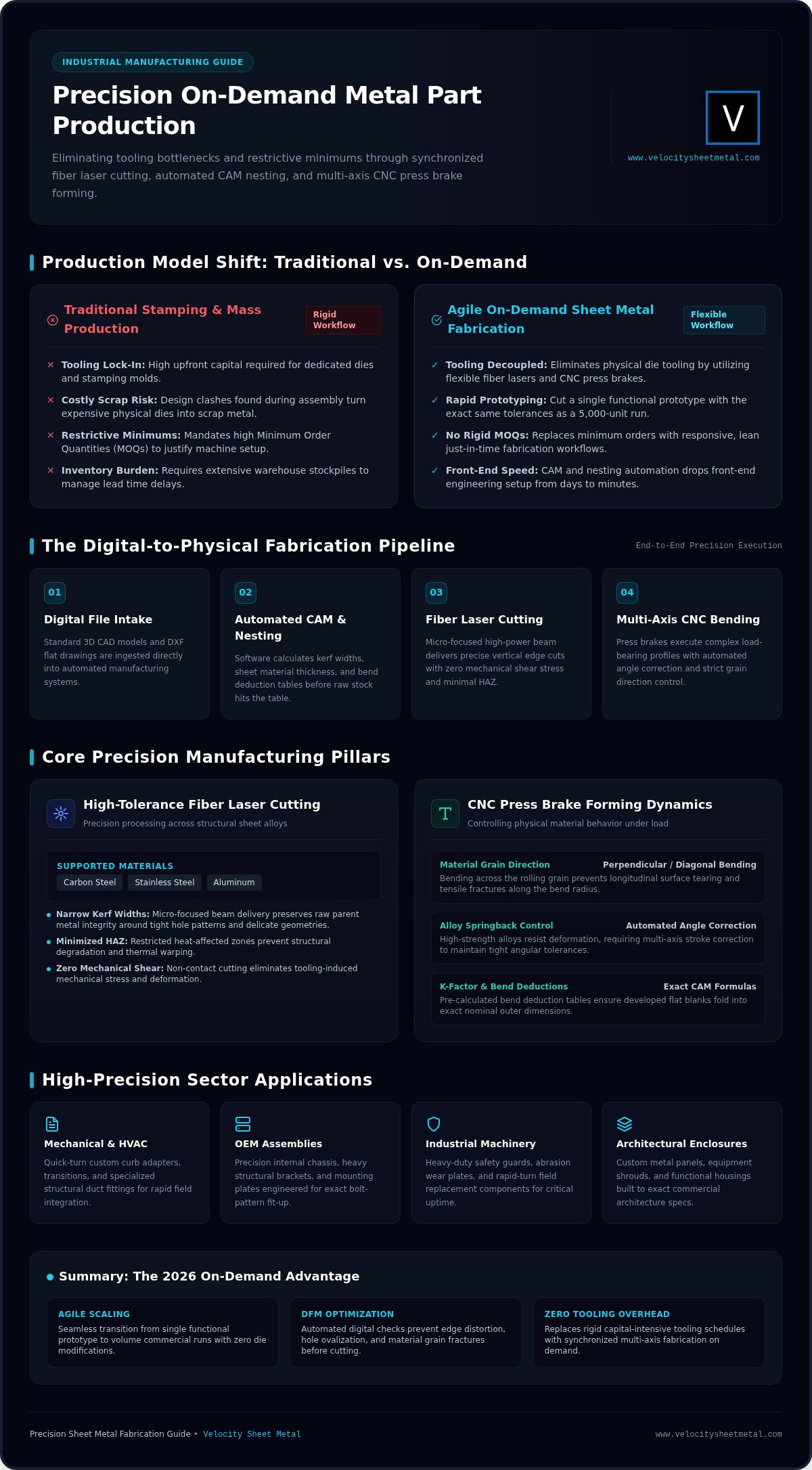
On-Demand Metal Part Production: 2026 Industrial Guide to Precision Manufacturing
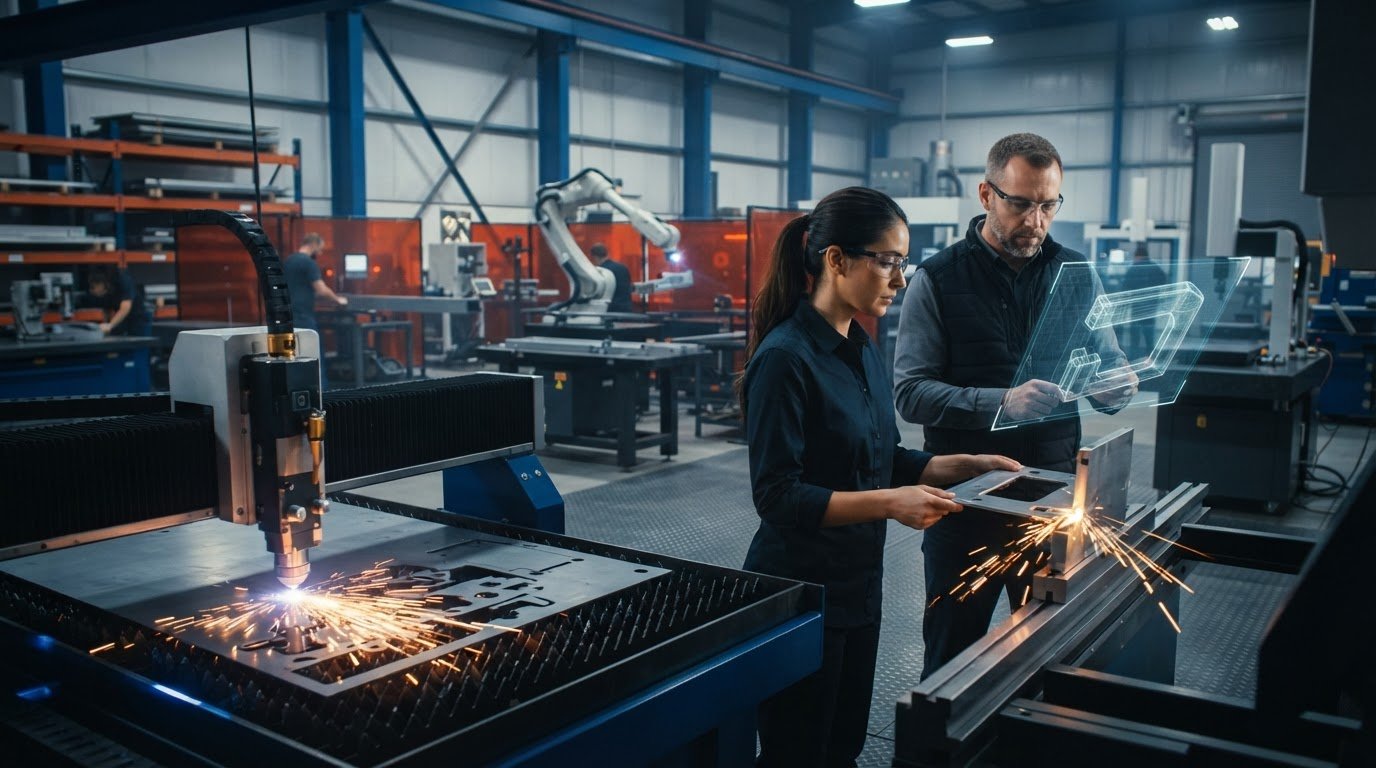
An instant online portal can quote a job in seconds, but software algorithms don't bend sheet metal. If you're an engineer or sourcing lead asking how to source custom parts on tight schedules without facing months of lead time, modern on-demand metal part production represents a vital operational shift. You've likely experienced the usual supply chain bottlenecks: unpredictable vendor schedules delaying critical project milestones, rigid minimum order quantities that penalize early prototyping, and parts delivered out of tolerance that force frustrating manual rework in-house.
True operational agility demands synchronized cutting, CNC forming, and rigorous manufacturing discipline, not just a digital intake screen. In this 2026 industrial guide, you'll learn how on-demand metal part production accelerates prototyping and scales custom fabrication without compromising engineering tolerances. We examine the streamlined digital-to-physical workflows, design-for-manufacturing parameters, and dependable domestic production standards that turn standard CAD models into production-grade precision sheet metal components, scaling seamlessly from first prototype to volume orders.
Key Takeaways
- Discover how on-demand metal part production replaces restrictive minimum order quantities with lean, just-in-time fabrication workflows.
- See how synchronized fiber laser cutting and precision CNC press brake bending maintain tight engineering tolerances across complex sheet metal geometries.
- Learn the critical vendor evaluation metrics to spot hidden production trade-offs before lead time delays impact your delivery schedule.
- Apply actionable Design for Manufacturing (DFM) rules to your 3D CAD files to prevent edge distortion and streamline quoting.
- Find out how to scale seamlessly from one-off functional prototypes to full-volume commercial runs without sacrificing part accuracy.
Understanding On-Demand Metal Part Production in Modern Industry
Traditional manufacturing thrives on massive volume, but modern engineering projects rarely do. Today's commercial schedules demand speed and precision without the burden of warehouse stockpiles. Broadly defined, modern on-demand metal part production translates digital design files straight into production-grade physical sheet metal parts on an as-needed basis. It eliminates rigid minimum order quantities, turning custom metal fabrication into a responsive, just-in-time asset.
The days of ordering a thousand brackets just to justify machine setup are gone. Instead, forward-thinking fabrication facilities bridge digital concepts and shop-floor execution directly through custom laser cutting and CNC press brake bending. Several high-precision sectors depend on this agile model daily:
- Mechanical and HVAC Systems: Quick-turn custom curb adapters, transitions, and specialized structural duct fittings.
- OEM Assemblies: Precision internal chassis, structural brackets, and mounting plates designed for exact fit-up.
- Industrial Machinery: Heavy-duty safety guards, wear plates, and rapid field replacement parts.
- Architectural and Equipment Enclosures: Custom panels and functional housings built to exact project specifications.
The Mechanics of Digital-to-Physical Sheet Metal Workflows
The manufacturing process begins with data, not tooling. Standard 3D CAD files and DXF drawings flow directly into automated nesting and CAM engines. This digital pipeline automatically accounts for kerf widths, material thickness, and bend deduction tables before raw stock ever hits the cutting table. Manual layout work disappears. Front-end engineering time drops from days to minutes, ensuring immediate machine code generation and consistent material traceability across every single cut.
On-Demand Prototyping vs. Traditional Volume Production Runs
Tooling commitments lock teams into rigid timelines. Traditional stamping or dedicated die forming requires substantial upfront capital, penalizing early-stage iterations. If an enclosure clash surfaces during assembly, those initial dies become expensive scrap metal.
Agile on-demand metal part production decouples tooling from quality. By relying on flexible fiber laser cutting and multi-axis CNC bending, operators can cut a single functional prototype with the exact same industrial tolerances as a run of five thousand units. You validate your mechanical fits in real-world conditions, optimize geometry early, and order component batches only as project phases demand them.
Core Capabilities Powering Precision Metal Part Manufacturing
Industrial-grade execution requires physical mastery of material dynamics. Web portals speed up ordering, but shop-floor results hinge directly on the machine technology shaping raw plate. In advanced manufacturing, cutting and bending operate as a tightly synchronized pair. This technical harmony makes dependable core capabilities powering precision fabrication possible, delivering reliable on-demand metal part production across varied structural alloys.
High-Tolerance Laser Cutting for Complex Geometries
Modern high-power fiber laser cutting systems deliver pinpoint accuracy across carbon steel, stainless steel, and aluminum. Micro-focused beam delivery produces narrow kerf widths and minimizes the heat-affected zone (HAZ), preserving the parent metal's structural integrity around tight hole patterns and delicate features. Unlike traditional stamping, laser processing introduces zero mechanical shear stress into the part. Reviewing our technical guide to precision laser cutting services highlights how optimized beam settings maintain vertical edge squareness across varied material gauges.
CNC Press Brake Forming and Structural Bending
Cutting flat blanks is only half the manufacturing journey. Multi-axis CNC press brake bending turns flat sheets into complex, load-bearing profiles. Success depends on controlling raw physical behavior:
- Material Grain Direction: Bending perpendicular or diagonal to the rolling grain prevents longitudinal surface tearing.
- Alloy Springback: High-strength alloys push back after forming, requiring automated angle correction during the stroke.
- Accurate K-Factors: CAM software must apply exact bend deductions matched to the shop's specific tooling radius.
Ignoring these material variables leads to angular drift and fit-up failures during final assembly. Consulting our engineering review of common press brake forming defects illustrates how proper tooling selection stops micro-fracturing along severe bend lines. When tight tolerances are non-negotiable for your assemblies, partnering directly with Velocity Sheet Metal ensures your formed components fit right out of the crate.
Evaluating On-Demand Fabricators: Lead Times, Tolerances, and Quality
A flashy checkout portal can mask severe operational shortcomings. Sourcing teams frequently discover this truth too late, receiving parts that fail dimensional checks or stall assembly lines. Real-world capability requires disciplined quality systems on the shop floor. When vetting partners for on-demand metal part production, look past automated turnaround claims and interrogate their quality control protocols, machine tolerances, and physical verification methods.
Procurement teams need hard operational benchmarks. High-performing vendors distinguish themselves across three foundational pillars:
- Dimensional Verification: Verifying true part geometry through calibrated optical comparators, digital height gauges, and coordinate measurement systems.
- Inter-Feature Consistency: Maintaining hole-to-edge and bend-to-bend spacing across hundreds of identical parts, not just on the first test blank.
- Process Transparency: Providing material test reports (MTRs) and verifiable heat numbers to confirm alloy grade integrity.
Dimensional Tolerances and Machine Repeatability Standards
Precision requires clear, unambiguous boundaries. Commercial fabrication tolerances often drift by plus or minus 0.030 inches, acceptable for basic brackets but unacceptable for precision mechanical enclosures. Industrial-grade operations hold laser cutting tolerances to plus or minus 0.005 inches and press brake bending within tight angular limits. These capabilities determine whether your team bolts assemblies together seamlessly or wastes hours grinding out interference fits in the field.
Domestic Supply Chain Security vs. Overseas Sourcing Risks
Lower overseas piece rates often prove deceptive once logistics intervene. International ocean freight introduces unpredictable shipping delays, unexpected customs holds, and shifting tariff obligations that wipe out anticipated margins. If a batch arrives with incorrect hole spacing, the turnaround loop to re-cut, reform, and reship can burn weeks of lead time.
Domestic fabrication eliminates those points of failure. Working with domestic facilities speeds communication during core operating hours, allowing real-time design clarification directly with engineers. As industrial insights from on-demand metal manufacturing show, localized agility secures intellectual property and insulates projects from international port disruptions. Standardized nationwide account programs protect scheduled assembly runs, ensuring the tenth production delivery meets the exact engineering specifications of your initial prototype.
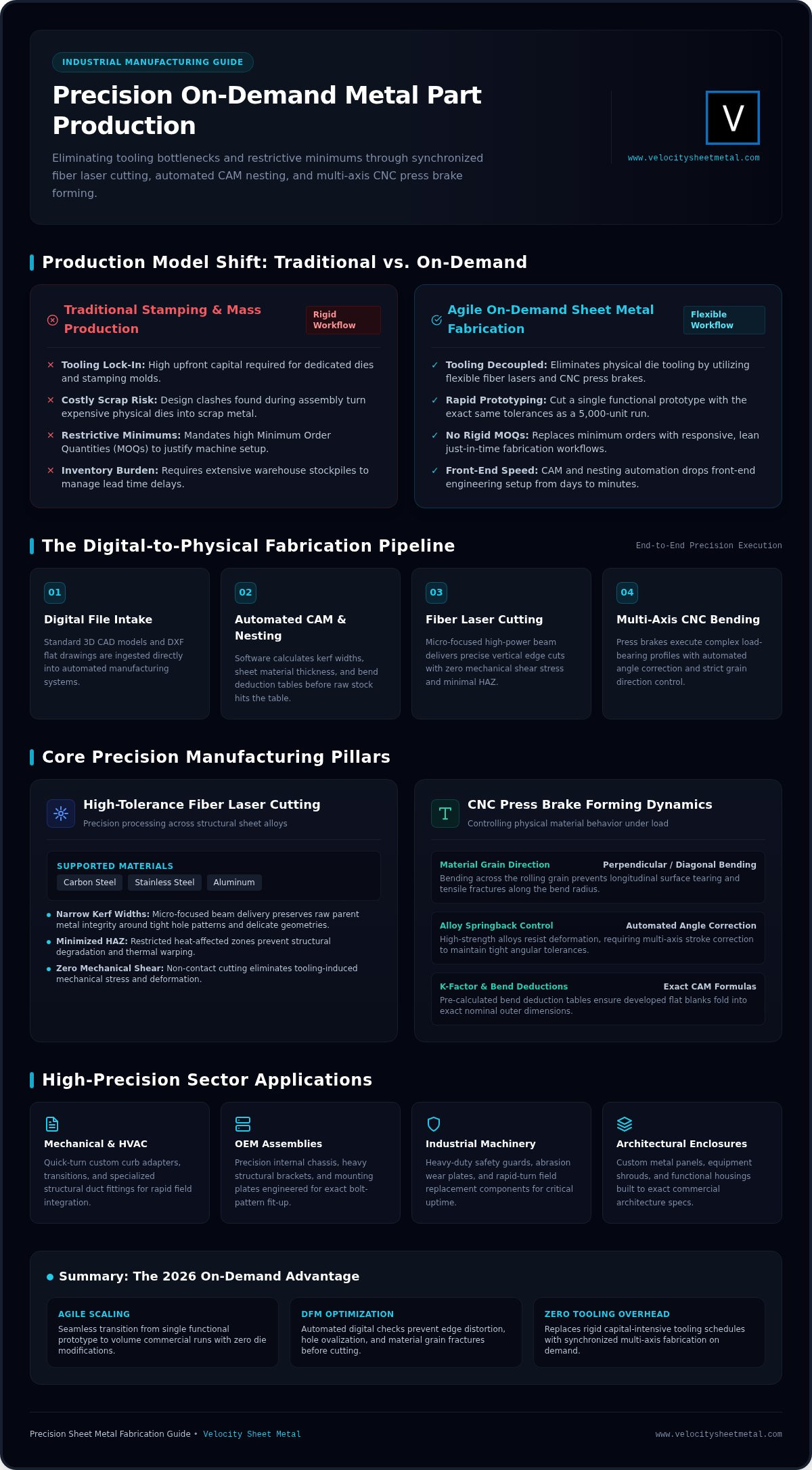
DFM Guidelines for Sheet Metal Parts
Design for Manufacturing (DFM) bridges digital geometry and physical shop-floor reality. Rigorous DFM optimization can reduce sheet metal fabrication costs by 15 to 30 percent while eliminating avoidable production delays. To streamline your on-demand metal part production, follow an actionable four-step framework: size internal features correctly, isolate cutouts from bend zones, detail proper corner reliefs, and clean up your export vectors.
Mastering Hole Sizes, Spacing, and Kerf Clearances
High-powered laser beams focus intense thermal energy into narrow kerfs. Piercing tiny geometries requires sufficient parent material to absorb that heat without burn-through. Maintain hole diameters equal to or greater than 1x material thickness, and keep slot widths at least 1.5x material thickness. To prevent internal edge distortion and ovalization during bending, position holes at least 2x material thickness from blank edges and at least 2.5x thickness plus the inside bend radius away from bend lines.
Bend Radii, Relief Notches, and Flange Proportions
Forming flat blanks into functional brackets requires adequate physical tooling clearance. Designing around consistent shop practices guarantees clean, repeatable bends:
- Uniform Bend Radii: Standardize internal bend radii across every fold to avoid costly, time-consuming tool changeovers during press brake runs.
- Minimum Flange Length: Design flange lengths to at least 4x material thickness, ensuring the sheet sits securely across bottom V-die openings without slipping.
- Bend Reliefs: Add rectangular or tear reliefs at flange transitions. Cut reliefs deeper than the inside radius to prevent tearing and material bunching at the corners.
Optimizing Digital Files for Rapid CNC Quoting
Clean files yield instant quotes and error-free machine code. Strip your 2D DXF files of duplicate lines, title blocks, and hidden construction layers, maintaining a true 1:1 scale. For formed components, package your assemblies into solid 3D STEP models that preserve explicit flange orientations, material specs, and critical tolerances. When managing complex duct and mechanical layouts, applying BIM clash detection for HVAC fabrication guarantees multi-component spatial accuracy before cutting starts.
Ready to move your designs from CAD to completed assemblies? When project timelines tighten, upload your files to Velocity Sheet Metal for rapid digital processing and precision on-demand metal part production built to your exact engineering specs.
Scaling from Prototype to Full Production with Velocity Sheet Metal
Fabricating a single proof-of-concept bracket proves your design works, but scaling that concept into continuous commercial runs is where traditional job shops falter. Growing from prototype to volume demands serious operational maturity. High-mix, variable-volume fabrication requires synchronized cutting tables, dependable CNC bending, and strict dimensional accountability. Backed by over 50 years of combined industry experience across our management team, Velocity Sheet Metal bridges the gap between digital models and volume supply, delivering reliable on-demand metal part production to manufacturing partners nationwide.
Standardized National Production and Logistics
Moving parts across the country requires bulletproof logistics. Our standardized national account programs maintain uniform tolerances whether parts are bound for an active commercial jobsite or an OEM assembly line. Every palletized shipment undergoes rigorous packaging protocols:
- Protective Material Interleaving: Applying paper or plastic barrier layers between finished sheets to eliminate cosmetic scratching and transit abrasions.
- Reinforced Skidding and Banding: Securing nested parts with high-tensile strapping and edge protectors to prevent shifting during freight transport.
- Coordinated Domestic Freight: Leveraging dedicated nationwide shipping channels to deliver finished components on strict project schedules.
This disciplined distribution network supports mechanical contractors, product developers, and OEM facilities across the United States without supply chain bottlenecks.
Initiating Your Next Precision Fabrication Order
Starting a production run shouldn't require weeks of administrative friction. The intake process begins when you submit 3D STEP models or 2D DXF flat patterns directly for technical review. Experienced fabrication operators evaluate your bend reliefs, hole clearances, and tooling access, verifying that your design intent aligns perfectly with automated laser cutting and CNC press brake workflows.
For engineering teams scaling structural enclosures and mounting assemblies, exploring our guide to CNC press brake services for OEMs outlines how automated forming cells maintain exact angular consistency across volume runs. From first-article sign-off to full production deliveries, the workflow moves from validated digital data to packaged, verified metal components with maximum speed.
Accelerate Your Pipeline with Industrial-Grade Precision
Modern assembly schedules leave no room for delayed deliveries or parts that require manual fitting in-house. Reliable on-demand metal part production demands more than a digital checkout cart; it requires engineering discipline, verified machine tolerances, and synchronized shop-floor operations. By optimizing CAD geometries around real press brake limits and strict laser clearances, your team eliminates rework before the first cut ever begins.
Velocity Sheet Metal turns digital designs into production-ready physical components without traditional lead-time friction. Our management team backs every run with over 50 years of combined industrial fabrication experience. Through comprehensive in-house custom laser cutting and precision CNC press brake bending, we maintain strict dimensional repeatability across every stage of development. Standardized national account programs ensure uniform tolerances and reliable freight logistics on every shipment, whether you need five functional brackets or five thousand finished assemblies.
Take control of your manufacturing schedule today. Partner with Velocity Sheet Metal for precision on-demand metal parts and keep your critical builds moving forward on time and within spec.
Frequently Asked Questions
What is the typical turnaround time for on-demand metal part production?
Turnaround times for on-demand metal part production typically range from 2 to 12 business days for functional prototypes and low-volume orders, with expedited options often cutting that to 2 to 5 days. Complex assemblies or higher production volumes generally require 2 to 6 weeks depending on forming requirements and secondary finishing. Sourcing domestically eliminates ocean transit, customs delays, and port bottlenecks, keeping assembly schedules intact.
Which digital file formats are required for sheet metal cutting and forming?
Flat 2D laser cutting requires clean 1:1 DXF or DWG files with all title blocks, text, and duplicate lines removed. For formed brackets and bent components, export 3D STEP (.step or .stp) or native CAD solid models from platforms like SolidWorks, Inventor, or Fusion 360. Providing both a 3D STEP file and a flat 2D vector file ensures automated software accurately interprets your bend deductions, flange angles, and dimensional tolerances.
Can on-demand manufacturing support custom bends and formed brackets?
Yes, advanced on-demand fabricators utilize multi-axis CNC press brakes alongside laser cutting to form complex brackets, enclosures, and structural mounts. Modern automated backgauges and segmented precision tooling allow rapid setups for one-off prototypes as easily as repetitive production volumes. Operators calculate specific K-factors, material grain direction, and springback for each alloy, ensuring every formed angle conforms strictly to your technical print specifications.
What metal materials are most commonly available for on-demand production?
Common materials include mild carbon steel (such as hot-rolled and cold-rolled commercial alloys), galvanized sheet, structural stainless steel (grades 304 and 316), and lightweight aluminum alloys like 5052 and 6061. Thickness options generally span light 26-gauge sheet up to heavy structural plate. Fabricators maintain certified stock accompanied by mill test reports, verifying parent metal mechanical strength and chemistry across every production batch.
How do on-demand suppliers maintain dimensional consistency between prototype and production runs?
Top fabricators rely on standardized tooling, automated machine programming, and calibrated measurement inspection tools like digital optical comparators and height gauges. Using identical CNC laser cutting paths and press brake programs for both prototypes and volume batches guarantees geometric uniformity. Standardized national account programs establish locked-in quality parameters, verifying that the five-thousandth formed part matches the exact tolerances and edge finish of the initial sign-off piece.
What are the key design rules to avoid sheet metal fabrication defects?
Keep hole diameters equal to or greater than the sheet thickness to prevent laser pierce blowout. Position holes at least 2.5 times the thickness plus the inside bend radius away from bend lines to avoid hole stretching. Always add bend relief notches at flange intersections to stop sheet tearing, and design flanges to at least 4 times the material thickness so the blank seats properly over bottom V-dies.
Does Velocity Sheet Metal ship custom fabricated components nationwide?
Yes, Velocity Sheet Metal delivers custom laser-cut parts, formed assemblies, and automated ductwork to contractors, engineers, and OEM facilities nationwide across the United States. Dedicated national account programs provide standardized manufacturing quality and reliable commercial freight logistics. Every shipment is carefully strapped and interleaved with protective barriers, ensuring high-precision on-demand metal part production reaches your facility or active jobsite ready for immediate installation.