High-Volume Sheet Metal Fabrication: A Practical Guide to Scalable Production
Can a fabricator keep repeat orders consistent when part mix, volume, and delivery demands change? High volume sheet metal fabrication depends on more than machine speed. The production method, drawing handoff, and repeat-order requirements all need to align.
It’s reasonable to focus first on whether a shop can make the part. Scalable production also means matching fabrication methods to part geometry and order patterns, carrying design details accurately into production, and managing revisions across runs.
This guide explains how to assess production fit, repeatability, fabrication methods, and delivery needs before choosing a high-volume sheet metal partner. You’ll see how part complexity, order frequency, and drawing readiness influence method selection, and how digital coordination can connect design information to finished components.
For HVAC projects, Velocity Sheet Metal provides automated rectangular duct, BIM coordination, and spool drawings. Custom laser cutting and CNC press brake bending address different part-production needs. Use the criteria below to compare production approaches and determine what information to prepare for a repeatable program.
Key Takeaways
- Assess high volume sheet metal fabrication by repeat demand, part variation, and schedule, not piece count alone.
- Prepare drawing requirements, quantities, and revision details early to support a clear handoff from design review to production.
- Compare rectangular duct, spiral and round duct, laser cutting, and press brake bending against the part’s geometry and application.
- Use repeat-order patterns and documented production standards to evaluate fit for multi-project procurement.
- Velocity Sheet Metal connects automated ductwork, BIM coordination, spool drawings, custom laser cutting, and nationwide shipping to production programs.
What High-Volume Sheet Metal Fabrication Requires Beyond a Large Order
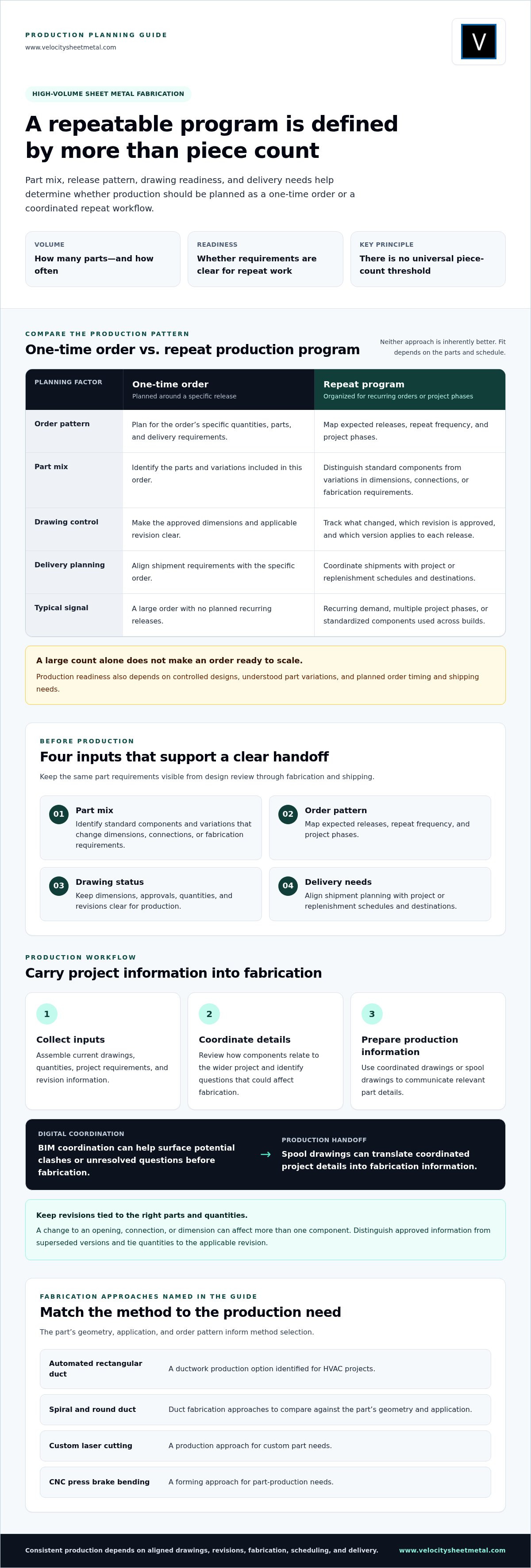
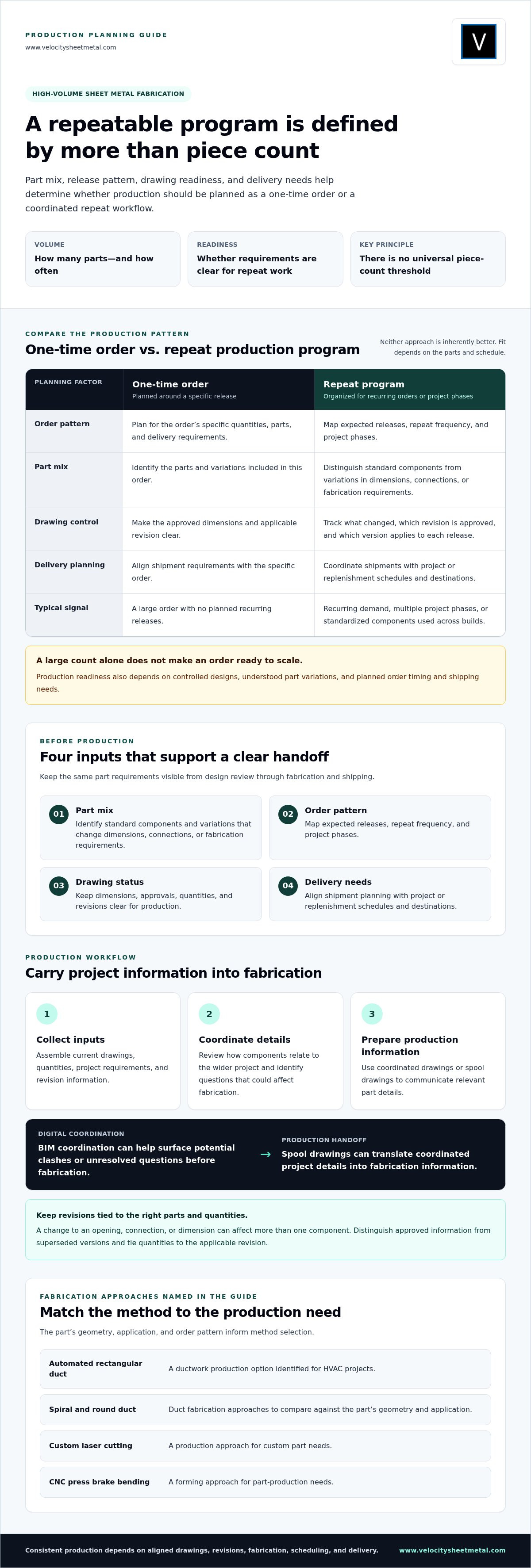
High-volume sheet metal fabrication is repeat production organized to deliver consistent parts across recurring orders or project phases, with drawings, fabrication, scheduling, and delivery coordinated as one workflow. There’s no universal piece-count threshold. A large one-time order may need a different plan from smaller orders released on a recurring schedule.
Volume describes how many parts are made and how often. Production readiness describes whether requirements are clear enough to support repeatable work: designs are controlled, part variations are understood, and order timing and shipping needs are planned. A high count alone doesn’t make an order ready to scale.
Material choice and processing also shape the work. A grounding in Sheet metal basics can help clarify how material and forming relate to part requirements. A production plan still needs to account for the specific geometry, application, and order pattern.
When Does a Sheet Metal Project Need a High-Volume Workflow?
Look for recurring demand, multiple project phases, or standardized components used across builds. These patterns make repeatability and coordinated scheduling more important than a single order’s total count. A project with frequent replenishment may benefit from a structured repeat process even if each release is modest. A one-time order can instead be planned around its specific quantities, parts, and delivery requirements.
Design changes add another variable. Revised dimensions, openings, or connection details can create distinct part versions and affect repeat orders. Track what changed, which revision is approved, and which version applies to each release. The right threshold for a high-volume workflow depends on the part mix, order frequency, and project schedule, not a fixed number.
What Buyers Need to Balance at Scale
Reliable production depends on connected details. Drawings need to reflect the intended parts, repeat orders need a clear basis for matching versions, and shipment planning must account for when components are needed and where they must go. Consistency is easier to manage when requirements stay aligned from design through fabrication and shipping. A planned workflow supports that alignment, but it does not establish a particular output rate.
Commercial HVAC and OEM programs can call for different production approaches. HVAC work may involve duct sections coordinated with project phases, while an OEM program may center on recurring components with controlled design revisions. In either case, define the requirements that affect planning:
- Part mix: Identify standard components and variations that change dimensions, connections, or fabrication requirements.
- Order pattern: Map expected releases, repeat frequency, and project phases.
- Drawing status: Keep dimensions, approvals, and revisions clear for production.
- Delivery needs: Align shipment planning with project or replenishment schedules and destinations.
These inputs help distinguish an order that’s simply large from a program that’s ready for repeatable production. Neither one-off custom work nor scalable production is inherently better. The fit depends on what the parts and schedule require.
How High-Volume Sheet Metal Fabrication Moves from Design to Production
In high volume sheet metal fabrication, the handoff from design to the shop floor needs to preserve the same part requirements at every stage. Clear drawings, quantities, and revision status give production teams a consistent basis for interpreting the work. If a drawing is outdated or a change isn’t visible to everyone involved, fabrication can proceed against information that no longer reflects the project.
A coordinated workflow connects project requirements to fabrication and then to shipment. BIM coordination and spool drawings can help resolve questions about how components fit and what information production needs before work begins. This is especially useful when ductwork must align with other building systems or repeat orders must follow current project details.
Prepare Drawings and Production Information
Start with current drawings and identify dimensions, quantities, part variations, and revisions. BIM coordination brings design information together to help surface potential clashes or unresolved questions before fabrication. Spool drawings can translate coordinated project details into fabrication information. For related guidance, explore BIM for sheet metal fabrication as part of planning the digital-to-production handoff.
Keep the revision trail clear. A change to an opening, connection, or dimension can affect more than one component. Distinguish approved information from superseded versions, and tie quantities to the applicable revision. Consistent digital inputs reduce interpretation differences between design, review, and fabrication.
A project-dependent workflow often follows these steps:
- Collect inputs. Assemble current drawings, quantities, project requirements, and revision information.
- Coordinate details. Review how components relate to the wider project and identify questions that could affect fabrication.
- Prepare production information. Use coordinated drawings or spool drawings to communicate the relevant part details.
- Review the handoff. Align the approved project information with the work planned for fabrication.
- Fabricate and ship. Produce parts against the applicable information and coordinate shipment with project needs.
This is a planning framework, not a fixed timeline. The level of coordination and review depends on the part mix, project requirements, and drawing status.
Coordinate Fabrication, Review, and Shipment
Production review connects approved project information to fabrication. It provides a point to align part details, quantities, and revisions before work moves forward. For repeat orders, consistent production standards help maintain continuity across project phases or account programs, while each release can still have its own requirements.
Include logistics in the plan. Shipment needs to match the project’s receiving and sequencing requirements, especially when components serve different phases or destinations. Velocity Sheet Metal offers nationwide shipping. Coordinating design information, fabrication planning, and shipment requirements helps reduce avoidable handoff friction.
For HVAC projects that need digital-to-production coordination, Velocity Sheet Metal’s BIM coordination and spool drawings connect project information with fabrication planning.
Which Fabrication Method Fits High-Volume Sheet Metal Parts?
Part requirements determine process fit. Geometry, repeat frequency, coordination needs, and how components will be used all shape the choice. A method suited to recurring ductwork may not suit a custom component with a distinct profile or formed features. For high volume sheet metal fabrication, compare the work itself rather than assuming one process is universally faster, cheaper, or more accurate.
Use this comparison as a starting point. Actual fit depends on the project’s drawings, part mix, and production requirements.
| Method | Geometry | Repeat frequency | Coordination needs | Suitable production context |
|---|---|---|---|---|
| Automated rectangular duct production | Rectangular HVAC duct sections | Recurring or standardized duct requirements | Project dimensions, connections, quantities, and coordinated building details | HVAC programs with repeatable rectangular duct needs |
| Spiral and round duct | Round duct and associated fittings | Repeated round-system components or project-specific runs | Route, connection, fitting, and quantity details | HVAC work designed around round duct geometry |
| Custom laser cutting | Parts defined by a custom profile | Repeat parts or planned batches of a defined design | Current digital part information and revision control | Discrete components requiring a cut profile |
| CNC press brake bending | Sheet components requiring formed bends | Repeated formed parts or project-specific components | Drawing details that define the intended shape and bends | Parts where bending is part of the required geometry |
Automated Ductwork Versus Custom Sheet Metal Parts
Rectangular duct production is organized around duct sections and the requirements of an HVAC system. Coil-line automated production is suited to rectangular duct requirements. Spiral and round duct, with its fittings, serves a different geometry and isn’t a direct substitute. Custom laser-cut or bent parts are discrete components rather than duct runs. A coil-line duct fabrication guide can provide more detail about the rectangular duct workflow.
Where Laser Cutting and Press Brake Bending Fit
Laser cutting suits custom part profiles defined by project information. CNC press brake bending forms sheet metal into components with specified bends. Some projects need one method; others require both to produce a component. The drawing and intended geometry guide the decision. A precision laser cutting guide can provide more detail about that method without implying it is right for every part.
Before selecting a process, group parts by geometry and function, then note which designs recur and what coordination each requires. This makes the comparison practical: ductwork can be planned as a system, while individual fabricated components can be assessed by profile and formed shape.
How to Evaluate a High-Volume Sheet Metal Fabrication Partner
A strong partner fit starts with the work itself: what parts you need, how often you’ll reorder, how ready the drawings are, and what coordination the program requires. In high volume sheet metal fabrication, repeatability isn’t simply a matter of making the same part many times. It also depends on keeping requirements clear across releases and projects.
Use this checklist to organize production requirements and identify open items before they disrupt a handoff:
- Part mix: Separate standard components from project-specific parts, and identify variations that affect fabrication.
- Order pattern: Describe expected repeat orders, project phases, and how quantities may change between releases.
- Drawing readiness: Bring current drawings and a clear revision record so production information is easy to interpret.
- Coordination: Identify BIM coordination or spool drawing needs, including how project stakeholders will review and approve information.
- Distribution: Define shipment destinations and how deliveries fit project or account requirements.
Standardization doesn’t have to eliminate flexibility. Repeated components can follow consistent production practices, while project-specific dimensions or variations remain distinct in drawings and order information. Separating these requirements keeps changes visible without treating every release as entirely new or identical to the last.
Questions to Resolve Before Production Starts
Before the production handoff, align on which drawings and revisions apply, what quantities belong to each release, and how part variations will be identified. Establish how approvals and project information move between stakeholders. If ductwork needs BIM coordination or spool drawings, include that work in the plan so fabrication can proceed from coordinated project details rather than assumptions.
Make ownership clear, too. Stakeholders should know how drawing changes are communicated and which information represents the current approved requirements. This creates a practical reference point for later orders and reduces the chance that teams interpret different versions of a part.
Assess Repeatability and Distribution Needs
For recurring programs, look for documented standards and consistent production practices that can support work across projects or accounts. Velocity Sheet Metal partners with national accounts on standardized quality and consistent production standards. Its nationwide shipping supports projects across the country, so include destinations and project sequencing in the shipping plan.
Keep capability separate from guarantees. A partner’s production focus, coordination services, and distribution reach help establish fit, but they aren’t promises of a particular output rate, tolerance, or lead time. Evaluate them against your actual parts and procurement pattern.
Velocity Sheet Metal’s management team brings more than 50 years of combined industry experience. Discuss your recurring ductwork and fabrication requirements to align the program with relevant production and coordination needs.
How Velocity Sheet Metal Supports High-Volume Fabrication Programs
Velocity Sheet Metal specializes in automated rectangular ductwork for HVAC requirements. This focus supports programs with recurring duct needs, while project scope and coordinated details shape the workflow. For high volume sheet metal fabrication, the goal is to connect production capability to the part schedule, drawing set, and distribution plan, not to assume every part belongs on the same process.
Digital coordination is part of that connection. BIM coordination and spool drawings help align project information with fabrication requirements. For discrete components, custom laser cutting and CNC press brake bending address different needs: cutting a defined profile and forming a sheet component. On-demand part production also supports project-specific requirements alongside recurring work.
Velocity Sheet Metal’s HVAC ductwork capabilities include spiral and round duct with fittings. The company also provides curb adapters for relevant HVAC projects. These offerings complement the automated rectangular duct focus. The appropriate process depends on system geometry and the project’s part requirements.
Align the Project with Velocity’s Fabrication Capabilities
Start by mapping the scope to the work: rectangular duct requirements, spiral or round duct and fittings, custom-cut parts, formed components, or a combination. Then match drawings and part schedules to those needs. BIM coordination and spool drawings support the transition from project information to fabrication planning, while clear revisions keep the handoff grounded in the intended design.
For national account programs, Velocity partners with customers on standardized quality and consistent production standards. This supports a structured approach to repeat work across projects, while project-specific details remain part of the planning rather than being treated as interchangeable components.
Start a Production Conversation
Prepare current drawings, part schedules, project scope, and expected repeat-order patterns. Note which items are standardized, where designs vary, and what coordination or shipping requirements affect the program. These inputs help focus the discussion on production fit, information readiness, and how the work can be organized. Velocity ships nationwide, supporting projects across the country.
For national account production programs, bring the same practical details: recurring part requirements, project differences, and the standards that need to carry across orders. Velocity’s management team has more than 50 years of combined industry experience, supporting conversations that connect project planning and fabrication needs.
Discuss your sheet metal fabrication project with the team and outline the parts, drawings, and repeat-order requirements that will shape the program.
Turn Your Production Plan into the Next Step
Move from evaluation to a production brief that makes decisions clear. Identify which parts are expected to stay consistent, where designs may change, and what information your team needs to align before an order is released. This gives your team a practical basis for planning high volume sheet metal fabrication around real project conditions, not an assumed run size or generic process.
Use the planning stage to set a clear path for updates as the program develops. Decide how revised drawings will be shared, how project-specific needs will be distinguished from repeat components, and how each release connects to the larger schedule. A well-prepared brief gives production conversations a useful starting point and keeps decisions visible as requirements evolve.
Bring your project scope and production priorities to Velocity Sheet Metal. Start planning your fabrication program with the parts, drawings, and repeat-order requirements that will shape the work.
Frequently Asked Questions
What qualifies as high-volume sheet metal fabrication?
There’s no universal piece-count threshold for high volume sheet metal fabrication. The term describes a program shaped by recurring demand, consistent production requirements, a process suited to the parts, and coordinated project information. A one-time order of many components differs from scheduled releases of repeat parts. For example, changing part versions across project phases may require more planning than a large order of identical components.
How do I choose a fabrication method for a high-volume order?
Choose a method by reviewing part geometry, material and specification requirements, order frequency, and drawing readiness together. Ductwork, custom-cut profiles, and formed components can require different processes. A defined profile may suit laser cutting, while a component with specified bends may need press brake forming. Compare each option with the actual part schedule and workflow. Volume alone doesn’t establish which method is the best fit.
Can a sheet metal fabricator support repeat orders across multiple projects?
Yes. Repeat production across projects can be organized around clear project information, controlled revisions, consistent standards, and coordinated orders. A national account program can benefit from shared practices that carry across projects, while each release still reflects its own scope. For example, a common component may recur, but quantities or surrounding project details can differ. Production plans should reflect those requirements rather than presume identical schedules or output.
How does BIM coordination help high-volume fabrication?
BIM coordination helps project teams review model information and identify potential conflicts before parts are fabricated. For example, reviewing duct routes against nearby building systems can bring coordination questions forward for resolution. Coordinated models and spool drawings can make the relationship between project design and fabrication information clearer. BIM doesn’t replace accurate source inputs, revision control, or stakeholder communication; teams still need to manage those details as designs change.
What information should I prepare before requesting sheet metal fabrication?
Prepare current drawings, part schedules, quantities, revision details, project requirements, and expected repeat-order patterns. Include BIM models or spool drawing needs if they apply. Note which components recur and which vary by project phase to make the scope easier to understand. Complete, consistent information helps teams assess process fit and coordinate next steps. Plan timing and pricing around the project’s scope and shipping requirements.
Does high-volume sheet metal fabrication include HVAC ductwork?
Yes. HVAC ductwork is one application of high-volume sheet metal fabrication, alongside other fabricated parts and components. Rectangular duct, spiral and round duct, and custom parts have different forms and production requirements, so they aren’t interchangeable categories. Velocity Sheet Metal provides automated HVAC ductwork, including coil-line automated rectangular duct, as well as spiral and round duct and fittings. Its related fabrication capabilities address distinct component needs, with project scope determining the relevant fit.
Can a fabrication partner ship orders nationwide?
Yes. Shipping coverage is separate from fabrication method and should fit the project’s destinations and distribution needs. Velocity Sheet Metal serves customers nationally and offers nationwide shipping. Include delivery destinations and project sequencing in the production plan so fabrication and logistics can be considered together.