Custom Aluminum Laser Cutting: The 2026 Technical Engineering Guide
Precision in aluminum laser cutting is achieved through alloy-specific thermal management, not just raw laser power. While many facilities offer standard stainless steel laser cutting services, aluminum presents a volatile set of challenges that can easily compromise a production run. You've likely faced the frustration of back-reflection damaging expensive optics or excessive dross ruining the underside of your parts. It's a common struggle for engineers who require tight tolerances but battle aluminum's high thermal expansion and reflectivity.
We understand that you need parts that move from a digital BIM model to a physical product without the typical administrative delays or technical failures. This guide will help you master the technical specifications, design rules, and alloy selections required for high-precision industrial applications. We'll examine how to identify the best alloy for your specific part, optimize designs to minimize scrap, and leverage modern high-power fiber lasers to ensure clean, burr-free results every time. Whether you're designing for commercial HVAC or OEM components, this is your roadmap for 2026 production excellence.
Key Takeaways
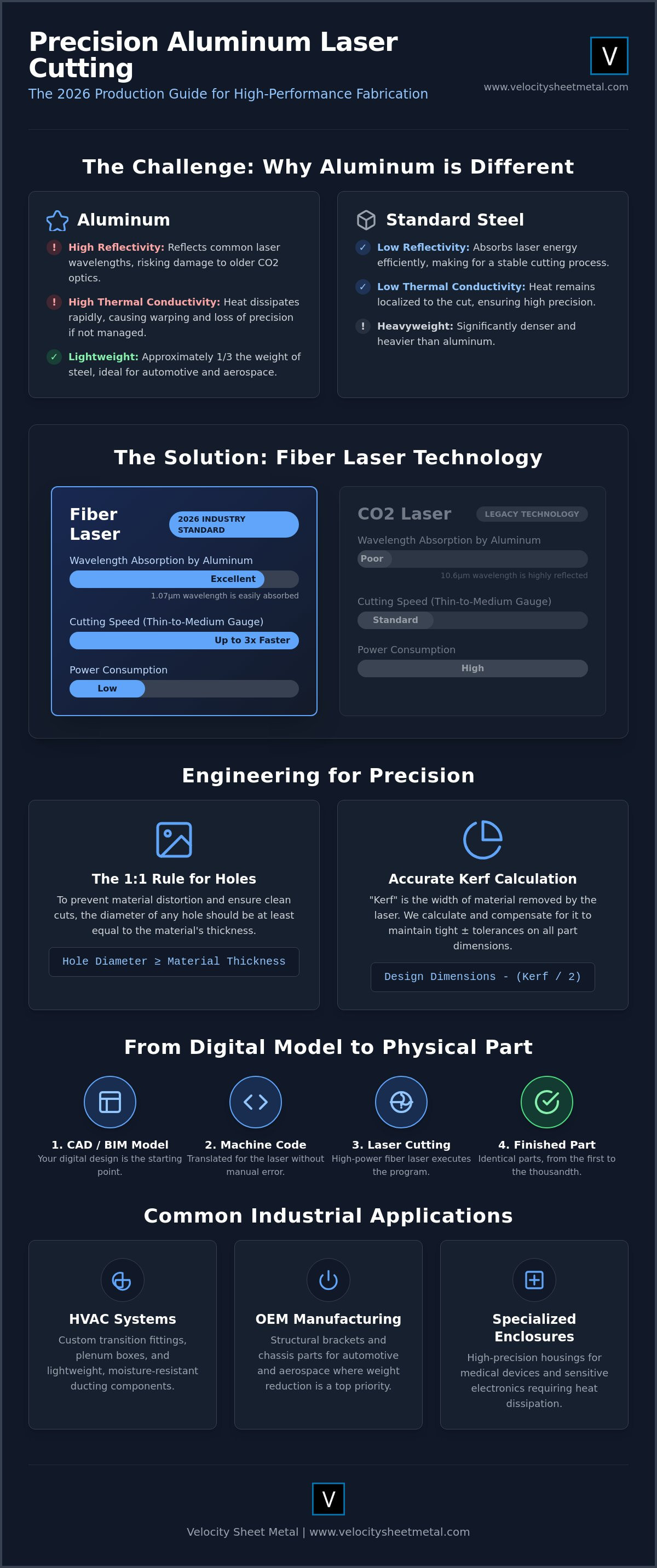
- Learn why Fiber lasers are the 2026 industry standard for aluminum fabrication, offering superior wavelength absorption over legacy CO2 systems.
- Apply the 1:1 design rule and accurate kerf calculations to maintain tight tolerances and minimize material waste during the cutting process.
- Understand the critical differences between aluminum processing and standard stainless steel laser cutting services, specifically regarding Nitrogen shielding gas to eliminate dross.
- Bridge the gap between digital BIM models and physical part production to ensure standardized quality across national high-volume projects.
- Identify the optimal non-ferrous alloys to balance weight and corrosion resistance for demanding industrial and commercial HVAC applications.
The Fundamentals of Custom Aluminum Laser Cutting
Aluminum represents a unique challenge in the fabrication world. Unlike carbon steel, aluminum is a non-ferrous metal with high thermal conductivity and significant reflectivity. Understanding The Fundamentals of Custom Aluminum Laser Cutting is essential for engineers who need to balance strength-to-weight ratios with precision. The process involves using a concentrated beam of light to melt or vaporize material, typically assisted by a shielding gas like nitrogen to blow away the molten metal. While many shops offer stainless steel laser cutting services, processing aluminum requires a different set of machine parameters and a deeper understanding of material physics.
The primary reason industrial sectors favor aluminum is its inherent corrosion resistance and lightweight profile. It's roughly one-third the weight of steel, making it the standard for components that require mobility or reduced structural load. However, its "back reflection" property is a major hurdle. Aluminum acts like a mirror to certain laser wavelengths. In older CO2 systems, this reflected energy could travel back up the beam path and destroy expensive optical components. Modern fiber lasers have largely solved this issue, but the material still requires high power density to break the initial surface reflection and establish a consistent cut.
Our workflow at Velocity Sheet Metal bridges the gap between digital design and physical production. We take your CAD files or BIM coordination drawings and translate them directly into machine code. This digital-to-physical path eliminates manual layout errors and ensures that the first part is identical to the thousandth. It's a streamlined approach designed for speed and repeatable accuracy.
Thermal Conductivity and Its Impact on Precision
Aluminum dissipates heat much faster than steel. While this is great for heat sinks, it complicates the cutting process. If the laser moves too slowly, the heat spreads into the surrounding material, causing the kerf to widen and the part to warp. We utilize higher feed speeds to keep the heat localized at the cut point. The relationship between material thickness and laser beam dwell time is critical; thicker plates require more power but also faster movement to prevent over-melting the edges and losing dimensional stability.
Common Industrial Applications for Aluminum Parts
The versatility of laser-cut aluminum makes it indispensable across several high-stakes industries. We regularly produce components for the following applications:
- HVAC Systems: Custom transition fittings, plenum boxes, and lightweight ducting components that resist moisture.
- OEM Manufacturing: Structural brackets and chassis parts for automotive and aerospace clients where weight reduction is a priority.
- Specialized Enclosures: High-precision housings for medical devices and sensitive electronics that require electromagnetic shielding and heat dissipation.
Because we specialize in both custom laser cutting and stainless steel laser cutting services, we understand how to pivot between these materials without compromising on edge quality or lead times. The goal is always a clean, burr-free part that's ready for immediate assembly.
Fiber vs. CO2 Laser Technology for Aluminum Fabrication
The choice between Fiber and CO2 lasers isn't just a matter of preference. It's a matter of physics. CO2 lasers operate at a 10.6-micrometer wavelength, which aluminum reflects like a mirror. In contrast, Fiber lasers operate at 1.07 micrometers. This shorter wavelength is absorbed significantly better by non-ferrous metals. While a provider of stainless steel laser cutting services might successfully use CO2 for steel, that same machine often struggles with aluminum's reflective properties. By 2026, Fiber technology has become the unequivocal industry standard for high-speed aluminum fabrication.
Beam quality also differs between these two systems. Fiber lasers offer a smaller, more concentrated spot size. This results in a narrower kerf width, allowing for more intricate geometries and tighter nesting on the sheet. Smaller kerfs mean less material waste. They also mean higher precision for complex components. Operational efficiency is the final clincher. Fiber systems typically consume about one-third of the power required by CO2 systems. They cut thin-to-medium aluminum up to three times faster. Many facilities that offer stainless steel laser cutting services have transitioned to Fiber to handle the increased demand for high-speed aluminum production.
Why Fiber Lasers Dominate Aluminum Cutting
Fiber lasers excel at processing common alloys like 5052 and 6061. Their solid-state design removes the need for complex internal mirrors or laser gas mixes. This translates to reduced maintenance and more uptime on the factory floor. Modern systems also include advanced back-reflection sensors. These sensors automatically shut down the beam if reflection is detected, protecting the machine and the operator. Innovation in this field, such as Scaling Production with National Fabrication Partners through optimized laser workflows, continues to push the boundaries of what's possible with non-ferrous metals.
When to Consider Alternative Cutting Methods
Laser cutting is high-speed and high-precision, but it isn't universal. For aluminum plates exceeding one inch in thickness, waterjet cutting is often more effective. It avoids the heat-affected zone entirely. Large-format sheets with low complexity might be better suited for CNC routing. If you're working on non-precision structural components where edge quality is secondary, plasma cutting remains a cost-effective alternative.
If your project requires high-tolerance parts with a fast turnaround, our custom laser cutting capabilities are built to deliver. We specialize in the precision that standard shops often miss, moving your project from digital file to physical part with surgical speed.
Engineering Design Rules for Laser-Cut Aluminum
Designing for aluminum fabrication requires a shift in mindset compared to ferrous metals. While many engineers are familiar with the tolerances of stainless steel laser cutting services, aluminum's high thermal conductivity and lower melting point demand specific geometric constraints. If you ignore these rules, you risk part distortion, poor edge quality, or outright project failure. Our goal is to ensure your digital file translates perfectly to a physical component without expensive redesigns.
The most critical guideline is the 1:1 Rule. Your minimum hole diameter must equal or exceed the material thickness. If you attempt to cut a 0.125-inch hole in a 0.250-inch plate, the heat concentration will melt the surrounding material before the laser completes the circle. This results in a slag-heavy, inaccurate opening. Similarly, you must maintain a minimum wall thickness of at least 1x material thickness between cutouts. This prevents the "bridge" of material from warping or melting away during high-heat cycles.
Accuracy also depends on calculating kerf. Kerf is the width of the material removed by the laser beam. For aluminum, this typically ranges between 0.008 and 0.015 inches depending on the alloy and plate thickness. Your CAD software must account for this offset to ensure final dimensions hit your target tolerances. Finally, optimize your part nesting. We use automated nesting algorithms to pack parts as tightly as possible. This reduces scrap rates and lowers your per-unit cost, especially in high-volume production runs.
Managing Corner Radii and Internal Cutouts
Sharp internal corners are a liability in aluminum. They create stress concentrations that can lead to fractures during assembly or operation. We recommend adding a minimum corner radius of 50% of the material thickness. If your design requires a square mating part, use "dogbone" fillets to clear the corners without creating a stress point. These considerations are especially vital if your parts are destined for CNC press brake bending, where material integrity at the bend line is paramount.
Tab Placement and Part Breakout Strategies
To keep small parts from falling through the slats or tilting into the beam path, we use micro-tabs. Strategic placement is key. We place tabs on flat edges rather than curves to minimize "witness marks" after breakout. If aesthetics or fitment are critical, we can move tabs to non-critical faces. For high-volume runs, we also offer integrated laser etching. This allows us to mark part numbers or alignment notches directly on the component, streamlining your downstream assembly process and ensuring every part is accounted for.

Overcoming Common Aluminum Fabrication Challenges
Aluminum fabrication is notoriously difficult to master. While the industry standard for stainless steel laser cutting services often delivers clean edges with minimal adjustment, aluminum requires constant calibration of assist gas pressure and nozzle stand-off distance. The most common defect is dross. These are the hardened droplets of molten aluminum that cling to the bottom of the cut. This occurs because the metal's high thermal conductivity causes it to cool and solidify before the assist gas can blow it clear of the kerf. Eliminating dross requires a perfect balance of laser power and feed speed.
Managing surface integrity is another challenge. Aluminum is significantly softer than carbon or stainless steel. It scratches easily during handling or while resting on the laser bed's slats. We mitigate this by using protective PVC films specifically designed to be laser-pierceable. This ensures the finished part remains pristine from the moment it's cut until it reaches your assembly line. Managing tolerance stack-up is also essential for multi-part assemblies. We maintain standard tolerances of +/- 0.005 inches, but when parts are mated, these deviations can accumulate. High-precision laser cutting minimizes this risk by ensuring repeatable accuracy across every production batch.
The Role of Assist Gases in Edge Quality
The choice of assist gas defines the edge's chemistry and appearance. Nitrogen is the premium choice for industrial aluminum parts. It acts as a cooling agent and prevents oxidation, leaving a bright, silver edge that's immediately ready for welding or coating. Oxygen is rarely used for aluminum as it promotes heavy dross and a charred finish. Compressed air is a viable, cost-effective alternative for non-aesthetic components, though it results in more visible striations on the cut face. We fine-tune gas pressure settings to balance speed with edge smoothness, ensuring the "striation" pattern remains consistent and minimal.
Secondary Finishing for Aluminum Components
Even with optimized laser settings, some applications require secondary processing. Vibratory deburring is our preferred method for removing micro-burrs across high-volume runs. This process uses ceramic media to smooth every edge simultaneously. If your parts require anodizing or powder coating, the laser-cut edge must be perfectly clean. The heat-affected zone (HAZ) in aluminum laser cutting is the area where the material's microstructure and mechanical properties are altered by the laser's thermal energy without melting the metal.
If you're struggling with inconsistent edge quality or surface damage, custom laser cutting from a specialist ensures your parts meet strict industrial standards without the need for extensive rework.
Scaling Production with National Fabrication Partners
Scaling a project from a single prototype to a multi-site industrial rollout requires a partner with national reach. Local fabricators often lack the standardized quality control or shipping logistics needed for large-scale operations. When you move beyond basic stainless steel laser cutting services and into high-volume aluminum production, consistency becomes your primary metric. A national partner ensures that a part cut in our facility today matches the tolerances of a part cut six months from now, regardless of the final destination. It's about maintaining technical integrity across every zip code.
Modern manufacturing has shifted away from inventory-heavy models. Carrying months of raw aluminum stock is a financial liability. We prioritize on-demand production. This approach allows you to order exactly what you need for a specific project phase. It reduces overhead and eliminates the risk of design obsolescence. By leveraging automated production lines, we turn digital files into physical components with surgical speed. This keeps your project on schedule without the bloat of traditional manufacturing warehouses.
From BIM Model to Finished Aluminum Part
The bridge between design and delivery is BIM for sheet metal fabrication. In complex HVAC installations, field collisions are the primary cause of budget overruns. BIM coordination allows us to identify these conflicts in a virtual environment before a single laser beam touches the metal. We take your spool drawings and feed them directly into our machine workflows. This direct-to-machine path removes administrative delays and manual layout errors. It ensures every hole, notch, and flange is exactly where the digital model says it should be, providing a seamless transition from the screen to the shop floor.
Streamlining Logistics for Large-Scale Projects
Logistics is where most fabrication projects fail. We don't just ship parts; we provide organized delivery solutions. Our packaging and kitting strategies ensure that parts arrive on-site sorted by floor, zone, or assembly sequence. This level of organization saves hundreds of man-hours during the installation phase. For national accounts, we provide production transparency. You'll know exactly where your parts are in the production line and when they'll arrive at the job site. This predictability is essential for maintaining the momentum of large-scale commercial builds.
Standard stainless steel laser cutting services often lack the engineering depth required for complex aluminum projects. Contact Velocity Sheet Metal today for a technical review of your next aluminum project. Our team is ready to act as the essential bridge between your digital file and a tangible, high-precision product.
Optimizing Your Next Production Run
Aluminum fabrication demands more than standard machine time. It requires a firm grasp of material physics and specific thermal management strategies. You've seen how Fiber laser technology has revolutionized the process, overcoming reflectivity where traditional stainless steel laser cutting services often fall short. By applying the 1:1 design rule and leveraging BIM-integrated workflows, you can eliminate field collisions and administrative delays before production begins. This technical precision is what separates high-performance industrial components from scrapped material.
Velocity Sheet Metal brings over 50 years of combined industry experience to every project. We specialize in bridging the gap between digital models and physical parts with national shipping and standardized quality across the US. Our automated production lines ensure that your high-volume orders are repeatable, precise, and delivered on schedule. Don't let dross or thermal expansion issues derail your next project. It's time to streamline your supply chain with a partner who understands the realities of the modern factory floor.
Get a Precision Quote for Your Aluminum Laser Cutting Project and let's get to work on your next build today.
Frequently Asked Questions
What is the maximum thickness for custom aluminum laser cutting?
Modern high-power fiber lasers can typically cut aluminum up to 1 inch (25mm) in thickness. While thin gauges under 0.250 inches offer the cleanest edges and fastest cycle times, thicker plates are manageable with specialized optics. Edge quality and taper become more pronounced as you approach the 1-inch limit. For projects exceeding this thickness, we recommend evaluating waterjet cutting to maintain dimensional integrity without significant thermal distortion.
Which aluminum alloy is best for laser cutting?
Alloys 5052 and 6061 are the most effective options for laser fabrication. 5052 is highly favored for its excellent formability and corrosion resistance, making it ideal for HVAC components and enclosures. 6061 provides superior structural strength but is slightly more prone to dross during the cutting process. Both alloys have predictable absorption rates for fiber lasers, ensuring consistent results across high-volume production runs with minimal machine downtime.
How do laser cutting tolerances differ between aluminum and stainless steel?
Aluminum tolerances are generally wider than those found in stainless steel laser cutting services due to its higher coefficient of thermal expansion. While we maintain a standard tolerance of +/- 0.005 inches, aluminum can expand and contract significantly during high-heat cycles. Stainless steel is more thermally stable, allowing for slightly tighter precision in thick plates. Engineers should account for this 0.002-inch variance when designing mating parts for multi-material assemblies.
Can you laser cut aluminum with a protective plastic film?
Yes, we utilize specialized laser-pierceable PVC film to protect the aluminum surface during the cutting process. This film prevents the metal from scratching against the laser bed slats and minimizes damage during handling. The laser settings are finely tuned to vaporize the plastic without melting it onto the part edge. This ensures your finished components arrive with a pristine, mill-ready surface that requires no additional polishing or cleaning.
Why is nitrogen used as an assist gas for aluminum laser cutting?
Nitrogen is used to prevent oxidation and ensure a bright, silver edge that is ready for immediate welding. It acts as a cooling agent and physically blows the molten metal out of the kerf before it can solidify. Using oxygen would cause a chemical reaction that results in a charred, dross-heavy edge. Nitrogen is the industry standard for high-quality industrial parts because it eliminates the need for secondary grinding or edge cleaning.
How does laser cutting cost compare to CNC routing for aluminum?
Laser cutting is significantly more cost-effective for thin-to-medium gauges and complex geometries. While a CNC router can handle large sheets, it suffers from slower feed speeds and high tooling costs due to bit wear. Lasers offer faster cycle times and superior material nesting, which reduces scrap and lowers the per-unit price. For high-volume production of intricate parts, the speed and efficiency of a fiber laser provide a clear financial advantage.
Does laser cutting aluminum affect its weldability?
Laser cutting does not negatively affect weldability as long as nitrogen assist gas is employed. Nitrogen ensures the edge remains free of the thick oxide layer that typically forms during heat-intensive processes. This oxide-free surface allows for excellent penetration and bead consistency in TIG or MIG welding applications. If parts are cut using oxygen or compressed air, the edges must be mechanically cleaned or ground to ensure a structural weld.
What file formats are required for custom laser cutting services?
We require standard vector files such as DXF or DWG for direct machine programming. For more complex projects involving stainless steel laser cutting services or BIM coordination, we accept STEP or IGES formats to ensure 3D model accuracy. It's essential that files are "clean," meaning they contain no overlapping lines or stray geometry. Providing high-quality digital files allows us to move your project immediately from the design phase into our automated production workflow.