Custom Aluminum Laser Cutting: The 2026 Industrial Guide to Precision and Scale
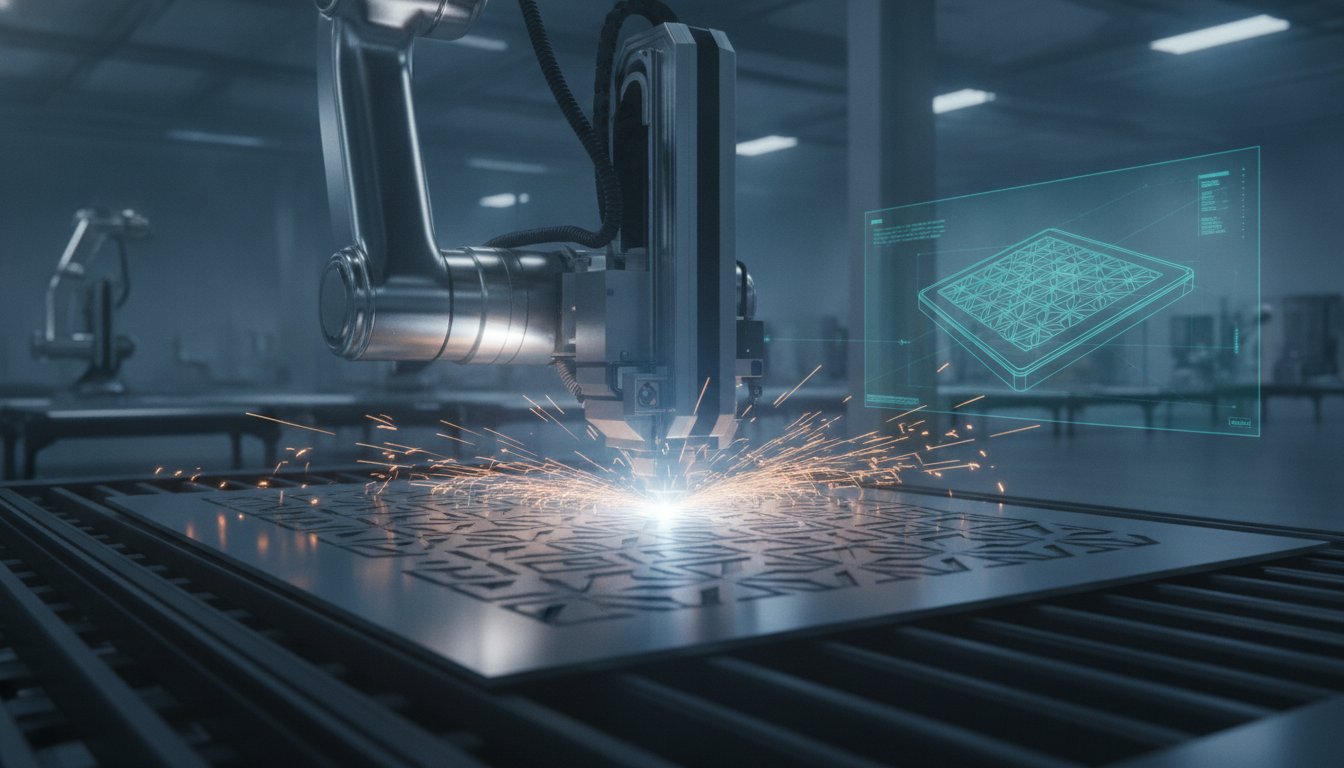
High-precision manufacturing in 2026 demands more than just a clean cut. It requires a seamless bridge from digital design to physical reality. You've likely dealt with the headache of inconsistent edge quality caused by aluminum's reflectivity, or the administrative drag of fabricators who can't speak the language of BIM. It's a common bottleneck that stalls national-scale projects and inflates lead times. This guide clarifies the technical path to superior custom aluminum laser cutting, ensuring your components arrive burr-free and exactly to spec.
We'll master the material selection process for 5052 and 6061 alloys, optimize your design workflows for fiber laser efficiency, and explore how high-pressure nitrogen assist gas delivers that essential industrial finish. From navigating the 5.57 billion dollar global laser market to scaling production for the electric vehicle sector, you'll learn how to integrate precision fabrication into your supply chain. We're breaking down the exact steps to move from a complex spool drawing to a finished part ready for immediate assembly. It's time to eliminate rework and get your projects moving at the speed of modern automation.
Key Takeaways
- Master the specific requirements of laser-friendly aluminum grades like 5052 and 6061 to ensure structural integrity and superior edge quality.
- Optimize your Design for Manufacturability (DFM) by understanding kerf width and minimum hole diameters to prevent heat-related material distortion.
- Evaluate the speed and cost-efficiency of custom aluminum laser cutting against traditional methods like waterjet or CNC punching for high-volume industrial applications.
- Bridge the gap between digital BIM coordination and physical production to eliminate administrative delays in national-scale HVAC and OEM projects.
- Streamline procurement for large-scale operations through on-demand fabrication and reliable national shipping that supports multi-site industrial workflows.
Defining Precision: What is Custom Aluminum Laser Cutting?
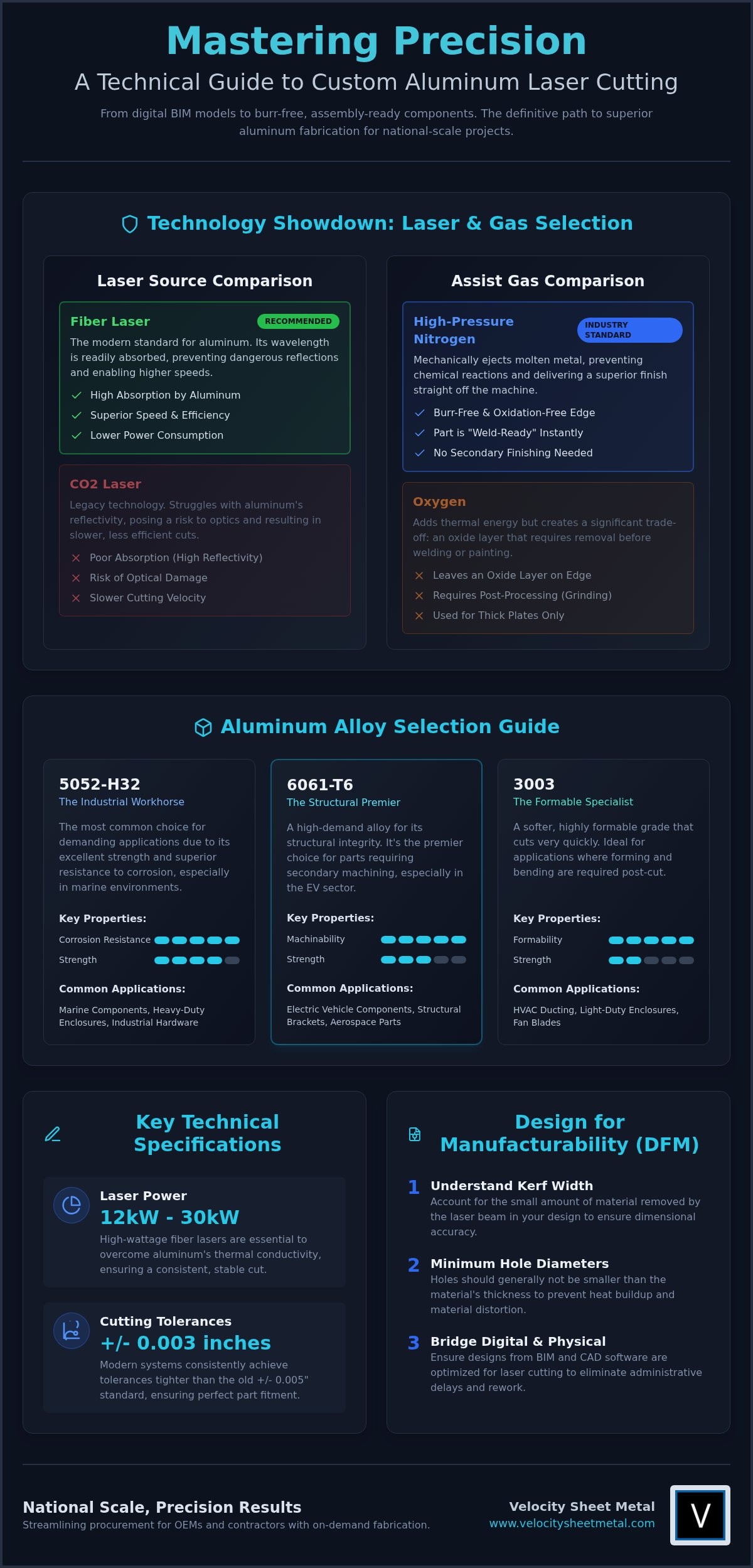
Laser cutting is a non-contact, thermal-based fabrication process that uses a concentrated beam of light to melt or vaporize material. When applying What is Custom Aluminum Laser Cutting? to industrial projects, the material's high thermal conductivity and reflectivity present unique hurdles. Aluminum dissipates heat faster than steel. This requires a more intense, stable energy source to maintain a consistent kerf. The reward is a lightweight, corrosion-resistant part that meets the rigorous standards of modern engineering.
By 2026, the industry has standardized on high-wattage fiber lasers, often ranging from 12kW to 30kW, to handle these specific thermal properties. This technology allows for the rapid production of everything from complex HVAC mounting brackets to high-volume OEM components for the electric vehicle sector. The precision offered by custom aluminum laser cutting ensures that parts integrate perfectly with digital BIM models. It reduces field errors and assembly time on national-scale projects.
Fiber Laser vs. CO2 Laser for Aluminum
Older CO2 lasers struggled with aluminum's "mirror effect." The reflected beam could travel back up the delivery path and destroy expensive optics. Fiber lasers solve this issue. They use a different wavelength that aluminum absorbs more readily. This shift hasn't just improved safety; it's revolutionized speed. In thin to medium gauge sheets, fiber lasers operate at significantly higher velocities than CO2 systems. They also consume less power. This makes high-volume production runs more cost-effective for national accounts.
The Role of Assist Gases (Nitrogen vs. Oxygen)
Your choice of assist gas defines the final edge quality and post-processing needs. For the vast majority of aluminum jobs in 2026, high-pressure nitrogen is the standard. Nitrogen acts as a mechanical force to blow molten metal out of the cut without causing a chemical reaction. This results in a burr-free, oxidation-free edge. These parts are "weld-ready" straight from the machine bed, eliminating the need for secondary finishing.
Oxygen is sometimes used for thicker aluminum plates to add thermal energy to the cut. However, the trade-offs are significant. Oxygen leaves an oxide layer on the cut surface. This layer often requires secondary cleaning or grinding before the part can be painted or welded. For industrial scale and precision, nitrogen-assisted fiber lasers provide the cleanest and most efficient route to a finished product.
Technical Specs: Mastering Aluminum Grades and Laser Tolerances
Successful custom aluminum laser cutting starts with metallurgy, not just machinery. Aluminum isn't a monolithic material. It's a collection of alloys, each reacting differently to the concentrated thermal energy of a fiber laser. While its high thermal conductivity helps dissipate heat, it also requires precise beam modulation to prevent the "heat-affected zone" (HAZ) from compromising the part's structural integrity. In 2026, mastering these variables is the difference between a high-performance industrial component and a scrap bin full of warped plate.
Selecting the Right Aluminum Grade
Your choice of alloy dictates the beam's behavior and the resulting edge finish. Matching the right grade to your application is the first step toward a successful precision fabrication project. Consider these three industry standards:
- 5052-H32 Aluminum: This is the industrial workhorse. Its high magnesium content provides excellent corrosion resistance and high strength. It's the most common choice for marine components and heavy-duty enclosures.
- 6061-T6 Aluminum: This structural alloy is in high demand for the electric vehicle industry. While it's more sensitive to laser heat than the 5000 series, it's the premier choice for parts that require secondary machining post-cut.
- 3003 Aluminum: Primarily used for HVAC ducting and light-duty enclosures, this grade is softer and highly formable. It cuts quickly but lacks the structural rigidity of 5052 or 6061.
Tolerances and Edge Quality
In 2026, standard industrial contracts have moved beyond the traditional +/- 0.005 inch floor. Modern high-wattage fiber lasers now consistently achieve tolerances of +/- 0.003 inches or better on thin to medium gauge sheets. However, as material thickness increases, you must account for the taper effect. This is a slight geometric deviation where the kerf, or the width of the cut, is wider at the beam's entry point than at its exit. For intricate internal geometries, your design must compensate for this kerf width to ensure mating parts fit perfectly.
Edge quality is further defined by the presence of dross. Dross is the solidified molten metal that clings to the underside of a cut; modern high-pressure nitrogen settings virtually eliminate it by ejecting the material before it can bond. By balancing wattage with feed rate, fabricators can deliver a clean, square edge that requires zero secondary grinding. This level of precision is essential for national-scale accounts where parts must be "plug-and-play" upon arrival at the job site.
Aluminum Laser Cutting vs. Traditional Fabrication Methods
Industrial fabrication is a race against lead times. Choosing the wrong method creates unnecessary bottlenecks. Waterjet cutting is effective for extremely thick plates, but it's slow, expensive, and requires extensive part cleaning to remove abrasive residue. CNC punching is fast for simple patterns, but it requires costly hard-tooling that limits design changes. Custom aluminum laser cutting bridges this gap. It provides the precision needed for intricate geometries without the overhead of physical dies. It's why modern OEMs prioritize this technology for precision laser cutting services. You get the speed of a punch press with the versatility of a digital workflow.
Cost-Benefit Analysis for High-Volume Runs
Hard-tooling is a liability in a fast-moving market. Traditional stamping requires dedicated dies that take weeks to produce and thousands of dollars to maintain. Laser cutting removes these barriers. It allows you to move from a digital concept to a physical component in a single shift. This speed is essential for high-volume OEM production where design iterations happen in real-time. Because the process is software-driven, you can adjust slot widths or hole diameters instantly. You don't pay for new tools every time a spec changes. The result is a leaner supply chain and lower per-part costs. High-quality primary cuts also reduce secondary finishing requirements, saving labor hours on the back end.
Accuracy and Repeatability in 2026
Repeatability is the foundation of national-scale industrial projects. In 2026, automated nesting software has matured to maximize material yield and minimize scrap. This software packs parts with surgical precision, often reaching 85% or higher material utilization. Digital twin integration further secures quality. It creates a continuous feedback loop between the design file and the laser head. Consider these key advantages over mechanical methods:
- Minimal Mechanical Stress: Unlike punching, which applies physical force that can deform thin aluminum, the laser uses non-contact thermal energy.
- Superior Yield: Automated nesting identifies the most efficient layout for nested sheets, significantly reducing material waste.
- Digital Consistency: Software-driven parameters ensure that the first part in a production run is identical to the ten-thousandth.
This level of consistency is critical when shipping components to multiple project sites across the country. You need to know that every bracket and enclosure will fit the first time without field modifications.
Design for Manufacturability (DFM): Optimizing Aluminum Parts
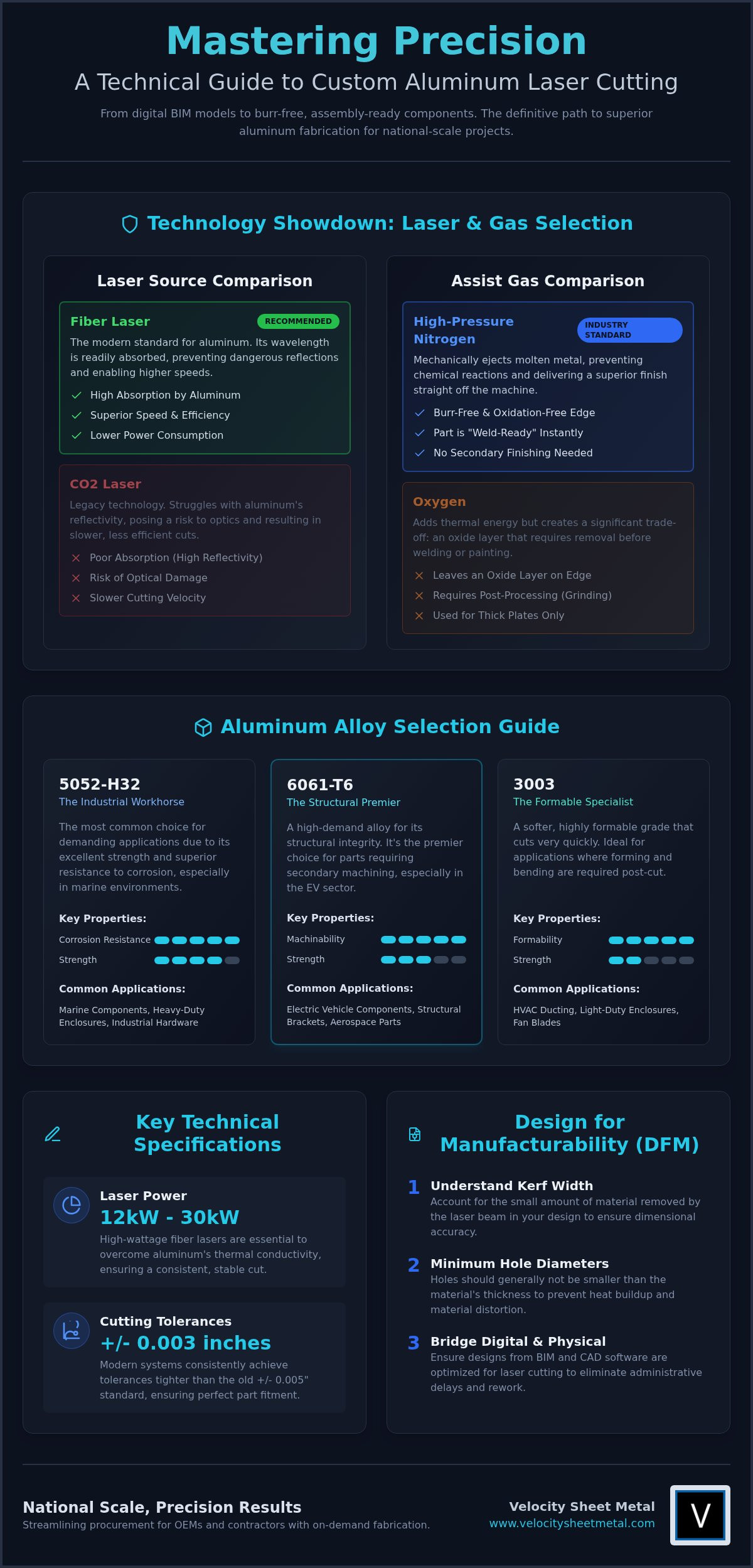
Efficiency in custom aluminum laser cutting starts long before the beam hits the plate. It begins in the CAD environment. Aluminum is softer and more thermally conductive than stainless steel, making the piercing phase particularly volatile. If you design a hole diameter smaller than the material thickness, the heat concentration can cause blowout or irregular geometries. Maintaining a 1:1 ratio between hole diameter and material thickness ensures a clean pierce and a consistent edge. This geometric discipline prevents material distortion and ensures your parts meet strict industrial tolerances.
For large-scale industrial projects, part stability during the cut is critical. Small components require strategic bridging or micro-tabs to stay secured within the nested sheet. Without these, parts can tilt, causing head collisions that stall production. When your design moves from the laser to CNC press brake bending, you must also account for corner radii. Sharp internal corners create stress risers. Adding a small radius prevents fractures during the forming process and ensures structural reliability in the field. This attention to detail is what separates a prototype from a production-ready component.
Integrating BIM and Spool Drawings
Digital-to-physical workflows are the new standard for national contractors. Utilizing BIM for sheet metal fabrication allows you to export fabrication-ready parts directly from Revit or Navisworks models. This integration eliminates the administrative lag of manual file conversion. By pre-cutting precision HVAC components based on a coordinated BIM model, you reduce field collisions and ensure every spool drawing translates perfectly to the physical build. It's about building it virtually so you can cut it once. Clean DXF or STEP files are the currency of this automated intake system, allowing for immediate production without manual drafting errors.
Common Aluminum Design Pitfalls
Avoid overly complex geometries in tight clusters. Excessive heat buildup in small areas can warp the aluminum or degrade the edge quality. You should also consider the material grain direction. Aluminum has a distinct grain from the rolling process; bending against the grain can lead to cracking in high-stress applications. For faster assembly, consider "self-tabbing" designs. These interlocking features allow parts to snap together before welding, significantly reducing jigging time and labor costs.
Ready to optimize your next industrial project? Submit your digital files for a technical review and experience a seamless transition from spool drawing to physical part.
Scaling Production: National Aluminum Fabrication for OEMs and Contractors
Scaling from a single prototype to a national production run requires more than just high-wattage lasers. It demands an integrated supply chain that treats fabrication as a logistics challenge as much as a technical one. For national accounts, the goal is to standardize quality across multiple project sites, ensuring that a part cut for a facility in one region is identical to its counterpart three thousand miles away. Velocity Sheet Metal bridges this gap by combining custom aluminum laser cutting with sophisticated digital workflows, moving your project from a coordinated BIM file to a palletized delivery with surgical precision.
On-Demand Part Production for Contractors
Just-in-time (JIT) fabrication is the most effective way to reduce local warehouse overhead. Instead of stockpiling raw materials or generic components, contractors can trigger on-demand production for specific project phases. We streamline field sorting by providing custom labels and kitting for every shipment, allowing your team to move directly from the delivery truck to assembly. In a high-efficiency HVAC workflow, automated coil lines for rectangular duct work in tandem with fiber lasers to produce every necessary fitting and bracket simultaneously. This synchronization ensures that no component is left waiting on the factory floor, accelerating your overall project timeline.
Partnering with a National Fabricator
Centralizing your procurement with a national partner ensures that production standards remain consistent regardless of the project's scale. Large commercial HVAC projects often face sudden surge capacity needs that local shops cannot handle. Our automated production lines provide the scalability required to meet these demands without sacrificing accuracy. With 50+ years of combined industry experience, we understand how to navigate complex fabrication hurdles, from managing material grain direction to optimizing part nesting for maximum yield.
National delivery for industrial accounts requires more than a simple parcel service. We manage the logistics of nationwide shipping for palletized freight, ensuring part integrity during transit through specialized packaging and secure loading protocols. This ensures your high-precision aluminum components arrive ready for immediate installation, exactly when the project schedule demands them. From the initial digital concept to the final physical result, we provide the essential bridge that keeps national-scale projects on track.
Accelerate Your Industrial Supply Chain
Mastering the technical nuances of custom aluminum laser cutting is the first step toward eliminating production bottlenecks. You now understand how fiber laser technology handles reflectivity, why 5052 and 6061 grades dominate the market, and how DFM principles prevent thermal distortion. This knowledge ensures your components move from a digital file to a physical assembly without the friction of rework or administrative delays.
Velocity Sheet Metal serves as your essential bridge between a BIM-integrated design and a national-scale build. With 50+ years of combined industry experience, we've refined a workflow that prioritizes speed, accuracy, and reliability. Our BIM-integrated fabrication workflow ensures field-ready precision; our nationwide shipping supports industrial accounts across the country. We don't just cut metal. We deliver the components that keep your national projects on schedule.
Request a Quote for Custom Aluminum Laser Cutting today and see how we can streamline your next production run. Let's get to work.
Frequently Asked Questions
Is laser cutting better than waterjet for aluminum?
Laser cutting is superior for speed and cost on gauges up to 0.75 inches. Waterjet excels on thicker plates but introduces abrasive moisture and slower feed rates. For most industrial applications, the laser provides a weld-ready edge without the secondary cleaning required by waterjet slurry. This efficiency makes it the primary choice for high-volume custom aluminum laser cutting projects where lead times are critical.
What is the maximum thickness of aluminum that can be laser cut?
High-wattage fiber lasers in 2026 can cut aluminum up to 30mm thick. However, edge quality and precision are most consistent on materials up to 20mm. For national HVAC and OEM accounts, we typically focus on sheets up to 0.5 inches to ensure the tightest tolerances. Exceeding these thicknesses may increase the taper effect, requiring more aggressive assist gas settings to maintain a square edge.
How does laser cutting affect the temper of aluminum?
The heat-affected zone (HAZ) is significantly smaller with fiber lasers compared to plasma or traditional CO2 systems. While any thermal process can slightly modify the temper at the immediate cut edge, the impact on structural 6061-T6 or 5052 alloys is minimal. High-speed cutting parameters ensure the heat is dissipated quickly, preserving the material's mechanical properties across the rest of the component.
Can you laser cut 6061-T6 aluminum without cracking?
You can cut 6061-T6 reliably using modern fiber technology. Unlike mechanical punching, which can cause micro-fractures in tempered alloys, the laser is a non-contact process. By optimizing the lead-in and pierce settings, fabricators prevent the thermal shock that leads to cracking. This makes it ideal for structural EV components or high-strength brackets that must maintain their integrity under heavy industrial loads.
Why is nitrogen used as an assist gas for aluminum laser cutting?
Nitrogen is the industry standard because it prevents oxidation on the cut surface. It functions as a mechanical force to eject molten material while simultaneously cooling the kerf. This results in a clean, silver edge that doesn't require grinding before welding. Using oxygen on aluminum often leaves a dark oxide layer that interferes with paint adhesion and weld penetration, making nitrogen the more efficient choice.
How do I prepare my CAD files for custom aluminum laser cutting?
Submit DXF or STEP files with all geometries converted to closed paths. Remove any dimensions, title blocks, or hidden layers that aren't part of the physical cut. For contractors using BIM coordination, exporting fabrication-ready parts directly from Revit or Navisworks ensures field-ready accuracy. This digital-to-physical integration allows our automated systems to move your project from design to production without manual drafting delays.
What are the typical lead times for high-volume aluminum parts?
Standard lead times for industrial production runs typically fall between 5 and 10 business days. On-demand fabrication for national accounts is built for speed, often delivering parts faster than local shops with limited capacity. By utilizing automated production lines and reliable national shipping, we keep your project on schedule. Large-scale surge capacity is managed through centralized procurement to ensure consistent delivery across multiple project sites.
Does aluminum laser cutting require secondary deburring?
Secondary deburring is rarely necessary when using high-pressure nitrogen assist gas. The process leaves a smooth, square edge that is free of dross and slag. While thicker plates may have a slight striation pattern, the parts are typically ready for immediate installation or secondary CNC press brake bending. This lack of post-processing is a major cost-saver for OEMs and contractors managing large-scale industrial assemblies.