Compare Cost Factors for a Fabrication Partner on Multi-State Projects
The lowest shop quote can become the most expensive choice once freight, schedule risk, and project coordination are considered. Compare a fabrication partner for multi-state projects on total delivered cost, production capability, reliability, scope, and qualifications, not unit price alone. The right partner has processes and capacity suited to the work at every destination.
Comparing options can feel complex when a project spans different locations, delivery windows, and site requirements. A clear evaluation makes the trade-offs easier to see and helps prevent gaps between fabrication, shipping, and installation teams.
This article explains how to assess a fabricator’s experience and delivery performance, define scope before production, and compare freight with fabrication location and configuration. It also covers the capabilities and qualifications to consider, so you can make a decision based on practical project criteria.
Key Takeaways
- Assess quality through completed work and testimonials, then weigh delivery reliability against the schedule risks of delays.
- Define deliverables, responsibilities, technical requirements, and destination-specific constraints before production begins.
- Compare freight routes and handling needs alongside fabrication location; the lowest shop cost may not mean the lowest delivered cost.
- Match fabrication capabilities, materials experience, automation, and qualifications to the project’s volume and complexity.
- Use a consistent evaluation process across locations to compare partner coverage, communication, and delivery coordination.
2. Reputation, quality, and delivery reliability
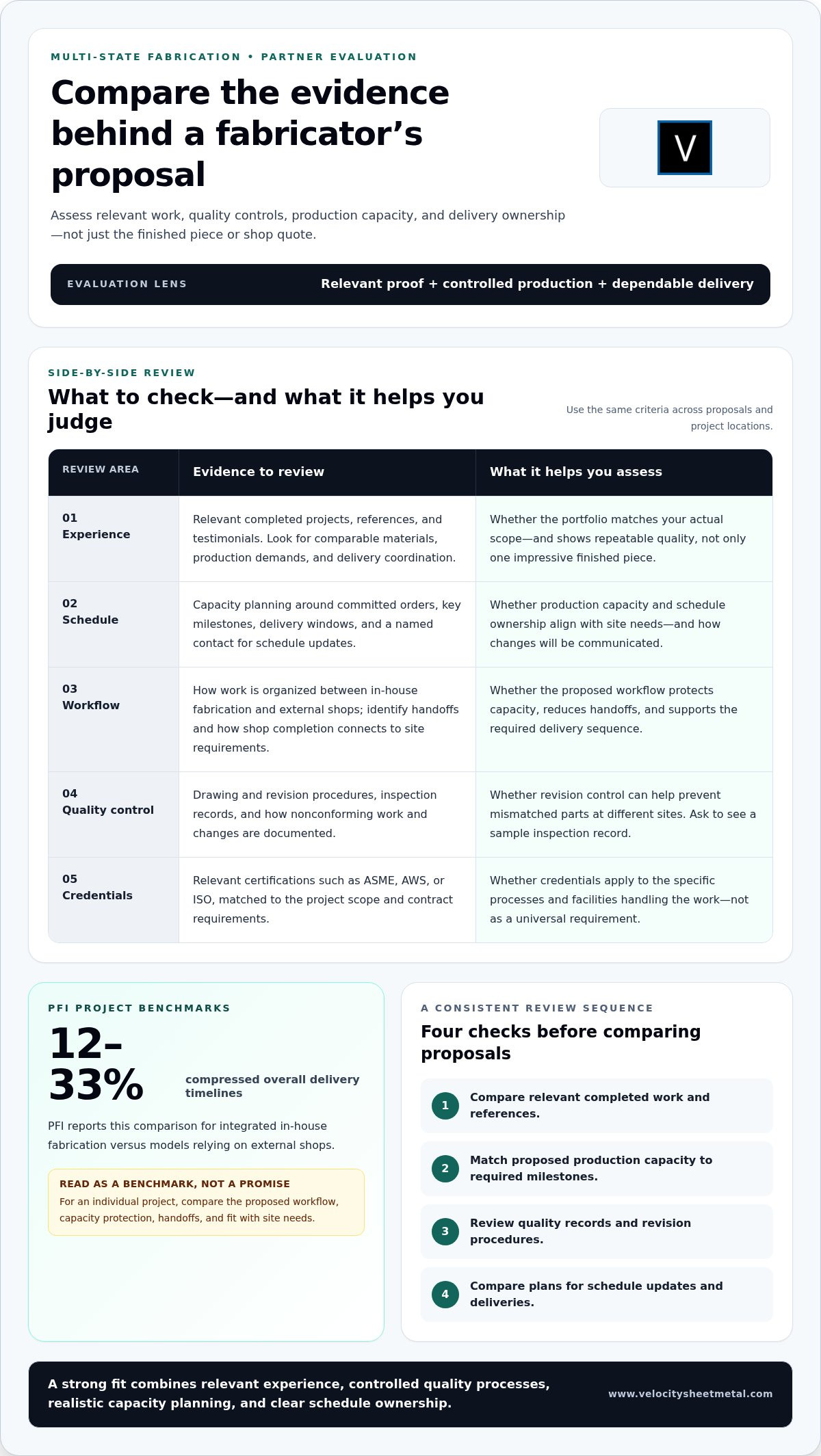
A strong reputation should show in relevant completed work, clear communication, and dependable delivery. Review project examples and testimonials for evidence that the fabricator has handled comparable materials, production demands, and delivery coordination. A polished portfolio is less useful if it does not reflect your scope. Look for repeatable quality across examples, not just one impressive finished piece.
Give delivery performance equal weight. Delays can disrupt site sequencing, hold up other trades, and add coordination work across multiple states. Ask how the fabricator plans capacity around committed orders and communicates schedule changes. Look for a schedule with key milestones, delivery windows, and a named contact for updates. Clear ownership helps teams respond early when a milestone shifts.
Production structure can also affect the schedule. PFI reports that integrated in-house fabrication has compressed overall delivery timelines by 12 to 33 percent compared with models relying on external shops, based on PFI’s project benchmarks. Treat that range as a benchmark, not a promise for an individual project. The practical comparison is whether the proposed workflow reduces handoffs, protects production capacity, and aligns shop completion with site needs.
Evaluate quality through the production process, not just the finished appearance. Review how drawings, revisions, inspections, and nonconforming work are handled. Ask to see a sample inspection record or learn how changes are documented. For repeated components sent to different states, consistent revision control helps prevent sites from receiving mismatched parts.
What certifications and quality standards should a multi-state fabrication partner meet? Match credentials to the project scope and contract requirements, and consider relevant certifications such as ASME, AWS, or ISO. Confirm that credentials apply to the processes and facilities handling your work, rather than treating any one certification as a universal requirement.
Use a structured review before comparing proposals. First, compare relevant completed work and references. Next, match proposed production capacity to required milestones. Then review quality records and revision procedures. Finally, compare plans for schedule updates and deliveries. This shows whether a partner can support consistent execution across locations, not simply manufacture to a drawing.
Choose the fabricator whose evidence matches the project’s actual demands. A strong fit combines relevant experience, controlled quality processes, realistic capacity planning, and clear schedule ownership. These signals help distinguish dependable execution from a proposal that looks complete but leaves delivery risks unresolved.
3. Defining project scope and requirements
A clear scope turns a multi-location concept into a production plan. Before requesting proposals, define what must be fabricated, how many locations need components, and what each delivery must include. For example, list drawings, quantities, materials, finishes, packaging, and destinations in one scope document. Giving every fabricator the same baseline makes capability gaps easier to identify.
Separate fixed requirements from open design decisions. Mark approved dimensions and materials as fixed, then identify what can still change. Include drawing versions, revision ownership, required submittals, inspection records, and acceptance criteria. When locations need similar assemblies with different dimensions, a location-by-location schedule helps prevent configuration mix-ups.
What state and local codes, permits, and licensing rules affect fabrication and installation projects? Requirements depend on the project location, component use, and whether the scope includes installation. Identify the applicable jurisdiction, codes, permits, and licensing requirements before releasing drawings or assigning field responsibilities.
Build a responsibility matrix around the project’s handoffs. Name who supplies approved drawings, resolves design questions, accepts substitutions, schedules freight, and receives each shipment. The initial partnership request should explain the intended outcome, each party’s contribution, responsibilities, and time commitment. Assigning an owner to every decision helps prevent approvals from stalling between locations.
What are common risks and project-management steps for multi-state fabrication work? Common risks include mismatched revisions, unclear ownership, missed handoffs, and delivery conflicts. Use a shared timeline that names task owners, budgeted expenses, meeting cadence, and a buffer for unexpected issues. Record action items and owners in meeting notes.
Test the scope against a realistic scenario before production. Imagine one site needs a revised component while another is ready to receive the original. Specify how the team will flag the revision, stop or redirect affected production, update documents, and notify both sites. This exposes change-control gaps before they cause rework or confusion.
Transportation limits can shape component geometry. Consider jurisdiction-specific restrictions and permitting requirements when setting dimensions for major components. A design that works at the fabrication shop may create route or delivery constraints at its destination. Include route feasibility in early scope discussions rather than treating shipping as a final administrative task.
Close scope review with a release checklist: approved drawings, quantities by destination, required documentation, responsible contacts, and agreed change-control steps. A fabrication scope planning discussion can help connect design information with the production capabilities needed for the work.
4. Fabrication location and freight economics
The nearest shop is not automatically the lowest-cost choice for a project serving several states. Compare the fabrication location with the full route to each destination, including handling, delivery coordination, and site access. A more distant shop may still make sense if its production setup suits the required volume and freight can be planned efficiently.
Start with a route map. Work with trusted carriers to assess whether modularization or traditional knock-down panel or stick fabrication suits the loads and destinations. For example, shipping a component in sections may avoid constraints that affect a large assembled unit. The engineering team, carrier, and project manager should consider route feasibility before finalizing component geometry.
Compare freight and crane fees for each configuration. A larger, more assembled shipment may reduce field assembly but require different unloading equipment. Smaller sections may simplify transport but add handling or assembly work at the site. Model both options against the actual delivery plan rather than comparing freight alone.
With sufficient volume, favorable labor rates may offset related freight costs, making fabrication location less important. The balance depends on the production mix, destinations, and how efficiently work can be grouped. Recurring components bound for nearby sites, for instance, may suit consolidated loads, while scattered deliveries can change the freight calculation.
What are typical pricing models and costs for multi-state fabrication projects? Pricing may be quoted by project, production lot, or defined scope, depending on the work. A quote depends on the specific requirements. Key cost factors include material, part complexity, production volume, finishing, packaging, freight, and delivery requirements.
Build a like-for-like comparison before choosing a shop. Give each bidder the same drawings, quantities by destination, delivery sequence, and packaging assumptions. Ask proposals to separate fabrication and freight where applicable. This helps reveal whether an offer excludes something another includes, such as special handling or multiple delivery stops.
Then test the plan against a destination scenario. If a site has limited unloading access, compare a smaller shipment with a larger load that requires different equipment. Include crane fees. If delivery dates vary by state, map each stop separately and assess whether consolidated shipping still fits the schedule.
Use the results to choose the best production and shipping configuration, not simply the closest facility. A sound comparison connects engineering decisions to carrier routes, site handling, and total delivered cost. It also gives the project manager clear assumptions for scheduling and coordination.
5. Fabrication partner evaluation questions
Use the same evaluation questions for every proposal to keep comparisons focused on project needs, not polished sales language. Start with components, materials, production volume, and destinations. Then ask how the fabricator’s equipment, workforce, and quality controls fit the scope.
How do fabrication companies handle sales tax, labor rules, and contractor requirements across states? These obligations vary by jurisdiction and project structure, so the contract should assign responsibility for determining and handling them. Document who manages applicable tax records, employment responsibilities, and contractor requirements at each location.
Next, ask about production capability. Does the shop have experience with the project’s materials, such as sheet metal, stainless steel, aluminum, or heavy plate? For repeat production, ask how automation and quality control support consistent output. For a prototype or one-off component, focus on custom design and precision-fabrication experience.
How do fabrication partners coordinate engineering, manufacturing, and installation across states? They use controlled drawings, revision records, assigned decision owners, and delivery schedules tied to each site. Define handoffs between engineering and manufacturing, and identify who coordinates installation, since fabrication and on-site installation are separate scopes.
Qualifications should match the work. Ask whether relevant credentials, such as ASME, AWS, or ISO, apply to the processes being used. Also review shop safety protocols and the quality-control steps used for your components. For complex assemblies, ask whether the fabricator can complete 100% trial assembly at the shop and share documented, photographed evidence of that process.
Discuss cost engineering directly. Ask where design changes, material substitutions, or commercially available alternatives could reduce expense without compromising required performance. For example, review a proposed member substitution against the approved design and project requirements before adopting it. Document the decision and drawing revision.
What insurance, warranties, and liability protections should a multi-state fabrication contract include? Define insurance responsibilities, warranty scope and duration, acceptance procedures, and how defects or damage are handled. Set out responsibility for components during fabrication, transit, and site receipt, along with claim-notice and resolution steps.
Finally, test the delivery plan. Ask who coordinates loading, delivery sequencing, and shipment tracking, and how updates reach each site. Projects with separate destination dates need a clear owner for every shipment. Record agreed responsibilities in the contract and project schedule, not only in meeting discussions.
Compare responses side by side. A strong proposal answers each question with a process, responsible role, or relevant example. If a response says “standard procedure,” ask for the inspection record, revision workflow, or delivery plan that applies to your components.
5. How to find and vet a fabrication partner with facilities or coverage across multiple states?
Start with a coverage map, not a facility count. Mark every project destination, then distinguish fabrication locations from delivery routes and service coverage. A partner may serve multiple states from one shop, while another may divide production across facilities. Compare each model with your destinations, shipment sequence, and production requirements.
Build a consistent shortlist from industry directories, contractor referrals, and project-team recommendations. Screen each candidate against the same scope summary, including components, materials, drawings, quantities, and delivery locations. This prevents broad capability claims from obscuring a practical mismatch, such as experience with prototypes but limited fit for repeated production.
Use a scorecard to compare evidence, not claims. Include relevant completed work, material experience, quality processes, delivery planning, engineering coordination, and applicable qualifications. Record the evidence behind each score. A project reference involving similar components, for example, is more useful than a general claim about serving national customers.
Test regional coverage with a sample delivery plan. Select a destination in each project state and map the proposed route, delivery owner, shipment communications, and receiving handoff. If the partner uses carriers or separate facilities, document who coordinates those transitions. A clear chain of responsibility helps prevent gaps between production completion and site receipt.
Review capacity against the production schedule, not just equipment or facility size. Ask how the shop would sequence your work alongside other committed production. A practical response identifies milestones, staffing or equipment constraints, and how schedule changes are managed. Compare candidates using the same project assumptions.
Include a shop review in the vetting process. Walk through drawing control, material identification, inspection records, and how revisions reach production. For a remote evaluation, request a live walkthrough. Use a sample component or drawing revision to trace how information moves from engineering approval through fabrication and final documentation.
Check references with questions about execution. Ask whether the fabricator met agreed delivery windows, communicated changes, and maintained consistency across locations. A reference for a single nearby job may not show performance across a multi-state schedule, so prioritize examples with comparable delivery complexity.
Finish with a side-by-side review of the scope, schedule assumptions, qualifications, delivery responsibilities, and contract terms. Record unresolved differences before selecting a partner. To discuss a project’s fabrication requirements and destinations, start a project conversation.
Close the review by checking how much quality-controlled work can be completed before shipment. The article recommends completing quality-controlled and non-destructive-tested sections at the fabrication facility to the maximum extent possible. For Australian industrial plants, confirm that structural work and welding comply with AS/NZS 5131 for structural steelwork and AS/NZS 1554 for structural steel welding. For mass-production projects, look for a fabricator with automated systems, robotic welding, and efficient quality control. Ask candidates to explain how their setup supports repeatability as well as delivery across your destinations.
Use relevant project examples to test whether a proposed configuration is practical. Ahern's Luther Midelfort Central Energy Plant project in Eau Claire involved work on a 25,000-square-foot facility. When comparing a centralized shop with work split across facilities, assess freight costs alongside crane fees. The cheapest shop arrangement may not be the best overall choice if delivery and site handling add complexity. Include those costs and handoffs in the same comparison, then select the partner whose documented capabilities, quality controls, and logistics best match the project.
Velocity Sheet Metal: Coil-line automated rectangular duct
Velocity Sheet Metal produces coil-line automated rectangular duct and ships nationwide. This offering suits projects that include coordinated duct production across multiple locations. Spiral and round duct and fittings, custom laser cutting, and BIM coordination and spool drawings can also support related fabrication requirements.
For projects sending components to multiple destinations, align drawings and delivery needs early. BIM coordination and spool drawings support coordination of the fabrication package, while ductwork can be planned against the project scope and shipping destinations.
Contact Velocity Sheet Metal to discuss your project requirements.
Put your project scope into motion
Your next step is to turn the comparison into a clear production brief. Gather current drawings, the component schedule, destination details, and delivery priorities. Then identify the fabrication capabilities that matter most, from coil-line automated rectangular duct to spiral and round duct and fittings or custom laser cutting.
A fabrication partner for multi-state projects should match the work you need produced and the way your team coordinates it. Velocity Sheet Metal’s fabrication capabilities can support that next discussion, including BIM coordination and spool drawings where the project requires them.
Share your project requirements with Velocity Sheet Metal and take the next step toward a fabrication plan built around your scope.
Frequently Asked Questions
What does a fabrication partner for multi-state projects provide?
A fabrication partner turns project requirements and approved drawings into components for delivery to assigned sites. Depending on scope, support can include fabrication, drawing coordination, production documentation, and shipment planning. For example, a commercial HVAC team may need coordinated duct components and spool drawings that match project documents. Agree on deliverables and handoffs so fabricated parts arrive with the information each receiving team needs.
What industries and project types require multi-state fabrication partners?
Commercial construction, mechanical engineering, and industrial production may require fabrication coordinated across state lines. A contractor building similar facilities in different states may need consistent components for each site. MEP firms and developers may coordinate HVAC packages across multiple locations, while OEMs with distributed production needs can use fabricated parts in their assemblies. The key fit is a recurring or coordinated fabrication scope serving multiple destinations.
How are shipping, freight costs, and delivery timelines managed for fabrication projects across state lines?
Manage delivery by matching shipment plans to production completion, destination requirements, and site receiving schedules. Assign an owner to coordinate each shipment, confirm the delivery sequence, and communicate changes to the relevant site contact. Separate shipments, for example, can be planned around each facility’s readiness rather than sent all at once. Compare freight options using the same packaging, delivery, and unloading assumptions for each proposal.
How to compare regional fabricators with national fabrication partners?
Compare each candidate against the same requirements, then assess production fit, quality processes, communication, and delivery coverage. A regional fabricator may suit a project concentrated near its facility; a national partner may suit work spread across distant destinations. Neither footprint alone proves capability. Compare how each candidate would coordinate revisions and shipments for the same multi-site component schedule, then weigh that approach alongside the proposal.