Commercial Ductwork Fabricator: HVAC Project Guide
Fabrication problems often start before metal reaches the shop. A commercial ductwork fabricator needs clear project information and coordinated production to make components that match the plan and support field work. The key question isn’t just whether a shop can make ductwork. It’s whether its fabrication, coordination, and shipment workflow fits the project.
Unclear scope, late design changes, and inconsistent production can complicate project handoffs. Those pressures increase when several orders or locations need to follow the same standards. A dependable workflow connects drawings to fabricated parts and gives teams a clear way to manage revisions.
This guide explains what a commercial ductwork fabricator contributes beyond forming metal, what to evaluate in fabrication and BIM coordination, and how production capabilities fit commercial project needs. It follows the workflow from project information and spool drawings to repeatable fabrication, including automated rectangular duct, spiral and round duct, custom laser cutting, and related sheet metal work. The goal is a clearer handoff between design intent and fabricated components.
Key Takeaways
- Separate fabrication from system design, field installation, and equipment service so the shop’s role is clear.
- Evaluate a commercial ductwork fabricator against your duct types, project information, coordination needs, and consistency requirements.
- Map the handoff from project inputs through coordination, fabrication, quality checks, and shipment, accounting for project details and revisions.
- Compare duct forms by their intended use and coordination requirements rather than assuming one approach suits every job.
- Understand how automated rectangular duct production, BIM coordination, and spool drawings connect digital project information to fabricated work.
What Does a Commercial Ductwork Fabricator Do?
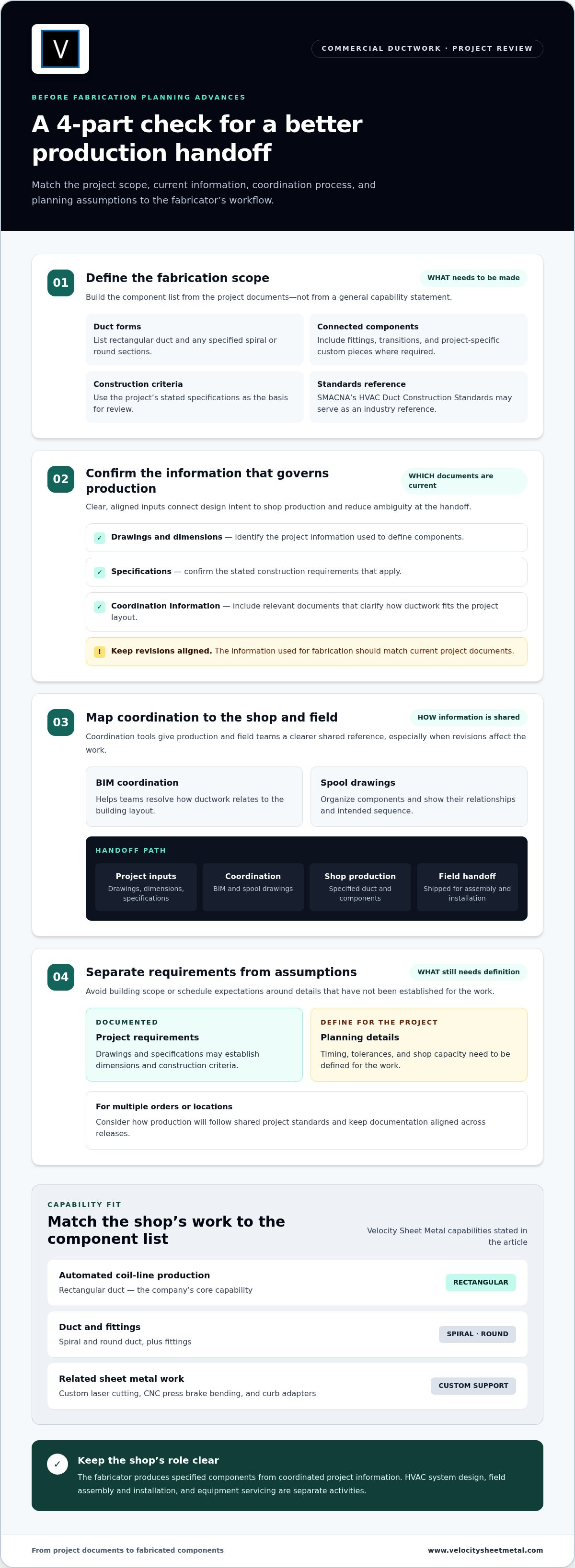
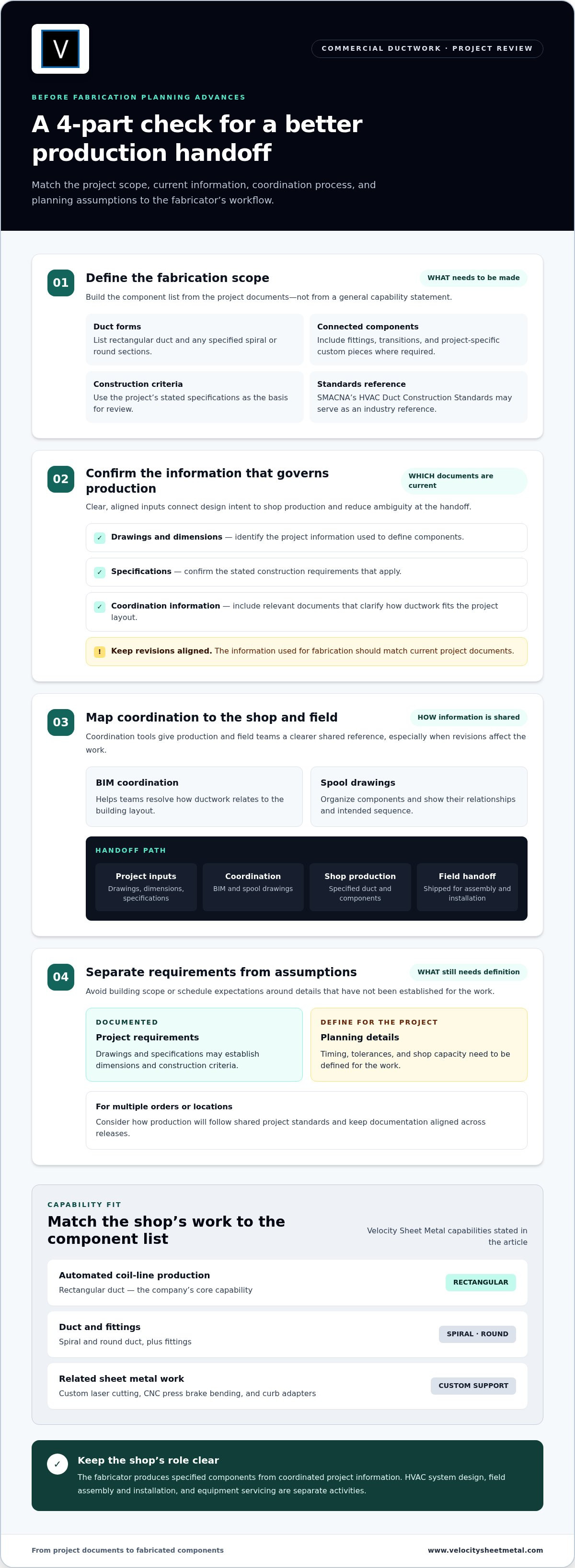
A commercial ductwork fabricator turns project drawings and specifications into HVAC duct sections and related sheet metal components. Fabrication is the production stage, separate from HVAC system design, on-site installation, and equipment servicing. The design establishes system requirements. The fabricator uses the applicable project information to produce specified components, which the field team assembles and installs.
That distinction matters because fabrication depends on interpreting dimensions, drawings, specifications, and coordination information consistently. Clear inputs connect design intent to shop production and reduce ambiguity at the handoff.
Which ductwork and components can commercial projects require?
Rectangular ductwork is a common commercial requirement. Depending on the system design and project scope, ductwork may also include spiral or round sections, fittings, and transitions. Custom components can address project-specific connections or configurations. The required duct forms and components should match the project documents and fabrication scope.
Velocity Sheet Metal’s core capability is automated coil-line rectangular duct production. Its offerings also include spiral and round duct and fittings. Custom laser cutting, CNC press brake bending, and curb adapters support other sheet metal requirements.
How does fabrication fit into the commercial HVAC workflow?
The workflow moves from project information to coordinated production, then from the shop to the field:
- Project inputs: Drawings, dimensions, specifications, and relevant coordination information define what needs to be produced.
- Coordination: BIM coordination and spool drawings can clarify how components relate to the project layout and to one another.
- Shop production: The fabricator makes duct sections and related components from the coordinated project information.
- Field handoff: Fabricated components are shipped for the project team to assemble and install.
Revisions can affect both the components in scope and production sequencing. Keep the information used for fabrication aligned with current project documents. The fabricator produces specified parts; field assembly and installation remain separate project activities.
How to Evaluate a Commercial Ductwork Fabricator for Your Project
Start with project fit, not a broad claim of capability. Assess a commercial ductwork fabricator against the duct types, components, drawings, coordination requirements, and production expectations in your scope. The goal is to match the project’s requirements to a workflow that can produce them.
Separate documented requirements from assumptions. Drawings and specifications may establish dimensions and construction criteria, while timing, tolerances, and shop capacity need to be defined for the project. Avoid building a schedule or scope around details that haven’t been established for the work.
Match fabrication capabilities to the project scope
Build a component list from the project documents before comparing fabrication capabilities. Include rectangular duct, spiral or round duct, fittings, and transitions where specified. Identify custom pieces and note where laser cutting or press brake work may support the scope. Velocity Sheet Metal provides automated coil-line rectangular duct, spiral and round duct and fittings, custom laser cutting, CNC press brake bending, and curb adapters.
Specifications may also reference construction standards. Use the project’s stated requirements as the basis for review, and consult SMACNA’s HVAC Duct Construction Standards as an industry reference. A general capability statement does not replace the project’s specified details.
Assess coordination and repeatability
Good coordination connects drawings to production with fewer interpretation gaps. BIM coordination can help teams resolve how ductwork relates to the building layout. Spool drawings organize components and show their relationships and intended sequence. Together, these tools give production and field teams a clearer shared reference, particularly when revisions affect the work.
For projects with multiple orders or locations, consider how production will follow shared project standards and keep documentation aligned across releases. Velocity Sheet Metal supports national accounts seeking standardized quality and consistent production.
Use this practical review before fabrication planning advances:
- Scope: List the duct forms, fittings, transitions, and custom components required by the project.
- Information: Identify the current drawings, specifications, and coordination documents that govern production.
- Workflow: Define how BIM coordination, spool drawings, and revisions fit into the project’s document process.
- Planning: Distinguish documented project requirements from assumptions about timing, tolerances, or capacity.
This review makes the production handoff more concrete. Explore Velocity Sheet Metal’s fabrication capabilities in relation to your project’s ductwork and coordination needs.
How Commercial Ductwork Moves from Drawings to Fabrication
Coordinated project information becomes fabricated duct through a controlled handoff: review the inputs, resolve coordination issues, produce the components, check them against project documents, then prepare them for shipment. The exact workflow depends on project scope, documentation, and revisions. Clear, current information helps the commercial ductwork fabricator plan production around the project’s requirements.
What information supports a clean fabrication handoff?
Start with current drawings and project specifications, then align them with relevant coordinated model information. These inputs define the intended duct layout and the requirements that guide production. Conflicting documents or unclear details can affect planning and downstream assembly, so identify and resolve gaps before they carry into fabrication.
Revision control matters. Distinguish current documents from superseded versions and track design changes before affected components enter production. That keeps the shop and project team working from the same information. File formats and fabrication tolerances should follow the project’s requirements, not assumptions.
How do BIM coordination and spool drawings support production?
BIM coordination helps teams review duct routes alongside surrounding building elements, making potential spatial conflicts easier to identify before field installation. Spool drawings provide practical references for organizing components and understanding how sections relate within an assembly. Together, they carry project intent from the digital model toward shop production and field assembly. For more on that connection, see the BIM for sheet metal fabrication guide.
Fabrication requirements can also draw on recognized industry references. The Sheet Metal and Air Conditioning Contractors' National Association (SMACNA) provides technical resources for the sheet metal and HVAC industry. Project specifications establish which criteria apply to a particular job.
From production checks to shipment
Once the coordinated information is ready, the shop produces the specified duct and related components. Quality checks compare completed work with the applicable drawings and project requirements. The components are then prepared for shipment so the field team can receive and assemble them as part of the larger installation sequence.
- Inputs: Gather current drawings, specifications, and model information.
- Coordination: Review spatial relationships and track revisions.
- Fabrication: Produce components from the coordinated project information.
- Checks and shipment: Review the work against project requirements, then prepare it for delivery.
Project details shape each handoff. Keeping documents aligned from coordination through shipment helps reduce ambiguity between the digital plan and fabricated work.
Which Commercial Ductwork Fabrication Approach Fits the Job?
No single duct form suits every commercial project. The appropriate configuration depends on system design, building geometry, and project specifications. Compare fabrication approaches against the drawings and coordination requirements rather than broad claims about speed, cost, or superiority.
A commercial ductwork fabricator may support different parts of a project with different production capabilities. Use the table to connect each duct type to its intended use and the information needed to coordinate it.
| Duct type or component | Typical project need | Coordination input | Production consideration |
|---|---|---|---|
| Rectangular duct | Commercial systems specifying rectangular duct runs | Current layout, dimensions, and project specifications | Automated coil-line production can support repeatable fabrication to project information |
| Spiral or round duct and fittings | Areas where the design calls for round duct sections or related fittings | Route, connections, and relationship to adjoining components | Match the duct form and fittings to the documented design |
| Custom-cut or formed components | Project-specific sheet metal details | Component geometry and applicable drawings | Custom laser cutting or CNC press brake bending may support the required scope |
When is automated rectangular duct production a practical fit?
Automated rectangular duct production is a practical fit when project documents call for rectangular ductwork across defined runs. A coil line provides an automated production approach, while coordinated drawings and specifications guide the work. The process supports repeatable fabrication, but project scope and required details still determine the production plan. See the coil line duct fabrication overview for more on this approach.
When do spiral, round, or custom-fabricated components matter?
Use spiral or round duct and associated fittings where the design specifies those forms. Custom details may call for laser-cut pieces or formed components, including work supported by press brake bending. These capabilities complement rectangular duct production; they are not a reason to substitute one configuration for another. The HVAC duct fabrication procurement guide offers additional context for aligning scope and procurement.
Review the drawings, specifications, and coordination information together before assigning production. Explore Velocity Sheet Metal’s duct fabrication capabilities to connect the project’s required duct forms with a practical production approach.
How Velocity Sheet Metal Supports Commercial Ductwork Projects
Velocity Sheet Metal connects commercial project information to shop production, with automated coil-line rectangular duct as its primary fabrication offering. BIM coordination and spool drawings carry digital project details toward organized fabrication, while additional sheet metal capabilities support other parts of a project scope. The company ships nationwide and supports national accounts seeking standardized quality and consistent production across projects.
Velocity Sheet Metal’s management team brings more than 50 years of combined industry experience.
Fabrication capabilities for commercial HVAC work
Fabrication scope starts with the components shown in the project drawings and specifications. Velocity Sheet Metal’s capabilities include:
- Automated coil-line rectangular duct production
- Spiral and round duct and fittings
- Custom laser cutting and CNC press brake bending
- BIM coordination and spool drawings
- Curb adapters
These capabilities support the production and coordination of commercial sheet metal components. Velocity Sheet Metal does not provide on-site HVAC installation. The project team uses fabricated components as part of its separate field assembly and installation activities.
Move from project scope to a fabrication conversation
A focused project discussion starts with clear inputs. Organize current drawings and specifications, identify required duct types and quantities, and outline BIM coordination or spool drawing needs. Note revisions and other project constraints that may affect production planning. This gives the fabrication team a practical basis for understanding the scope and shaping the workflow around project details.
As a commercial ductwork fabricator, Velocity Sheet Metal brings production and coordination capabilities together to support the handoff from project documents to fabricated work. For multi-project or national account needs, consistent standards can help teams align production across orders and locations.
Ready to discuss your scope? Discuss a commercial ductwork project with Velocity Sheet Metal.
Move Your Ductwork Project Toward Production
The right commercial ductwork fabricator does more than make components. Project fit depends on matching duct types to the scope, keeping drawings and coordination information aligned, and connecting shop production to the field handoff. Clear inputs help teams plan fabrication around project requirements instead of assumptions.
Velocity Sheet Metal’s primary offering is automated coil-line rectangular duct, supported by BIM coordination and spool drawings that connect digital project information to production. The company also ships nationwide, and its management team brings more than 50 years of combined industry experience.
Bring current drawings, specifications, quantities, and coordination needs into the conversation. That gives the project team a practical starting point for defining fabrication scope and workflow. Discuss your commercial ductwork project with Velocity Sheet Metal and take the next step toward a coordinated production plan.
Frequently Asked Questions
How do I choose a commercial ductwork fabricator for a project?
Choose a commercial ductwork fabricator whose capabilities and workflow fit your project scope. Start by listing required duct types and components, then review how drawings, BIM coordination, spool drawings, and revisions will be handled. Clarify which project requirements are documented and avoid basing plans on assumed timing, tolerances, or production capacity. For multiple orders, consider whether consistent standards across projects matter to your team.
What is the difference between duct fabrication and duct installation?
Duct fabrication is the shop production of duct sections and related components from project information. Duct installation is the field work of assembling and placing those components as part of the HVAC system. Fabricated duct supports the installation team, but the roles are separate. Velocity Sheet Metal provides commercial ductwork fabrication and coordination services, not on-site HVAC installation.
How does BIM coordination help commercial ductwork fabrication?
BIM coordination helps project teams review duct routes in relation to surrounding building elements before components reach the field. Identifying potential spatial conflicts in the coordinated model can clarify routing and relationships between parts. Spool drawings provide practical references for organizing fabricated components and field assembly. Together, these tools connect digital project information to production and make the handoff clearer.
What information is needed to start commercial ductwork fabrication?
Start with current project drawings, specifications, dimensions, required quantities, and relevant coordination information. Include the duct types and components in scope, such as rectangular runs, round sections, fittings, or custom parts. Track revisions so the project team and fabrication workflow use current information. Project documents should define applicable specifications rather than relying on assumed file formats or tolerances.
Can one fabricator produce rectangular, spiral, and round ductwork?
Yes, a fabricator with the relevant capabilities can produce more than one duct form. Velocity Sheet Metal provides automated coil-line rectangular duct, along with spiral and round duct and fittings. The appropriate form depends on the project design and specifications. Match required components to the fabrication scope so coordination and production follow the documented system layout.
Does a commercial ductwork fabricator install the ductwork?
Fabrication and installation are separate project activities. A fabricator produces duct and related components in the shop; field teams assemble and install them at the job site. Velocity Sheet Metal focuses on commercial ductwork fabrication, BIM coordination, and spool drawings. Its fabricated components support the installation workflow, but the company does not provide on-site HVAC installation.
How does a fabricator support projects with multiple locations?
A fabricator can support multi-location work by aligning production with shared project standards and keeping documentation coordinated across orders. Consistent drawings, specifications, and revision tracking help teams manage repeat requirements while accounting for each project’s details. Velocity Sheet Metal supports national accounts seeking standardized quality and consistent production, and ships nationwide. Project scope and coordination information guide the fabrication workflow for each order.