CNC Metal Forming Services: How to Choose the Right Fabrication Partner
A machine label can’t tell you whether a formed part will fit or repeat consistently. Choosing CNC metal forming services based on equipment lists alone leaves important questions unanswered: Does the fabricator understand your part’s geometry? Can it work from controlled drawing revisions? Will the finished part suit your assembly or installation requirements?
Equipment and price matter, but so does the production handoff. A capable partner should review the design and clarify requirements before work begins, rather than leave assumptions to surface after parts are formed.
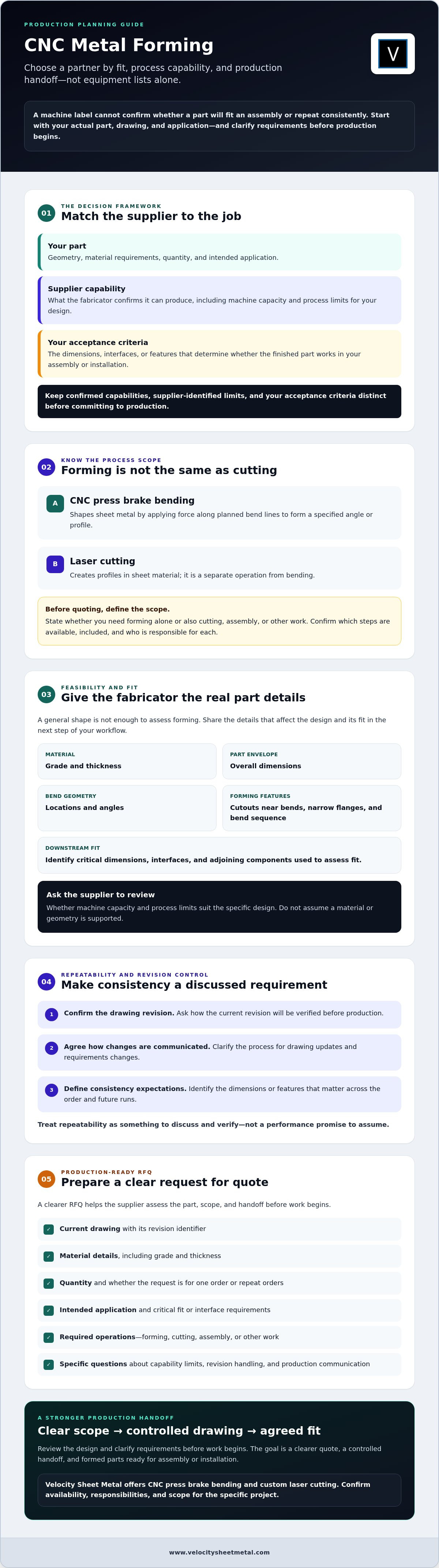
This guide explains how to evaluate a fabricator’s capabilities against your part and project requirements, prepare a production-ready RFQ, and reduce avoidable delays caused by missing details. It also covers what to discuss about drawings, revisions, repeatability, and downstream fit, so you can assess whether a partner’s CNC press brake bending capabilities align with the job. The goal is a clearer quote, a controlled handoff, and formed parts ready for the next step in your workflow.
Key Takeaways
- Evaluate CNC metal forming services against your part geometry, material requirements, quantity, and application, not just the supplier’s equipment list.
- Separate confirmed capabilities, supplier-identified limits, and your own acceptance criteria before committing to production.
- Distinguish forming from cutting: CNC press brake bending shapes sheet metal, while laser cutting creates profiles. Confirm which steps your project requires.
- Build a clear RFQ with current drawings, revision identifiers, material details, quantities, intended application, and specific questions for the supplier.
- Ask how the fabricator will manage drawing revisions and communicate requirements so formed parts are ready for downstream assembly or installation.
What CNC Metal Forming Services Do for a Production Project
CNC metal forming is the digitally controlled shaping of sheet metal into a specified geometry. The term describes a process, not necessarily a complete part-production package. A forming supplier may handle bending only, while a broader project may also require profile cutting, assembly, or other work. Define the scope before requesting a quote. For a general overview of how cutting, bending, and assembly relate, see these metal fabrication processes.
Velocity Sheet Metal offers CNC press brake bending and custom laser cutting. These are distinct services, so confirm which steps are available and included for your specific project rather than assuming they are part of one production scope. Contractors, engineers, makers, and OEMs may use formed parts in different workflows, from a project-specific component to a repeat production part.
How CNC press brake bending shapes a sheet metal part
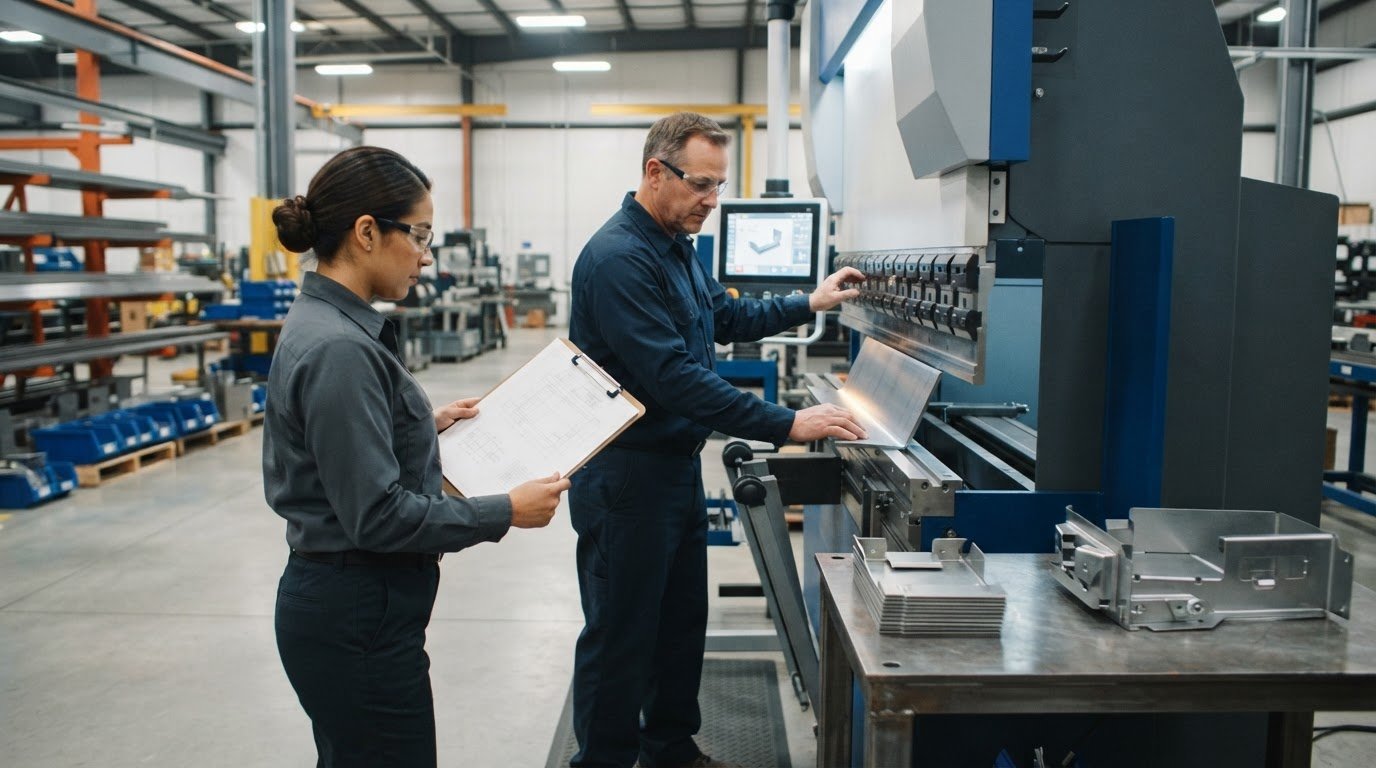
The process starts by positioning a sheet metal blank between the press brake’s tooling. The machine applies force along a planned bend line, and CNC controls guide the operation to form the specified angle or profile. The result depends on the design, material, bend geometry, and other part details. Before ordering, ask the supplier to review the drawing and confirm that its machine capacity and process limits suit the specific part.
A forming service shapes a part, but it doesn’t automatically cover every step needed to deliver a finished component. Clarifying that distinction helps prevent gaps between the quote and the production scope. If the part also needs cutting, assembly, or another fabrication operation, list each requirement and confirm who will perform it.
When outsourced metal forming makes sense
External forming can complement in-house production when internal equipment, available capacity, or production planning doesn’t align with a project’s needs. For example, a contractor may source a formed component for a commercial project, while an OEM may need a supplier to bend parts to its current production drawing. Both workflows depend on clear geometry, controlled revisions, and an agreed scope.
Velocity provides CNC press brake bending alongside other sheet metal services, including custom laser cutting. Those capabilities may suit a project that needs more than one operation, but confirm availability, responsibilities, and handoff details for the specific order. Share the current drawing and revision, state whether the request is for forming alone or includes additional steps, and ask the fabricator to clarify any open capability limits before production begins.
How to Assess Part Fit, Repeatability, and Forming Requirements
The right supplier for CNC metal forming services is one whose confirmed capabilities match the part and production handoff. Compare more than equipment lists or quotes. Review the design, material requirements, order quantity, revision handling, and how clearly the supplier raises questions before production.
What part details affect CNC forming feasibility?
Give suppliers enough information to assess the actual part, not just its general shape. Identify the material grade and thickness, overall dimensions, bend locations and angles, and features that affect forming. Cutouts near bend lines, narrow flanges, bend sequence, and interfaces with adjoining components may all need early review. Don’t assume a material or geometry is supported. Ask the supplier to confirm machine capacity and process limits for your design.
Agree on what an acceptable part means for your workflow. If a component must fit against another assembly, identify the critical dimensions or interfaces you’ll use to assess fit. State the production quantity and whether the requirement covers one order or repeat orders. Keep your acceptance criteria separate from the capabilities the fabricator has confirmed.
How to compare repeatability and revision control
Treat repeatability as a requirement to discuss and verify, not a performance promise to assume. Ask how the supplier will confirm the current drawing revision before production and how changes will be communicated. Define your expectations for consistency across the order and future runs, including which dimensions or features matter most. For more supplier-selection questions, see this CNC press brake services buying guide.
Use a simple comparison framework to keep the review grounded in facts:
- Confirmed capability: What the supplier has explicitly confirmed for the part and requested scope.
- Supplier-confirmed limits: Any material, geometry, capacity, or production constraints the supplier identifies for further review.
- Buyer acceptance criteria: Required dimensions, fit conditions, quantity, revision, and expectations for repeat orders.
Keep answers tied to the specific drawing. A general statement about a shop’s capabilities doesn’t establish that a particular part will fit or repeat as required.
Velocity Sheet Metal provides CNC press brake bending. If you’re evaluating a part, you can discuss your project with Velocity and clarify drawing details, requirements, and capability limits before the production handoff.
CNC Metal Forming Compared with Other Fabrication Options
Select a production route based on the geometry the part needs, rather than assuming one process is better. CNC press brake bending shapes sheet metal by creating bends. Laser cutting removes material to produce an outline, openings, or other profile features. The processes solve different problems, and a part may need both: it can be cut to its flat profile, then bent to its final shape.
When a part needs forming, cutting, or both
Start with the drawing. A flat component with slots or a shaped perimeter may need cutting but no forming. A panel that must turn along defined lines needs bending. A bracket with a profile, holes, and flanges may require both operations. Review the flat pattern and finished geometry together so the supplier can identify the requested scope and flag questions before quoting.
Velocity Sheet Metal offers CNC press brake bending and custom laser cutting. Because these are distinct services, confirm whether both are available for your project and how the steps, drawings, and handoff will be coordinated. For more on cutting requirements in a cut-and-form workflow, see this guide to precision laser cutting services.
Choosing outsourced capacity versus internal production
Internal production can make sense when the required equipment, available workload, and engineering support are already in place. Outsourcing may be worth considering when internal capacity is committed, the needed equipment isn’t available, or the project calls for a supplier’s confirmed service. Neither route is automatically right. Compare the full workflow, including how design questions and drawing revisions will reach the people doing the work.
For example, an engineering team may keep routine work in-house while sourcing a particular bend operation externally. An OEM may compare internal and supplier options for a production part. In either case, clarify responsibilities: who reviews the drawing, confirms the process scope, and communicates approved changes? Access to a machine alone doesn’t ensure a clean handoff.
Base the decision on the part’s requirements, workload, equipment access, and coordination needs. If the selected route includes forming, discuss the design with the supplier and confirm any applicable process limits. For additional context on issues to consider during bending, read about common press brake forming defects.
Prepare a CNC Metal Forming RFQ That Gets Clear Answers
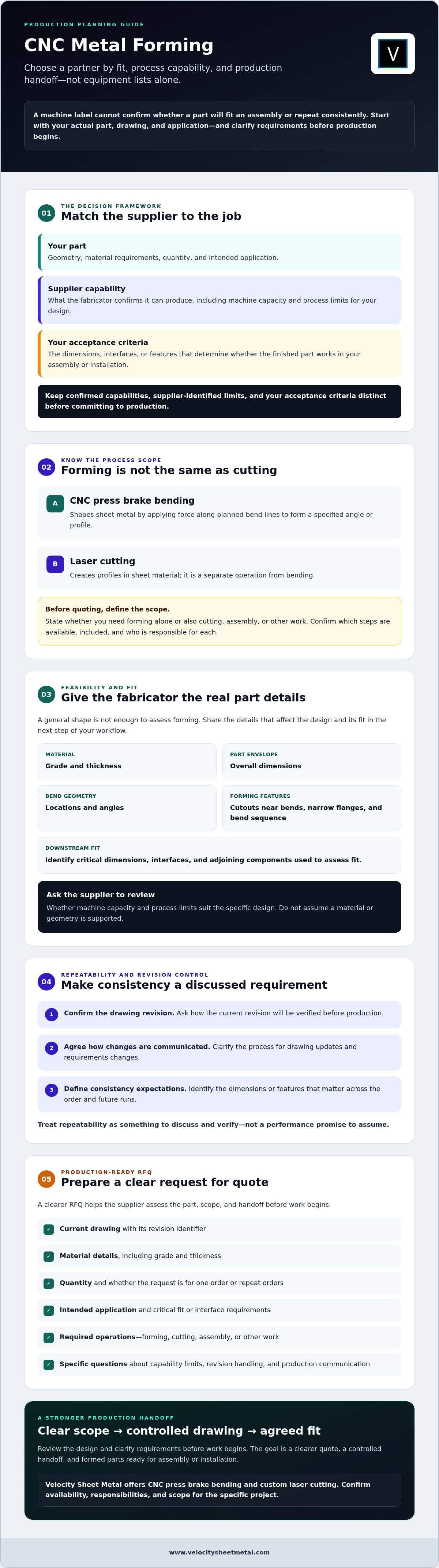
A useful RFQ gives the fabricator enough information to review the part and identify open questions. It doesn’t guarantee a particular quote or schedule, but it can reduce ambiguity before production. For CNC metal forming services, make the requested work, acceptance criteria, and handoff responsibilities explicit.
Files and specifications to include in the RFQ
Attach the current drawing and, if available, a matching 3D model. Mark each file with its revision identifier and state clearly which revision governs the request. Before sending files to Velocity, confirm which formats it accepts. Provide the details you know, and flag anything still under review rather than leaving suppliers to guess.
- Part definition: Material grade, thickness, overall dimensions, bend details, and any finish requirements.
- Critical features: Dimensions or interfaces that affect fit, function, or assembly. Identify your acceptance criteria for these features.
- Order needs: Quantity, whether repeat orders are anticipated, and the intended application.
- Delivery details: Packaging requirements, delivery destination, and any handling considerations relevant to the part.
If a detail is unknown, say so. Ask the supplier what it needs confirmed to assess the part and scope.
Questions to ask before approving production
Use this sequence to move from an RFQ to a clear production handoff:
- Prepare the drawing package. Gather current 2D drawings and available 3D models, then label revisions consistently.
- Define the part and order. State material details, quantity, intended use, critical dimensions, finish needs, and acceptance criteria.
- Set the scope. Specify whether the request is for CNC press brake bending alone or includes other confirmed services. Clarify what the supplier is expected to provide.
- Resolve open points. Ask the supplier to identify drawing ambiguities and confirm which revision it will use before production begins.
- Agree on handoff details. Confirm inspection expectations, packaging, shipping responsibilities, and delivery destination.
Before authorizing production, make sure both sides are working from the same revision and agree on what counts as an acceptable part. Confirm any material or process limits that apply to your design. Don’t treat unaddressed assumptions as agreed requirements.
Have a part drawing ready? Discuss your CNC press brake bending RFQ with Velocity and clarify the project scope, file requirements, and open technical questions.
Working with Velocity Sheet Metal on CNC Metal Forming
Velocity Sheet Metal provides CNC press brake bending as part of a wider set of sheet metal services. Whether it’s a fit depends on the part and scope you need. Share the design and project requirements so the team can discuss whether its capabilities align with the work, rather than assuming every service applies to every component.
What Velocity Sheet Metal can support
For projects requiring bending, Velocity offers CNC press brake bending. Other offerings include custom laser cutting, coil-line automated rectangular duct, spiral and round duct and fittings, curb adapters, and BIM coordination and spool drawings. These services address different needs. A request for a bent component, for example, is distinct from a request for HVAC ductwork or drawing coordination. Define the part, intended application, and requested operations so the scope can be reviewed clearly.
Velocity supports contractors, engineers, makers, OEMs, and national accounts, with nationwide shipping available. The management team brings more than 50 years of combined industry experience. These details provide context about the company’s background and reach, but they don’t replace a part-specific capability review. Confirm material, geometry, quantity, and other relevant requirements directly before proceeding.
The next step from drawing to supplier conversation
A focused first conversation starts with a clear project package. Prepare the current drawing and revision identifier, expected quantity, intended use, critical fit or acceptance criteria, and questions about the requested process. If the project includes more than bending, list each operation separately. This gives both sides a practical basis for discussing scope and identifying details that need confirmation.
Review open items together. Ask whether the requested service fits the part, which project details still need clarification, and what should be agreed before production is authorized. Material, capacity, tolerances, and schedule require project-specific confirmation. Don’t assume them based on a general service description.
Ready to review a part? Discuss your CNC metal forming project with Velocity Sheet Metal. Share your drawings, revisions, quantities, acceptance criteria, and questions to start a direct conversation about CNC press brake bending and project fit.
Move from Part Requirements to a Clear Production Plan
The strongest supplier choice starts with a clear match between your part and the fabricator’s confirmed capabilities. Define whether the job needs forming alone or additional services, then document the current drawing revision, critical fit criteria, quantity, and acceptance requirements. These details help surface questions before production, rather than after a part reaches assembly.
Velocity Sheet Metal provides CNC press brake bending and supports national accounts with nationwide shipping. Its management team brings more than 50 years of combined industry experience. For your project, confirm material, geometry, process limits, and scope directly so the production plan reflects the part’s actual requirements.
Have a drawing or project specification ready? Discuss your CNC metal forming project with Velocity Sheet Metal. Share the relevant files, revisions, quantities, and questions to start a focused conversation about fit and next steps. Clear requirements and open communication help you move forward with a shared understanding of the work.
Frequently Asked Questions
What are CNC metal forming services?
CNC metal forming services use digitally controlled equipment to shape sheet metal, often by creating bends in a flat blank. The term describes a process, not necessarily every step needed to make a finished part. Velocity Sheet Metal’s forming service is CNC press brake bending. Cutting, assembly, or other work may be separate, so define the requested scope and confirm which operations the supplier can support.
What is the difference between CNC metal forming and CNC machining?
CNC metal forming reshapes sheet material, while CNC machining removes material to create a part’s features. A press brake bends a sheet along planned lines; machining may remove material to produce pockets, holes, or other geometry. The suitable process depends on the part design and intended use. A drawing review can help identify whether the part needs forming, machining, cutting, or a combination of processes.
Can CNC press brake bending produce consistent parts?
It can be used for repeat production, but consistency should be treated as a requirement to confirm, not an assumed guarantee. Tell the supplier which dimensions and features are critical, how the parts fit into the next assembly, and whether repeat orders are expected. Ask how the production drawing revision will be confirmed and how your acceptance criteria will be applied. Verify process limits for your specific part before approving production.
What information should I send for a CNC metal forming quote?
Send the current drawing with a clear revision identifier, along with available 3D models and the requested quantity. Include material grade and thickness, part dimensions, bend details, finish requirements, intended application, and critical-to-fit features when known. State acceptance criteria, packaging needs, and delivery destination. Identify unknowns instead of leaving suppliers to guess, and confirm which drawing and file formats they accept before sending the RFQ.
How do I know if my part is suitable for CNC press brake bending?
Suitability depends on the part’s design and the supplier’s confirmed equipment and process limits. Provide the material details, thickness, dimensions, bend geometry, and information about cutouts, flanges, and assembly interfaces. These features can affect how the part is formed and whether it meets your fit requirements. Ask the fabricator to review the actual drawing and identify design questions or constraints before you commit to production.
Can a sheet metal fabricator handle cutting and forming for the same part?
Some fabricators offer both operations, but confirm the services and scope for your specific project. Cutting creates a part’s flat profile or openings; press brake bending forms the cut sheet into a three-dimensional shape. Velocity Sheet Metal offers custom laser cutting and CNC press brake bending. If your part needs both, clarify which operations are requested, which drawings govern each step, and how revisions and production handoffs will be managed.
What should I confirm before approving CNC formed parts?
Confirm that the supplier is using the approved drawing revision and that both sides agree on the requested process scope. Review material details, quantity, critical dimensions, acceptance criteria, and open questions about capability limits. Also clarify inspection expectations, packaging, shipping responsibilities, and delivery destination. Resolve technical ambiguities before authorizing production so the supplier and buyer share the same definition of an acceptable part and completed order.