Choose a sheet metal fabrication partner for value, not price alone
The lowest bid isn't automatically the best fit. To decide how to choose a sheet metal fabrication partner, weigh quality controls, material traceability, production capacity, communication, and total project cost, not price alone. For regulated work, choose a fabricator that maintains documented material chain of custody and can produce material certifications on demand.
Price matters, but so does understanding what the quote covers and how the shop will manage your parts from drawing review through production. Inspection processes, revision control, and the ability to meet your schedule can shape the result as much as the estimate.
This guide breaks the decision into practical checks: assessing quality and traceability, matching capacity to your order, comparing quotes, evaluating communication, and managing design changes. Use these criteria to find a partner whose process fits the work, not just a bid that looks attractive upfront.
Key Takeaways
- Look beyond a quality certificate: assess inspection steps, revision control, and how material traceability is documented.
- Match production capacity to your order and schedule, and clarify how the shop manages disruptions and delivery updates.
- Compare quotes by what they include, such as materials, design support, finishing, and delivery, not unit price alone.
- Use project-specific questions during quoting to surface assumptions, technical risks, and communication expectations early.
- Agree on a documented process for reviewing design changes so revisions are understood before they affect production.
1. How can I evaluate a fabricator’s quality?
Evaluate quality by examining the system behind each part, not just a finished sample. Ask which certifications apply to the work and what each certification covers. ISO 9001 is one example: it indicates documented processes for consistency, corrective action, and continuous improvement. A certificate alone does not show how the shop controls your specific drawings, materials, and inspection requirements.
Ask about the inspection sequence before production starts. A thorough process may include first-article review, in-process dimensional checks, and final inspection against the approved drawing. Confirm how results are recorded, drawing revisions are controlled, and nonconforming parts are handled. If a hole location falls outside tolerance, for example, the process should identify affected parts, document the issue, and define corrective action.
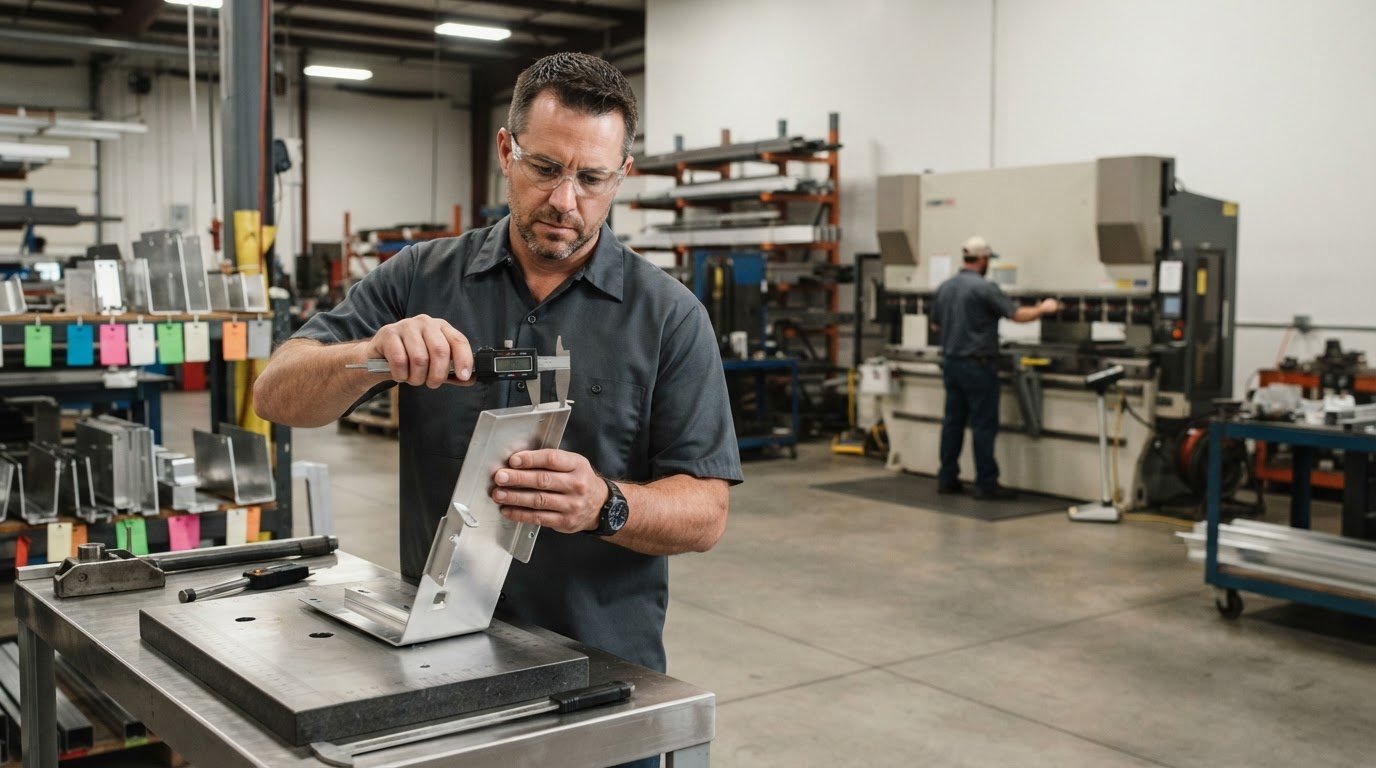
Check that measurement methods suit the part’s critical features. Calipers and gauges may be appropriate for basic dimensions, while a coordinate measuring machine can inspect complex geometry. Ask how the fabricator verifies dimensions, weld quality, and material properties when those checks apply. For welding work, clarify which qualifications and inspection methods are relevant to your application. Certifications such as AWS, ASME, or ISO may matter depending on project requirements, but they are not interchangeable.
For traceability, ask how material is identified from receipt through fabrication. Material test reports, often called MTRs, document material details and test results. For regulated work, a fabricator should maintain documented material chain of custody and provide material certifications on demand. Ensure the records can be tied to the parts or production lot you receive, rather than kept as unrelated paperwork.
The U.S. Bureau of Labor Statistics projects approximately 40,300 annual openings for welders, cutters, solderers, and brazers in the United States over 2025–2035. That workforce context makes clear procedures, qualified personnel, and documented inspection especially relevant when evaluating cutting and welding operations.
To assess certifications and inspection, review the certificate’s scope alongside first-article, in-process, and final inspection procedures. Ask what records accompany the order, how revisions are controlled, and how nonconforming material is contained. For a supplier-specific assessment, ask about measurement equipment, material traceability, welding qualifications, and examples of comparable work.
Assess reliability through references, completed work, communication, and delivery history. Ask for customer references and an on-time delivery record over the preceding six months; compare the evidence with your schedule and order requirements. For local companies, compare shops using the same drawing package and criteria, including relevant capabilities, inspection documentation, delivery expectations, and communication. Before signing, review contract terms for drawing revision approval, acceptance criteria, confidentiality and intellectual property ownership, change authorization, and responsibility for defects or delays. Have qualified counsel assess liability language where the project risk warrants it.
2. Lead times and production capacity
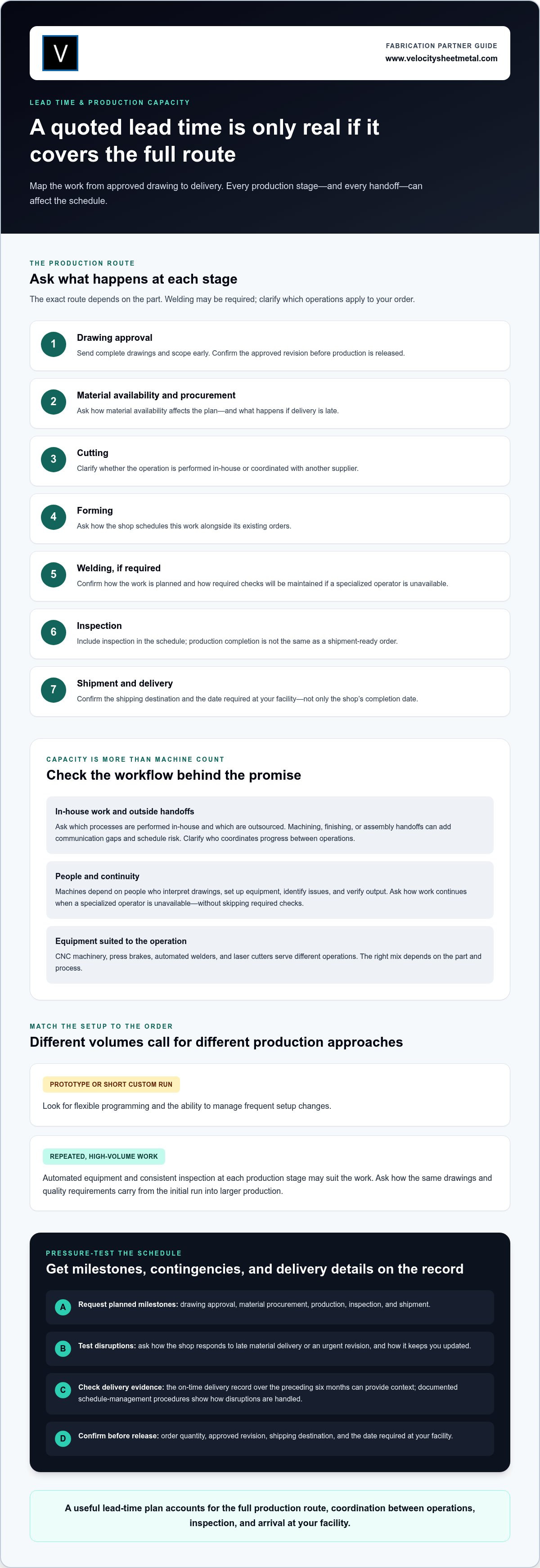
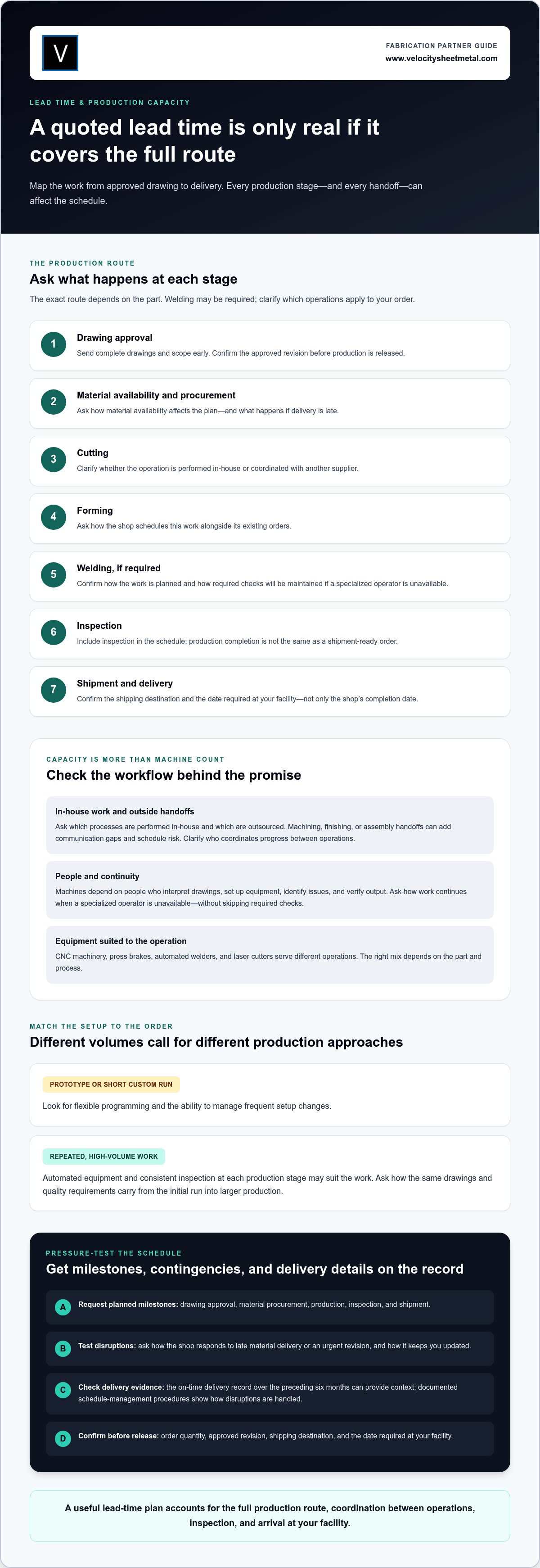
A quoted lead time is useful only if it covers the full route from approved drawing to shipment. Map each production stage: material availability, cutting, forming, welding if required, inspection, and delivery. A delay at one stage can hold up everything that follows. Send complete drawings and project scope early, including quantities, material details, tolerances, and required delivery date, so the shop can plan accurately.
Capacity means more than the number of machines on the floor. Ask how the shop schedules your order alongside existing work, which processes it performs in-house, and which it outsources. Outsourced machining, finishing, or assembly can add handoffs, communication gaps, and schedule risk. If one supplier cuts a part and another finishes it, for example, clarify who coordinates and tracks progress between operations.
Match the production setup to your order volume. A prototype or short custom run may need flexible programming and frequent setup changes. Repeated, high-volume work may benefit from automated equipment and consistent inspection at each production stage. Ask how the same drawings and quality requirements will carry from the initial run into larger production. CNC machinery, press brakes, automated welders, and laser cutters serve different operations; the right mix depends on the part and process.
Skilled labor also affects capacity. Machines still depend on people who can interpret drawings, set up equipment, identify production issues, and verify output. Ask how the team assigns work when a specialized operator is unavailable and how production continues without skipping required checks. A clear answer should explain the workflow, not simply promise a fast turnaround.
Test the schedule with a specific scenario. Share your target date and ask for planned milestones, including drawing approval, material procurement, production, inspection, and shipment. Then ask how the shop responds to a late material delivery or urgent revision. Its on-time delivery rate over the preceding six months can provide context, while documented schedule-management procedures show how it handles disruptions.
Before release, confirm the order quantity, approved revision, shipping destination, and date required at your facility. These details help expose mismatches between shop completion and actual arrival. If you’re comparing production workflows for sheet metal work, review production capabilities as part of your assessment.
3. Should I choose a fabricator based on price alone?
No. The lowest bid may exclude work your project needs, such as design support, finishing, inspection, or delivery. Compare quotes using the same drawing revision, material, tolerances, quantity, and acceptance requirements. Otherwise, different assumptions can make bids look comparable when they cover different work.
Relevant experience matters because a fabricator must understand both the process and its application. Ask about projects with similar geometry, materials, tolerances, and production demands. A shop experienced with simple brackets may not bring the same insight to a complex enclosure or a part requiring tight fit-up. Review examples, references, or case studies, and look for evidence of quality control throughout production, not just a finished sample.
Evaluate capabilities against the part’s actual manufacturing route. Cutting, forming, welding, machining, assembly, and finishing each require appropriate equipment and process knowledge. CNC machinery, press brakes, laser cutters, and automated welders serve different tasks; owning a machine alone doesn’t prove the shop can meet your specifications. Ask who operates the equipment and how the process controls critical features from one part to the next.
Material expertise matters in practice, too. Aluminum, stainless steel, carbon steel, and specialty alloys behave differently during cutting, forming, and welding. Ask how the fabricator accounts for the specified material and thickness when planning the work. If the drawing calls for a particular grade, the quote should identify it rather than quietly assume a substitute.
Design for manufacturability can reveal cost drivers before production. Ask the fabricator to review CAD files or drawings for features that complicate cutting, bending, assembly, or finishing. A bend close to a hole, for example, may require a design adjustment or a different production sequence. A useful review explains the trade-off and preserves the part’s function instead of changing geometry without approval.
To compare sheet metal fabrication quotes and total costs, request an itemized breakdown of materials, labor, finishing, inspection, packaging, and delivery. The final price depends on the project and is provided after a quote request; material, geometry, quantity, tolerances, finishing, and delivery requirements all affect the total. Compare the complete scope and expected outcome, not a unit price stripped of included work.
Use one evaluation sheet for each bid. Record relevant project experience, required capabilities, material assumptions, quality controls, included finishing, and delivery terms. Flag exclusions and unresolved drawing questions. This makes trade-offs visible and helps you select a fabricator based on fit, execution, and total project value.
4. Communication during quoting and production
Clear communication starts before a quote is issued. A useful estimate identifies the drawing revision, material grade, quantity, tolerances, included processes, and delivery assumptions. It also flags open questions. If a bend dimension is unclear, the fabricator should explain the ambiguity and its effect on forming before pricing the work. That exchange keeps different assumptions from turning into production instructions.
Use the quoting stage to assess how the team communicates technical information. Notice whether it asks focused questions about the drawing, intended use, and acceptance criteria. A laser-cut part with a critical hole pattern, for example, may require clarification about dimensions and inspection expectations. A clear response distinguishes confirmed requirements from assumptions, then documents agreed adjustments in the quote or drawing package.
Before production, agree on a communication plan with named roles and update points. Confirm who handles drawing questions, schedule changes, quality issues, and delivery coordination. Set the preferred channel for approvals, such as email or a project portal, and keep decisions in writing. A single current record helps engineering, purchasing, and production follow the same instructions.
Changes need a controlled process. When a revised drawing arrives, the fabricator should identify the revision, describe affected operations, and explain schedule or scope impacts before proceeding. Changing a slot after cutting begins, for instance, may affect completed parts and work still in process. Require written approval for the revised scope and ensure obsolete files are clearly withdrawn from production use.
Material substitutions also require direct approval. If the specified grade becomes unavailable, the fabricator should explain the proposed alternative and wait for authorization before substituting. The same applies to changes in thickness, finish, or other specified attributes. Record the approved material and revision with the order so receiving and inspection teams can compare delivered parts with authorized requirements.
During production, progress reports should provide useful facts, not generic reassurance. Agree on updates tied to milestones such as material release, cutting completion, forming, inspection, and shipment. If a supply disruption affects the schedule, the update should explain what changed, which operation is affected, and the recovery plan. That gives your team time to adjust downstream work or communicate a revised delivery expectation.
Close the communication loop at delivery. Confirm shipment details, identify accompanying inspection or material records, and document any open issue with an owner and next action. A practical test: can your team find the latest approved drawing, quote assumptions, change approvals, and delivery status without searching scattered messages? If not, clarify the documentation process before the next production release.
5. How do you handle engineering changes or design refinements mid-project?
Start with a documented change process, not an informal shop-floor conversation. When a design revision arrives, identify the changed feature, affected components, current production stage, and approval owner. Then assess impacts on material, tooling, inspection, assembly, and schedule. This gives engineering and production the same facts before anyone builds from a new file.
A practical review starts with the CAD model and drawing revision. The fabricator can compare dimensions, tolerances, and functional requirements, then flag manufacturing risks. Moving a hole near a bend, for example, may affect tool clearance or part fit. The team should explain the constraint and suggest options, such as shifting the hole, changing the bend sequence, or revising the tolerance.
That is design for manufacturability: improving how a part is made without losing its required function. Review material choice, geometry, joining methods, and the number of unique components. A small adjustment to a slot or flange can simplify cutting or forming, reduce handling, or make assembly more consistent. The engineer or buyer still approves any design change that alters intended fit or performance.
For each proposed refinement, record the reason, drawing revision, affected parts, and approval status. Keep the approved CAD file and production drawing aligned, and remove obsolete versions from the work package. If fabrication has started, separate completed parts from work still in process. Decide whether existing parts remain usable, need rework, or should be replaced before releasing the revision.
Clarify the scope of engineering collaboration before work begins. Some projects need drawing review and fabrication guidance; others may involve design, engineering, fabrication, assembly, and installation as a coordinated turnkey arrangement. These are distinct stages, and the project plan should identify who owns each handoff. Define who approves engineering decisions, supplies final specifications, and accounts for assembly requirements in component design.
Customization works best when the end-use environment is part of the review. Explain how the part fits with adjacent components, what surfaces must mate, and which dimensions control function. A bracket supporting another assembly, for instance, needs mounting locations and clearance considered together. This context helps the manufacturing team identify conflicts before cutting material or forming the part.
Before approving a change, confirm its effects on scope, inspection criteria, and delivery expectations in writing. Keep a simple change log with the revision, decision, approver, and date. For a project involving sheet metal parts, start with your project drawings to move the design discussion toward production-ready details.
Velocity Sheet Metal: Coil-line automated rectangular duct
Velocity Sheet Metal supports sheet metal projects that call for fabrication, ductwork, or coordinated drawings. For HVAC contractors and project teams, its coil-line automated rectangular duct helps move ductwork from project requirements into fabrication. Spiral and round duct and fittings, custom laser cutting, and BIM coordination and spool drawings support related production needs. CNC press brake bending is also available for formed components. Turn to Velocity when your project calls for these fabrication capabilities or when BIM coordination and spool drawings can help align ductwork details with the project. Share the relevant drawings and requirements to start the discussion. Contact Velocity Sheet Metal or visit www.velocitysheetmetal.com.
Put your next project in motion
The next step is to turn your priorities into a clear project brief. Gather the latest drawings, required materials, critical dimensions, intended use, and delivery needs. Include any unresolved design questions. A focused brief gives your fabrication team a useful starting point and helps your internal stakeholders align before work begins.
Apply what you’ve learned about how to choose a sheet metal fabrication partner by using the same project requirements to discuss fit and scope. For HVAC ductwork, Velocity Sheet Metal offers coil-line automated rectangular duct, as well as spiral and round duct and fittings. For custom components, its custom laser cutting can produce parts from supplied designs.
Bring the project details and questions that matter most to your next conversation. Contact Velocity Sheet Metal to discuss your fabrication requirements. A well-defined starting point can help your team move from planning to production with greater clarity.
Frequently Asked Questions
Can you provide full material traceability and mill certifications?
Yes, for projects requiring traceability, specify the records and how they must identify the material in your purchase requirements. A mill test report, or MTR, can document a material’s grade and test results. Define whether documents must connect to a heat, lot, or finished part, and include that requirement in the order. This makes receiving review more precise and helps keep records with the parts.
Can you share examples of similar work, including drawings or case studies?
Ask for examples that demonstrate comparable geometry, material, tolerances, and intended application. A useful case study explains the production challenge and decisions made, not just the finished part. Drawings may be confidential, so an anonymized example or redacted image can still show relevant details. Compare the example with your design, then note where the production method or requirements differ.
How can I evaluate a fabricator’s quality?
Translate your drawing into a short acceptance checklist before reviewing a shop’s process. Identify the dimensions that control fit, surfaces that affect performance, and features requiring documented inspection. For a mating assembly, for example, verify the relationship between hole positions and the adjoining component, not just each measurement in isolation. Then compare the fabricator’s inspection records with those acceptance criteria.
How do you handle engineering changes or design refinements mid-project?
Before approving a proposed revision, assess it against the part’s function and downstream interfaces. A change to a flange, for example, may affect clearance, mounting, or how another component seats. Ask for an impact summary covering affected parts, completed work, and updated inspection requirements. Assign a designated approver to release the revised design so production doesn’t rely on informal interpretations.
How do you handle nonconformances and customer corrective actions?
A controlled response should contain affected parts, document the deviation, identify its cause, and define corrective action. Ask how the fabricator distinguishes an isolated defect from a process issue and verifies the fix in later production. If a feature repeatedly misses its drawing requirement, for example, the response should address the setup or process cause, not just sort affected parts. Keep dispositions and approvals in the quality record.
Should I choose a fabricator based on price alone?
No. A practical way to decide how to choose a sheet metal fabrication partner is to compare the production risk and scope behind each quote, not just its price. A low bid may leave responsibilities unclear for packaging, inspection records, or handling rejected parts. Review exclusions and acceptance terms alongside the proposed approach. Compare equivalent deliverables and the effort your team must manage around them.
What capabilities should a sheet metal fabrication partner have?
Choose capabilities that cover the actual route your part requires, rather than selecting a shop by its equipment list alone. A design may require cutting, bending, joining, finishing, or assembly, while a ductwork project may depend on coordinated drawings and fittings. Map each required operation to a responsible production step. If several steps involve different suppliers, define who manages handoffs, drawing updates, and final part acceptance.
What materials, thicknesses, and fabrication processes can a shop handle?
Capability depends on the specific material grade, thickness, geometry, and process required by the drawing. List these details clearly, including surface finish or forming requirements, then compare them with the shop’s stated production range. A process suitable for one alloy or thickness may not suit another. For a mixed-material assembly, assess each component separately and confirm that the planned methods preserve fit and function.